


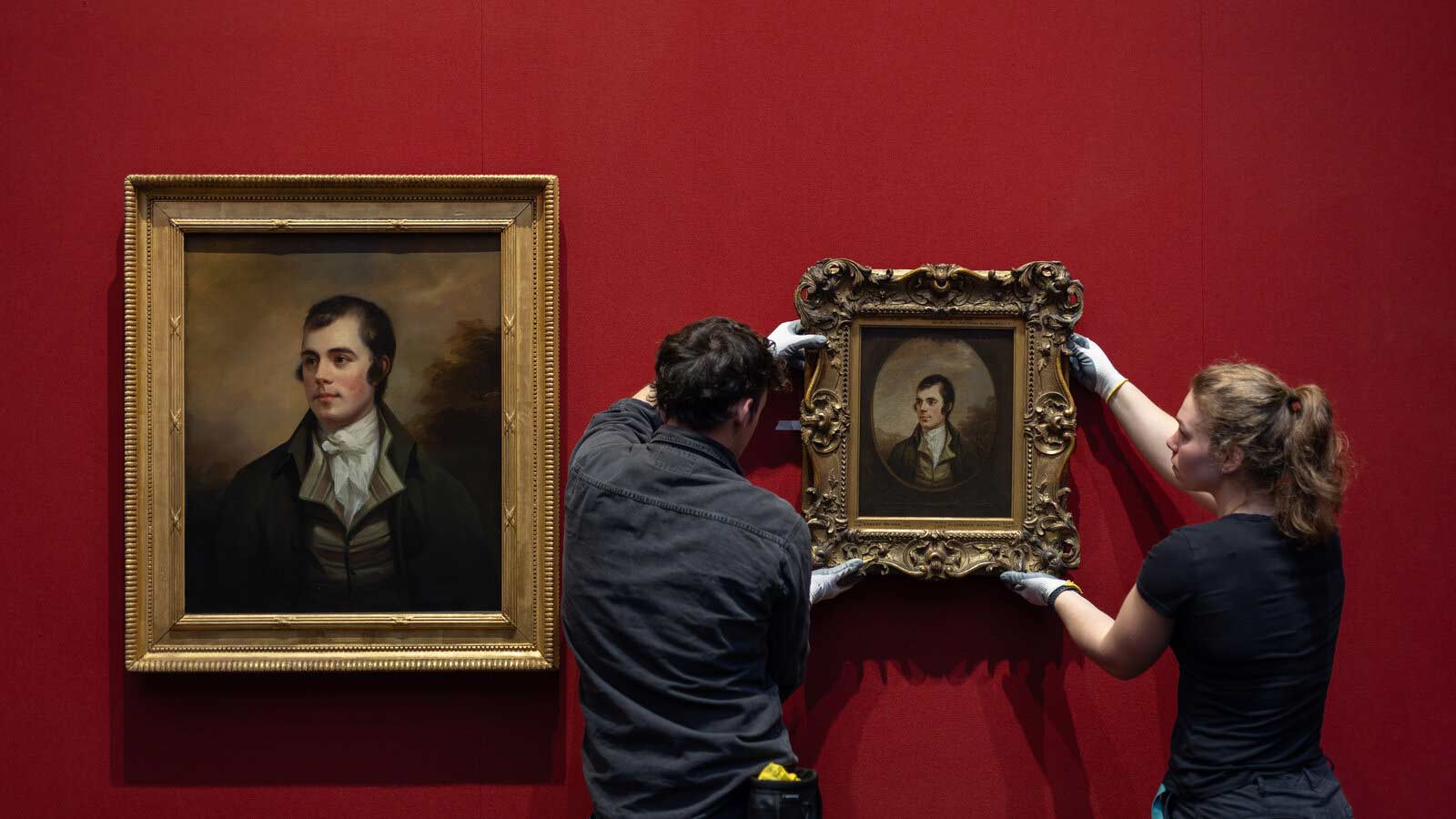
EDINBURGH (Azat TV) – January 25, 2026, marks the annual Burns Night, a global celebration honoring Scotland’s national poet, Robert Burns, with traditional suppers and recitations, particularly prominent in Scotland and Northern Ireland. This year’s festivities are further amplified by the public display of a long-lost portrait of Burns by Sir Henry Raeburn, a significant cultural event after two centuries of mystery, now available for public viewing in Edinburgh.
Burns Night Celebrations Across the Globe
Burns Night, celebrated annually on January 25, commemorates the birth of Robert Burns, widely regarded as Scotland’s most beloved poet. The tradition, which began informally with his friends gathering on the fifth anniversary of his death in 1801, has evolved into a global phenomenon. These gatherings typically feature a formal dinner, centered around haggis—a traditional Scottish dish—served with “neeps and tatties” (turnips and potatoes), accompanied by speeches, poetry readings, and music. A key moment is the ceremonial “Address to a Haggis,” one of Burns’s own works.
Northern Ireland’s Unique Connection to Burns
The celebration holds particular resonance in Northern Ireland, a connection rooted deeply in history. Dr. Frank Ferguson, director of the Centre for Irish and Scottish Studies at Ulster University, explained to BBC News NI that the tradition’s presence dates back to the 17th century. During this period, tens of thousands of Lowland Scots settled in Ulster as part of a plan by King James I to unite the kingdoms, bringing with them their language, ideas, and songs. This migration fostered the Ulster-Scots culture, leading to an early affinity for Burns’s work. “Nearly as soon as Burns was published in Scotland, his poetry was appearing in Belfast papers,” Dr. Ferguson stated, highlighting Belfast as one of the first places to republish his poetry. William Miller, treasurer of the Ballymena Services Club, emphasized the Ulster-Scots dimension in his community’s culture, noting that Burns Night helps understand identity and heritage.
Royal Endorsement and Wider Appeal
The enduring appeal of Burns Night also extends to the British Royal Family. King Charles III has previously marked the occasion by reciting Burns’s famous lines and participating in traditional toasts. Similarly, in 2021, Prince William and Kate Middleton utilized the Scottish holiday to commend NHS Tayside staff for their frontline efforts during the pandemic, underscoring the event’s capacity to transcend mere cultural observance. David Gilliland, director of development at the Ulster Scots Agency, articulated this broader appeal, describing Burns as someone who “transcends that sort of political divide” and is “for anybody, young and old.” Burns’s global recognition is evident in statues erected in Canada, the United States, and Australia, reflecting his universal resonance.
The Rediscovered Portrait of Robert Burns
Adding a significant cultural layer to this year’s celebrations is the public display of a long-lost portrait of Robert Burns by renowned Scottish painter Sir Henry Raeburn. This painting, commissioned by publishers Cadell and Davies over 200 years ago as an engraving for future editions of Burns’s books, mysteriously vanished shortly after its completion. The disappearance fueled a two-century-long quest, with even figures like Arthur Conan Doyle, creator of Sherlock Holmes, noting attempts by collectors to locate it. Dr. Bill Zachs, director of the Blackie House Library and Museum in Edinburgh, dedicated 42 years to finding the portrait. He finally stumbled upon it in a London auction house last March during a house clearance, initially unsure of its authenticity amidst numerous copies of the more famous Nasmyth portrait. After acquiring the painting for £68,000, Dr. Zachs initiated a meticulous verification process. Lesley Stevenson, senior conservator of paintings at the National Galleries of Scotland, confirmed the attribution to Raeburn, praising its “expressive, seemingly effortless brushwork, the characteristic warm palette, soft atmospheric lighting and sensitive rendering of the instantly recognisable Robert Burns.” The Raeburn portrait is now on public display at the National Galleries of Scotland in Edinburgh, hanging alongside the iconic Nasmyth portrait, offering a unique comparative viewing until July, after which it will move to the Robert Burns Birthplace Museum in Ayr. Anne Lyden, director general of the National Galleries of Scotland, described the opportunity to see both works side by side as “very special.”
Burns’s Enduring Literary Legacy
Burns’s literary contributions continue to shape cultural touchstones worldwide. His poem “A Red, Red Rose” remains a Valentine’s Day classic, while “Auld Lang Syne,” based on an older Scottish folk song, is an indispensable part of New Year’s Eve celebrations globally. The proverb “the best-laid schemes o’ mice an ‘men Gang aft agley” (often go astray) originates from his poem “To a Mouse,” and “To a Louse” offers the insightful wish “O wad some Pow’r the giftie gie us. To see oursels as ithers see us!” These works underscore his profound understanding of human nature and universal experiences.
The convergence of widespread Burns Night celebrations with the unveiling of a historically significant portrait highlights the enduring and multifaceted legacy of Robert Burns. His poetry, deeply rooted in Scottish dialect, has transcended its origins to become a unifying cultural force globally, fostering a sense of shared heritage and identity across diverse communities from Northern Ireland to the farthest reaches of the Scottish diaspora. The rediscovery of the Raeburn portrait, after two centuries, not only enriches the visual record of this literary giant but also rekindles public engagement with his life and work, affirming his continued relevance as a figure whose insights into love, humanity, and societal observation remain profoundly resonant in the 21st century.