


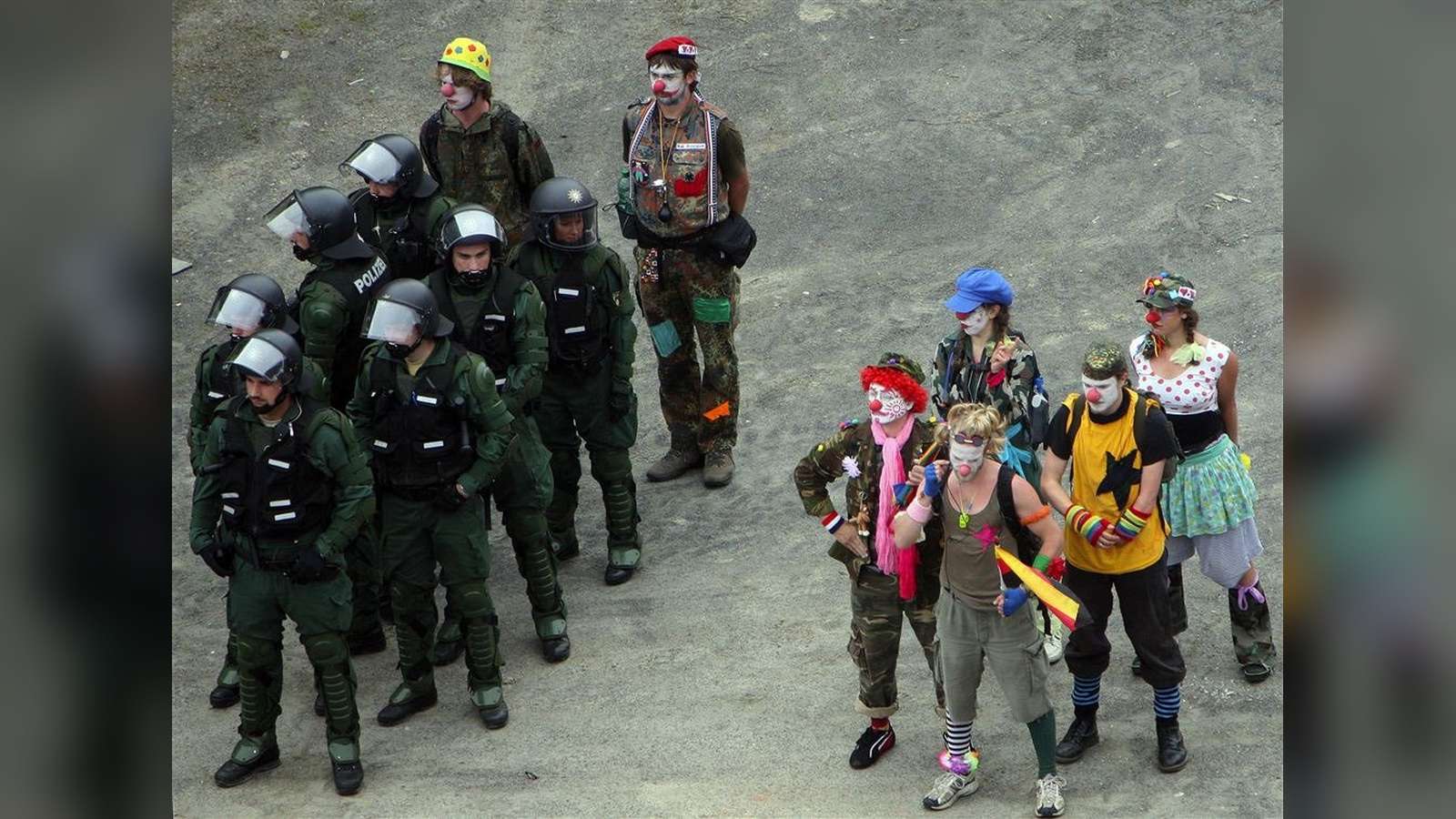
Standing directly before the cold steel of police barriers and the heavy tactical gear of law enforcement, two figures in full clown makeup, bright orange and magenta wigs, and oversized polka-dot garments introduce a striking visual dissonance into a landscape dominated by state security. This photograph captures an arresting moment during the fierce demonstrations surrounding the 33rd G8 summit in northern Germany in June 2007, serving as the primary visual anchor for exploring how performance art, irony, and theatrical disruption were mobilized on the front lines of global political dissent. Through this single frame, the viewer is invited to examine the intersection of peaceful satirical protest and militarized crowd control at a pivotal juncture in European activist history.
What the photograph shows
The composition of the photograph hinges on stark contrasts. In the foreground, the vibrant, exaggerated features of the clowns—their greasepaint smiles, bulbous red noses, and flamboyant attire—defy the austere, tense atmosphere of the urban protest zone. Their postures are relaxed yet defiant, presenting a deliberate caricature of authority and solemnity. Directly behind them, the visual field is crowded with the muted tones of riot shields, dark police uniforms, and the looming metallic infrastructure erected to contain the crowds. This spatial juxtaposition foregrounds the psychological warfare of the protest: the confrontation between the state’s rigid apparatus of control and the citizenry’s deployment of absurdist humor as a shield and weapon.
The moment behind the image
The instant captured by the shutter occurred during a week of unprecedented civil unrest in and around Rostock and the nearby Baltic resort of Heiligendamm, where heads of state had gathered. Just days before this photograph was taken, a massive demonstration featuring tens of thousands of participants had degenerated into violent street battles when radical factions clashed with police lines, leaving over 400 officers and 500 demonstrators injured. In the wake of that violence, as authorities maintained a high-security perimeter enforced by water cannons, tear gas, and a staggering deployment of 16,000 police officers, various affinity groups continued their mobilization. Clowns, street theater troupes, and non-violent direct-action networks utilized humor to diffuse tension, cross police lines, and assert their right to public space under intense surveillance.
Photographer and provenance
While the precise individual attribution for this specific frame remains tied to wire services and international photo agencies documenting the Baltic demonstrations, the image circulated widely across European newspapers, independent media outlets, and digital archives dedicated to the anti-globalization movements of the mid-2000s. Photographers operating in Rostock faced extreme hazards, navigating volatile clashes between militant black-bloc groups and riot police, enduring chemical irritants, and working amid rapidly shifting perimeters. Their work under these demanding conditions ensured that the spectrum of protest tactics—from violent confrontation to peaceful carnivalesque resistance—was thoroughly recorded for the historical record.
Historical context
The 2007 G8 summit took place in a climate of intense historical anxiety. Organizers and authorities were acutely conscious of the violent clashes that had marred the 2001 Genoa summit, where an Italian protester had been killed by police fire. Determined to avoid a repetition of Genoa, the German government ring-fenced the Heiligendamm resort with a seven-mile steel security fence topped with barbed wire, backed by thousands of troops and police officers. Protesters responded with a decentralized strategy: while some militant groups engaged in direct street combat, thousands of others established autonomous camps in nearby villages like Reddelich, complete with watchtowers, field kitchens, and cultural workshops, preparing for coordinated civil disobedience campaigns designed to shut down the summit proceedings.
Why it still matters
Decades after the fences came down and the world leaders departed, this photograph endures as a powerful emblem of creative resistance in modern political discourse. It illustrates the enduring capacity of civil society to deploy irony and theatrical subversion against overwhelming state power. By freezing the moment when greasepaint met riot gear, the image reminds contemporary observers that protest culture is profoundly multifaceted, encompassing not only direct physical confrontation and policy debate, but also spectacle, humor, and the refusal to be intimidated by authority.