


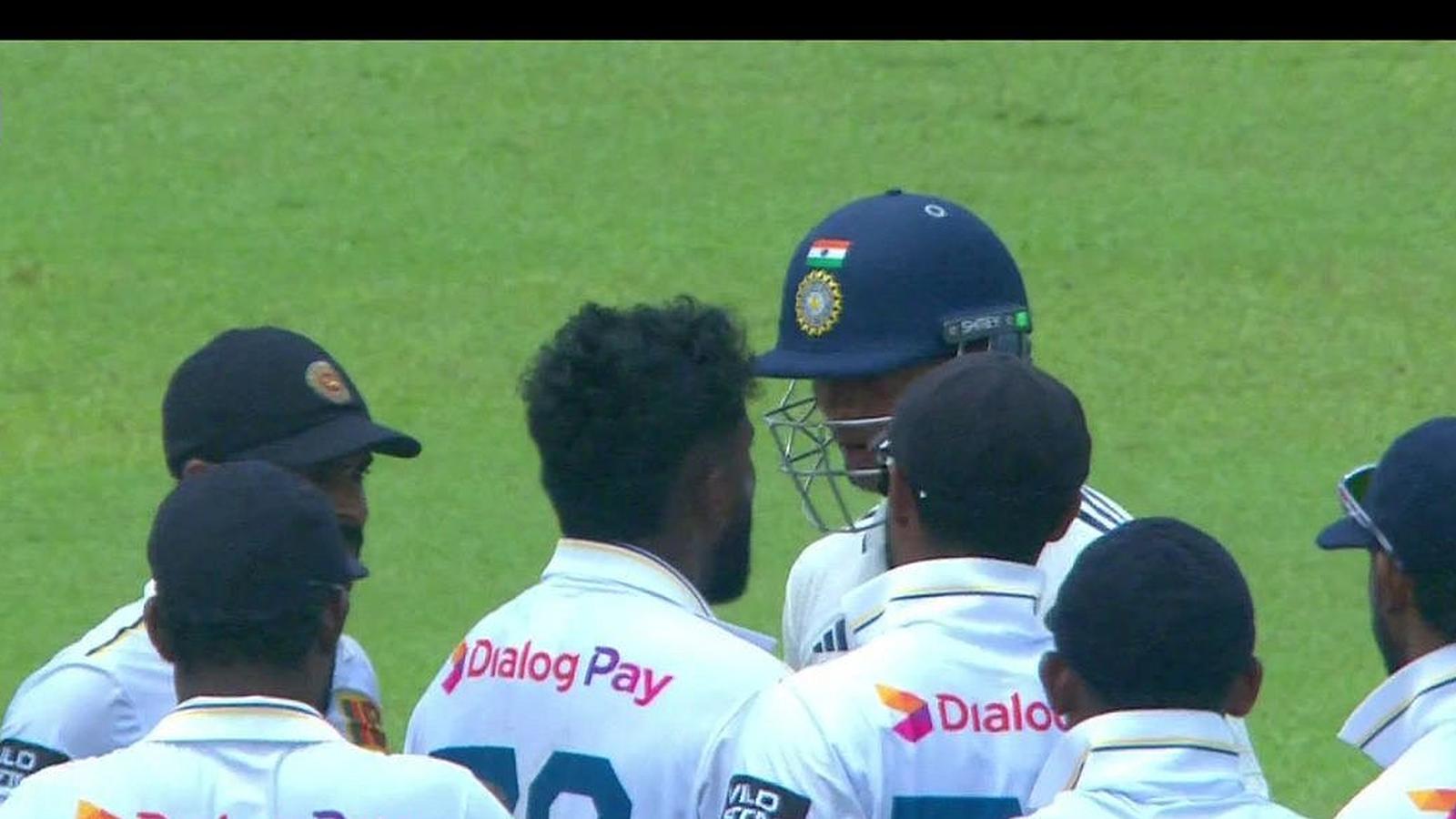
The Flashpoint in Colombo: Inside the 17th Over
The second Test match between India and Sri Lanka in Colombo, a crucial fixture in the ICC World Test Championship cycle, was suddenly overshadowed by a dramatic physical confrontation on its opening day. On August 23, 2026, the competitive tension between Indian opener Yashasvi Jaiswal and Sri Lankan fast bowler Asitha Fernando boiled over into physical contact, prompting swift disciplinary intervention from the International Cricket Council (ICC). The governing body announced on Monday, August 24, that both players had been fined 25 percent of their match fees and handed one demerit point each for breaching Level 1 of the ICC Code of Conduct.
The confrontation occurred during the final delivery of the 17th over of India’s first innings. Prior to the dismissal, Jaiswal had asserted dominance over Fernando, punishing the Sri Lankan seamer with three consecutive boundaries. However, Fernando responded with a sharp, jagging short delivery that caught Jaiswal’s inside edge, crashing directly into the stumps. Jaiswal, dismissed for 45 runs off 53 deliveries, initially began his walk toward the pavilion. In a sudden turn of events, the young Indian opener reversed his direction, charging back toward the bowler. What followed was a heated verbal exchange that rapidly escalated into physical contact, with both players making head-to-head contact on the pitch before Sri Lankan captain Dhananjaya de Silva and other players rushed in to separate them.
Deconstructing Article 2.12: The ICC Disciplinary Framework
The actions of both players were deemed a direct violation of Article 2.12 of the ICC Code of Conduct for Players and Player Support Personnel. This specific article covers “inappropriate physical contact with a Player, Player Support Personnel, Umpire, Match Referee or any other person” during an international match. Under the ICC’s regulatory hierarchy, Level 1 breaches carry a minimum penalty of an official reprimand, a maximum fine of 50 percent of a player’s match fee, and the addition of one or two demerit points to the offender’s disciplinary record.
According to the official ICC statement, the physical contact was a mutual escalation, though television replays offered a more nuanced view of the mechanics of the clash. Visuals suggested that Jaiswal initiated the physical trajectory by turning and walking aggressively toward Fernando, who took a small step forward to meet him. Fernando then moved his head toward Jaiswal during the verbal exchange, and Jaiswal leaned his helmeted head in response, resulting in physical contact. Because both players admitted to the charges and accepted the sanctions proposed by Emirates ICC Elite Panel Match Referee Andy Pycroft, no formal hearings were required. The charges were officially leveled by the on-field officiating team, which included umpires Ahsan Raza and Sharfuddoula Ibne Shahid, third umpire Rod Tucker, and fourth umpire Prageeth Rambukwella.
A Defiant Response: Jaiswal’s Defense and Team Dynamics
Despite accepting the financial penalty and the demerit point, Jaiswal did not strike a conciliatory tone when addressing the media before the start of play on day two. The opener offered a staunch defense of his actions, signaling that his aggression was a direct response to verbal provocation from the Sri Lankan bowler. “If you don’t know what he said then please don’t make your judgment,” Jaiswal asserted. “If anyone crosses the line, we need to let them know. This India will fight and reply.”
Jaiswal’s comments highlight an ongoing cultural shift within the Indian national team, which has increasingly embraced a highly vocal, uncompromising, and combative on-field philosophy over the past decade. This “fightback” doctrine dictates that any perceived disrespect or verbal intimidation from the opposition must be met with immediate, visible resistance. However, while this approach is often celebrated by domestic fans and team management as a sign of mental resilience, it frequently pushes players to the absolute brink of the ICC’s disciplinary boundaries, occasionally crossing into punishable physical territory.
The Broader Stakes: Demerit Points and Future Suspension Risks
While a 25 percent match fee fine represents a manageable financial penalty for elite modern cricketers, the addition of a demerit point carries far more significant structural risks. The ICC’s demerit system operates on a rolling 24-month window. If a player accumulates four or more demerit points within a two-year period, those points convert into suspension points. Accumulating four demerit points triggers a ban of either one Test match or two One-Day Internationals (ODIs)/T20Is, depending on the team’s upcoming schedule.
Fortunately for both Jaiswal and Fernando, neither player had any previous disciplinary offenses on their records during the preceding 24 months. This clean record mitigates the immediate threat of a suspension. However, for an opening batter of Jaiswal’s caliber—who is widely regarded as a cornerstone of India’s future across all formats—carrying a demerit point for the next two years reduces his margin for error. Future high-intensity series, including upcoming campaigns against aggressive opponents, will require Jaiswal to balance his combative instincts with strict adherence to the ICC’s physical boundaries to avoid costly suspensions that could disrupt India’s top-order stability.
Sporting Focus Returns to the Pitch
Despite the opening-day drama, the sporting focus quickly shifted back to the competitive dynamics of the Test match. Following Jaiswal’s dismissal, which left India at 66 for 2, Sri Lanka’s bowling attack sought to capitalize on the breakthrough, with Fernando also dismissing Shubman Gill and Ravindra Jadeja to help reduce India to 300 for 5 by the end of the first day. However, India’s lower-middle order staged a formidable recovery on day two. Despite rain interruptions halting play during the second and third sessions, India declared their first innings at a commanding 503 for 9. The declaration followed a magnificent, unbeaten century by wicketkeeper-batter Dhruv Jurel, who anchored the tail to put India in a dominant position in the match. As the series progresses, the ICC’s swift disciplinary action serves as a stark reminder to both squads that while intense competition is encouraged, the physical boundary remains non-negotiable.