


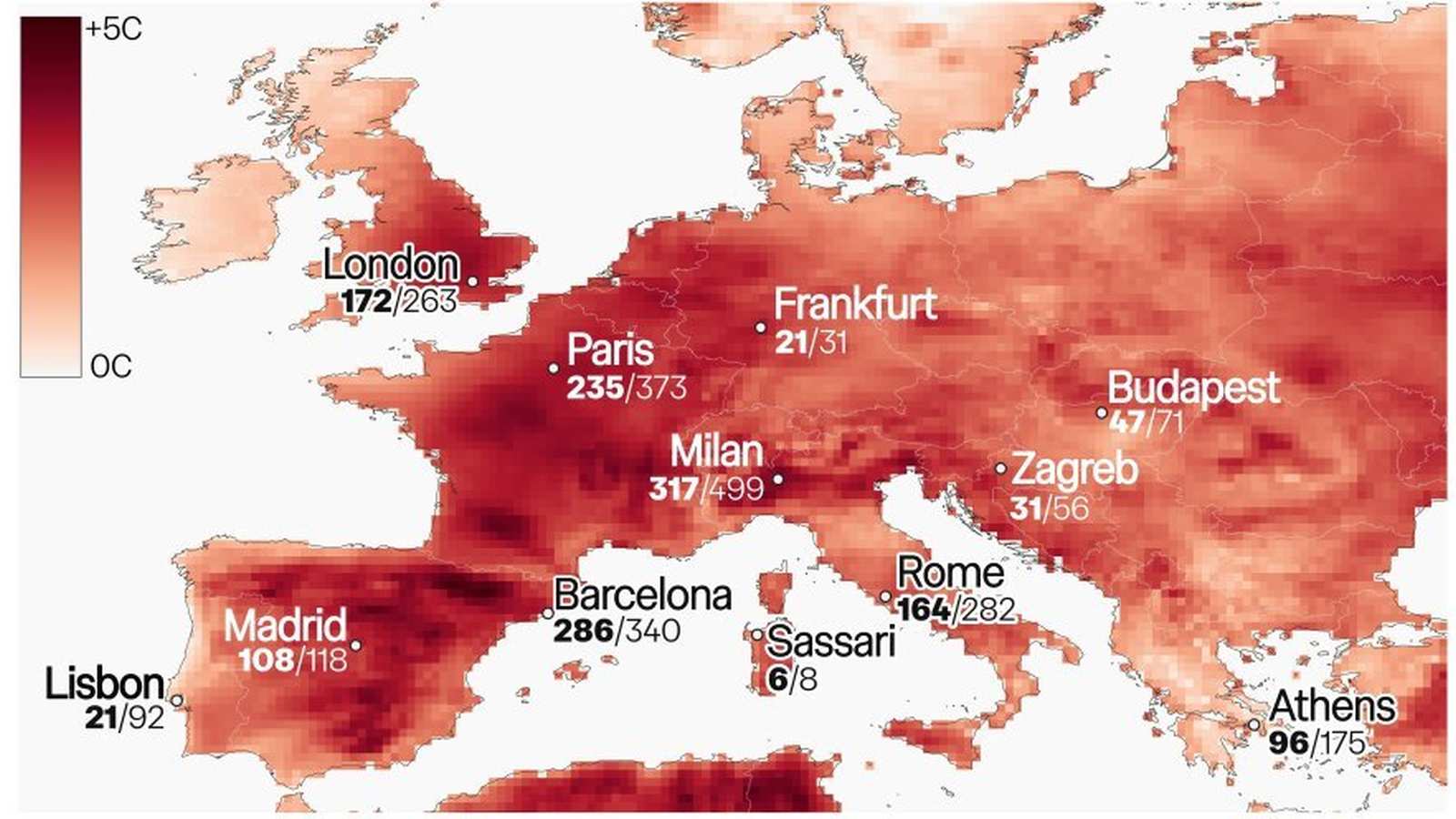
A recent study has revealed that a powerful heatwave that gripped Europe between June 23 and July 2, 2025, resulted in approximately 2,300 deaths across 12 major cities. The findings, published on July 9, 2025, underscore the intensifying impact of climate change, as two-thirds of these fatalities were directly linked to human-induced global warming.
Heatwave’s Scope and Impact
The 10-day heatwave brought extreme temperatures exceeding 40°C (104°F) in parts of Spain and caused widespread wildfires in France. According to researchers from institutions such as Imperial College London, climate change elevated temperatures during the heatwave by up to 4°C (7.2°F) compared to historical norms. Cities like Madrid, Barcelona, London, and Milan were among the most affected, with their combined population exceeding 30 million. The researchers employed epidemiological models and historical mortality data to estimate the death toll, which primarily consisted of elderly individuals and those with preexisting health conditions.
Dr. Ben Clarke, a climate researcher at Imperial College London, emphasized the seriousness of the findings: “Climate change has made it significantly hotter than it would have been, which in turn makes it a lot more dangerous.” The study highlighted that about 1,500 of the 2,300 deaths were attributable to climate change’s role in exacerbating the heatwave.
Wildfires and Secondary Disasters
During the same period, southern France grappled with devastating wildfires near Marseille, consuming 720 hectares of land and forcing hundreds of residents to evacuate. Flight disruptions at Marseille Airport and halted train services compounded the chaos. Climate scientist Max Dugan-Knight from Deep Sky Research noted that while human activities, such as a car fire, initiated the blaze, the prevailing hot, dry, and windy conditions made the fires inevitable. Similar incidents were reported in Türkiye, where wildfires ravaged the Izmir region and along the Turkish-Syrian border, destroying thousands of hectares of forest and displacing communities.
“These events are unfortunate reminders of the changing and volatile climate that Europe needs to adapt and prepare for,” stated the European Environment Agency, urging swift action to mitigate future risks. The agency called for investments in urban cooling strategies, improved public health systems, and early warning mechanisms to better prepare for such extreme events.
Climate Change: The Underlying Driver
Europe is warming at nearly twice the global average, making it a hotspot for climate-related disasters. According to Garowe Online, researchers from the Barcelona Institute for Global Health (ISGlobal) and the World Weather Attribution group concluded that the heatwave’s intensity would have been extremely rare without the influence of greenhouse gas emissions. Dr. Joan Ballester, a lead author of the study, described the event as “one of the clearest signals we’ve seen of the deadly toll that climate change is already taking in Europe.”
The study also identified prolonged drought conditions and stagnant air masses as contributors to the heatwave’s severity. These factors, combined with record-breaking temperatures, have led to an alarming increase in heat-related mortality across the continent. “What used to be extreme is now becoming the new normal,” stated Friederike Otto, a climate scientist at Imperial College London.
Call to Action
With the frequency and intensity of such events expected to rise, experts are calling for immediate action to address climate change. This includes reducing carbon emissions, enhancing urban planning to mitigate heat effects, and improving healthcare accessibility for vulnerable populations. The European Environment Agency stressed the importance of adapting to the “weather whiplash” that oscillates between droughts and floods, which are becoming more common across the continent.
As Europe faces an increasingly volatile climate, the tragic toll of the recent heatwave serves as a stark reminder of the urgent need for action to combat and adapt to the effects of global warming.