


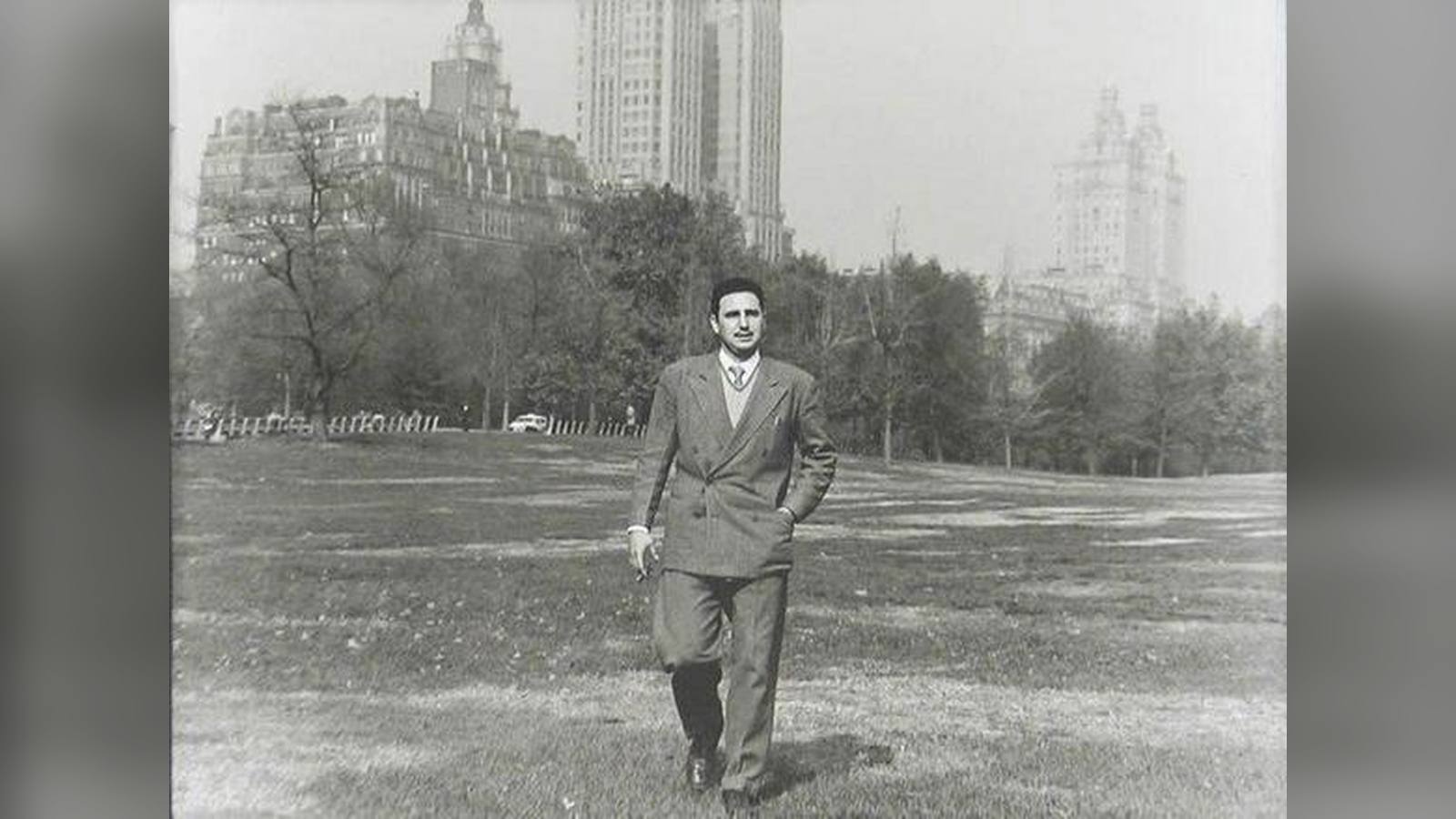
This quiet, black-and-white photograph captures a young man sitting on a wooden bench in Central Park, New York, during the autumn of 1955. Dressed in a dark overcoat, a crisp white shirt, and a neat tie, he looks like any other intellectual or professional enjoying a peaceful afternoon in Manhattan. Yet, this is Fidel Castro, the future leader of the Cuban Revolution, years before he would adopt the iconic olive-green military fatigues, the thick beard, and the cigar that defined his global image. This photograph captures a fleeting, transitional moment in history—an interlude of exile and preparation. It raises a fascinating question: how did this clean-cut, respectable-looking young lawyer sitting on a New York park bench manage to rally the Cuban diaspora and secure the funds necessary to launch a revolution that would reshape the Cold War?
What the photograph shows
In the frame, the 29-year-old Fidel Castro sits relaxed but contemplative. His posture is upright, his hands resting naturally, and his gaze directed away from the camera lens, suggesting a moment of unposed reflection. He is entirely clean-shaven, save for a very light, neatly trimmed mustache, and his dark hair is combed back carefully. The composition is simple and intimate. The wooden slats of the park bench run horizontally across the frame, while the soft, diffused light of a New York autumn filters through the trees in the background. There are no crowds, no banners, and no weapons—only the quiet atmosphere of one of the world’s most famous urban parks. This visual presentation was deliberate and necessary; it reflects the persona Castro maintained during his travels in the United States, designed to project legitimacy, moderation, and intellectual seriousness to foreign observers and potential donors.
The moment behind the image
The photograph was taken in late October or November 1955. Just months earlier, in May 1955, Castro had been released from Cuba’s Presidio Modelo prison under a general amnesty after serving less than two years of his fifteen-year sentence for the failed attack on the Moncada Barracks. Realizing that peaceful political opposition was impossible under the dictatorship of Fulgencio Batista, Castro fled to Mexico to organize an armed uprising. However, a revolution required substantial funding, weapons, and equipment. To secure these resources, Castro embarked on a highly coordinated tour of the United States to mobilize the Cuban emigrant community. New York, with its large population of Cuban exiles, tobacco workers, and political dissidents, was a primary destination. During his stay, Castro stayed in modest apartments and spent his days organizing “Patriotic Clubs” and meeting with potential supporters, occasionally taking brief walks through Central Park to clear his mind between intense organizational meetings.
Photographer and provenance
The exact identity of the photographer remains somewhat uncertain, though historical evidence suggests the image was captured by one of Castro’s close companions or a sympathetic member of the local Cuban exile network in New York. During this tour, Castro was accompanied by key organizers of the 26th of July Movement, including Juan Manuel Márquez, who helped document the trip to show supporters back in Mexico and Cuba that their leader was actively building a transnational coalition. The photograph was preserved for decades within the archives of the Cuban Office of Historical Affairs (Oficina de Asuntos Históricos del Consejo de Estado) in Havana. It eventually entered wider circulation as a rare and captivating artifact of Castro’s pre-revolutionary life, illustrating the stark visual contrast between his early political career and his later decades as a state leader.
Historical context: The American fundraising tour
To understand the significance of this image, one must look at the political strategy Castro employed in late 1955. At this stage, he did not openly preach Marxist-Leninist ideology. Instead, he presented himself as a patriotic reformer and the rightful heir to Cuba’s nineteenth-century independence hero, José Martí. His goal was to overthrow the corrupt, unconstitutional dictatorship of Batista and restore democratic governance. This moderate, democratic platform was crucial for appealing to wealthy Cuban exiles and working-class emigrants in cities like New York, Miami, Tampa, and Key West. On October 30, 1955, Castro delivered a historic speech at the Palm Garden in New York, declaring to a passionate crowd that the revolution would bring freedom and social justice to Cuba. The money raised during this American tour was instrumental in purchasing the yacht Granma and the weapons used by the 82 revolutionaries who sailed from Mexico to Cuba in late 1956 to launch the guerrilla war in the Sierra Maestra.
Why it still matters
This photograph remains memorable because of its profound historical irony. It places a man who would become one of the United States’ most enduring geopolitical adversaries in the peaceful, iconic heart of New York City. The image serves as a visual bridge between two entirely different chapters of Castro’s life: the bourgeois, educated lawyer seeking democratic reforms, and the radical, bearded guerrilla commander who would align Cuba with the Soviet Union and bring the world to the brink of nuclear war during the Cuban Missile Crisis of 1962. By looking closely at this quiet moment in Central Park, viewers are reminded that historical trajectories are rarely linear, and that the symbols we associate with revolutionary power are often constructed over time, leaving behind quiet, unexpected remnants of the past.