


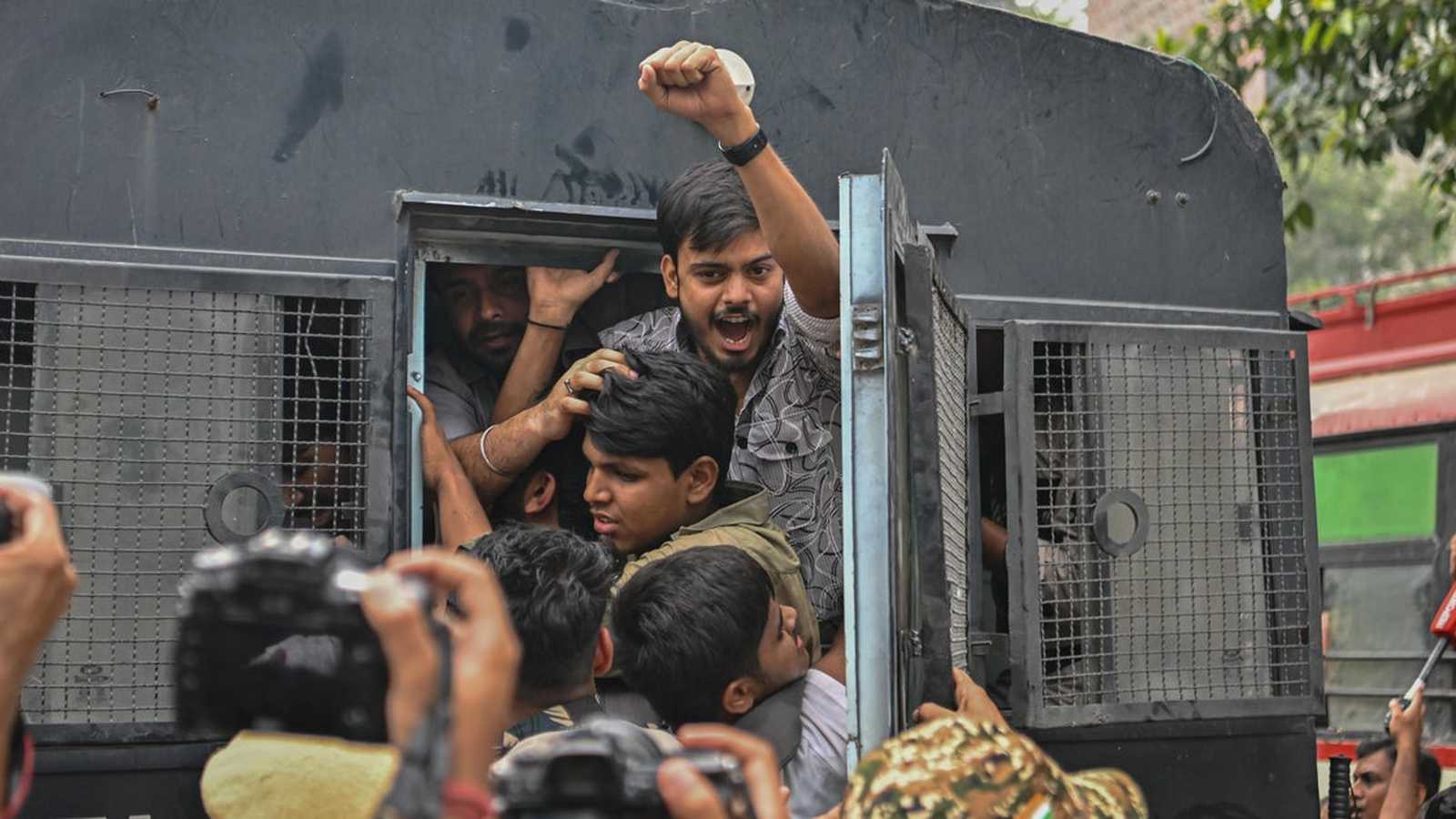
NEW DELHI (Azat TV) – An executive magistrate court in New Delhi ordered the release of three key leaders from India’s viral youth movement, the Cockroach Janta Party (CJP), following a sweeping security crackdown that saw thousands detained across the capital, according to CBS News. CJP founder Abhijeet Dipke, alongside fellow leaders Saurav Das and Ashutosh Ranka, were freed on Sunday on the condition that they commit no breach of peace for the next year, legal director Ratna Singh announced on social media.
The arrests occurred Saturday as police boarded the leaders’ flight from Mumbai upon landing in New Delhi, intercepting them before they could lead a planned demonstration at Jantar Mantar. Authorities deployed over 25,000 police and paramilitary personnel, barricaded central streets, suspended mobile internet services in parts of the city, and shuttered metro stations to neutralize the mobilization. According to The Guardian, the security apparatus detained more than 7,000 protesters over the weekend, including several senior opposition lawmakers and repeat student demonstrators such as Neha Bora.
Targeting the Election Commission and Voter Rolls
The youth movement’s “Season 2” protests are directed against Chief Election Commissioner Gyanesh Kumar, whom the CJP accuses of orchestrating an “assault on democracy.” According to CNN, the Election Commission is currently conducting a massive nationwide revision that has removed tens of millions of names from electoral rolls. Opposition parties and civil society groups claim the purge disproportionately strips eligible minority and marginalized voters from registries to benefit Prime Minister Narendra Modi’s ruling Bharatiya Janata Party (BJP).
The CJP first gained prominence in May following an off-the-cuff remark by a senior judiciary member, adopting the moniker as a symbol of stubborn resilience. The movement previously forced a major political climbdown in July by successfully demanding the resignation of then-education minister Dharmendra Pradhan over an exam paper leaks scandal. Unlike ministerial accountability, removing the chief election commissioner requires a complex parliamentary process and a special majority in both legislative houses, presenting a much steeper institutional hurdle for the decentralized youth campaign.
Political Fallout and Government Response
Following his release, CJP founder Abhijeet Dipke launched a scathing critique of the administration, writing on social media that Prime Minister Narendra Modi is “an embarrassment to India” and a “coward and bully.” Other movement figures accused the central government of declaring war on its own citizens through heavy-handed policing and emergency restrictions.
In contrast, the ruling BJP strongly condemned the protests. Nitin Nabin, president of the ruling Bharatiya Janata Party, asserted that the movement’s organizers are attempting to destabilize a self-reliant India at the behest of foreign forces. Meanwhile, India’s Supreme Court intervened by ordering the restoration of public transport services and mobile internet access across the capital, though central Delhi remained heavily fortified as sporadic demonstrations continued into Sunday afternoon.
Broader Implications of the National Security Measures
The unprecedented weekend crackdown highlights the growing friction between the central government and the country’s digitally organized youth demographic. As reported by ABC News, the international community has also taken notice of the civil liberties restrictions in the capital. The United Nations human rights office called for the immediate and unconditional release of all individuals arbitrarily detained during the demonstrations, a move that India’s foreign ministry quickly dismissed as interference in domestic affairs.
Despite the high-security posture, prominent figures like YouTuber Dhruv Rathee were released after midnight following their weekend detentions, according to Helsinki Times. Nevertheless, student leaders and opposition politicians have signaled that the movement will not dissipate. With state elections scheduled to begin in early 2027, the confrontation over electoral rolls and government accountability looks set to remain a central flashpoint in Indian politics.