


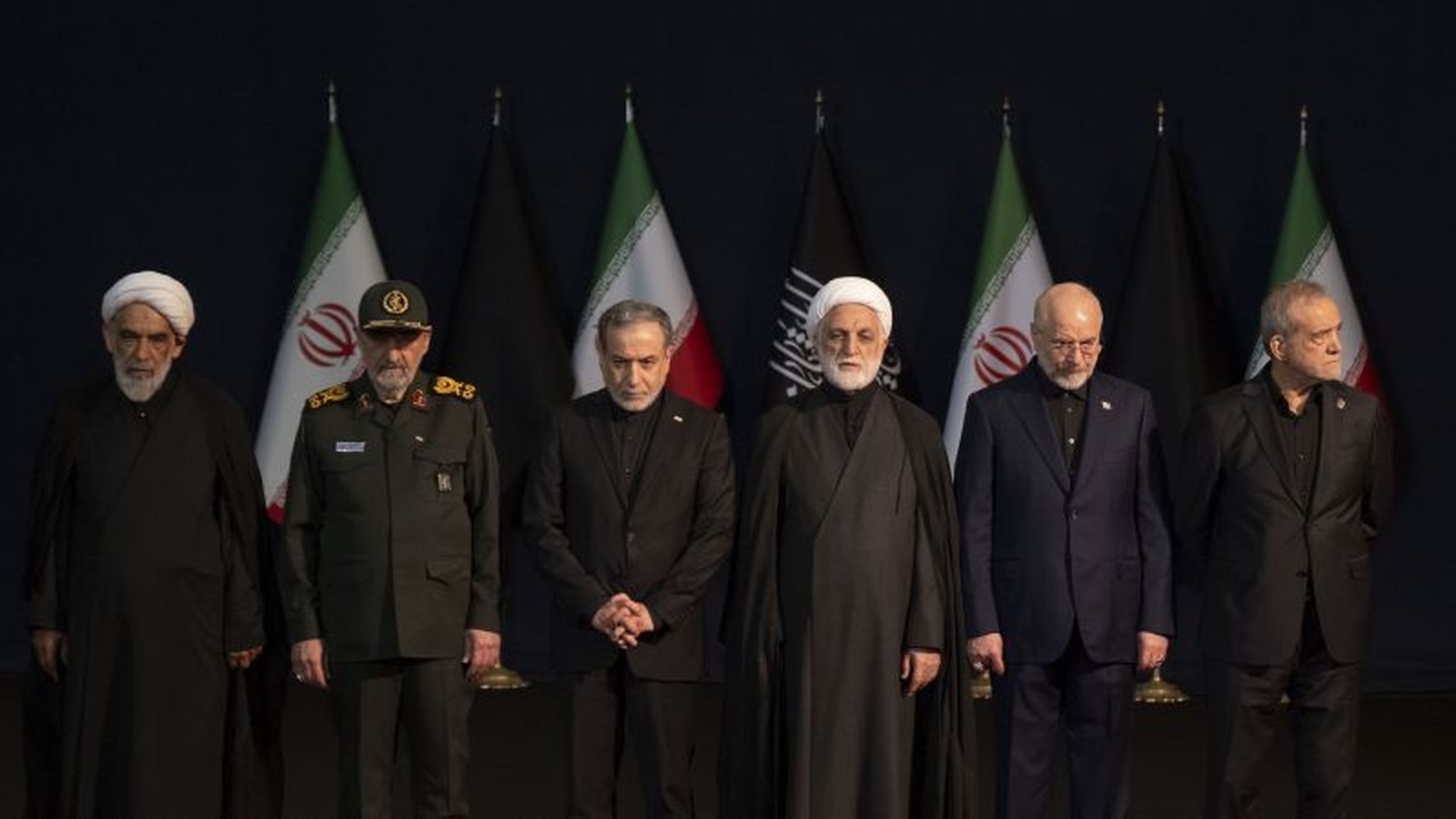
The Visible Trio and the Invisible Leader
In the wake of Supreme Leader Ali Khamenei’s death, the Islamic Republic of Iran has descended into a volatile internal power struggle, with radical hardline factions accusing the country’s visible leadership of orchestrating a “soft coup.” As reported by CNN and The Guardian, the core of the friction lies between the pragmatic-conservative administration of President Masoud Pezeshkian and the ultra-hardline Paydari (Endurance) Front, which views any diplomatic engagement with the West as a betrayal of revolutionary ideals.
The tension reached a boiling point during Ali Khamenei’s funeral in Tehran. While President Pezeshkian walked alongside the late leader’s coffin, mourners—identified by observers as members of radical factions—chanted “death to the compromiser.” Nearby, Iran’s top diplomat, Abbas Araghchi, was forced to flee after being pelted with rocks by a mob labeling him a “traitorous sellout” for his role in negotiating a short-lived ceasefire with the United States. These incidents signal a profound breakdown in the internal consensus that previously held the regime’s disparate factions together under the elder Khamenei’s authority.
Central to the instability is the prolonged public absence of Mojtaba Khamenei, the late leader’s son and designated successor. Since his father’s death, Mojtaba has neither addressed the nation nor appeared in public, leading to intense speculation regarding his status. Sources cited by CNN suggest he may be hiding for fear of his life or is potentially incapacitated. In this vacuum, a trio of officials—President Pezeshkian, Parliament Speaker Mohammad Bagher Ghalibaf, and Foreign Minister Araghchi—have become the de facto faces of Iranian governance, a development the hardliners claim is a deliberate attempt to sideline the Supreme Leader’s office.
Allegations of a ‘Soft Coup’
Hardline lawmakers, led by figures such as Mahmoud Nabavian, have utilized social media and public forums to frame the current administration’s actions as an institutional takeover. Nabavian warned on X (formerly Twitter) of an impending coup, accusing the leadership of defying the orders of the new Supreme Leader while he remains invisible. The rhetoric suggests that the Pezeshkian-Ghalibaf alliance is attempting to consolidate power by elevating the role of the Supreme Council for National Security (SCNS) at the expense of the traditional clerical and parliamentary authorities.
Kamran Ghazanfari, a hardline MP, echoed these concerns, stating that the leadership is shifting power away from traditional centers to carry out a “political coup step by step.” This internal rift is exacerbated by the collapse of the ceasefire agreement with the Trump administration. Hardliners argue that the deal was a “catastrophic capitulation” that failed to secure meaningful sanctions relief or compensation while surrendering Iran’s strategic leverage in the region.
The Strait of Hormuz as a Geopolitical Flashpoint
The strategic future of the Strait of Hormuz has become a primary point of contention. The Guardian reports that hardliners, including Kayhan editor Hossein Shariatmadari, have questioned why Tehran would agree to reopen the waterway, which they consider Iran’s strongest bargaining tool. The recent collapse of the truce followed attacks by the Islamic Revolutionary Guard Corps (IRGC) on shipping in the strait—actions that appeared designed to sabotage the diplomatic efforts of the Pezeshkian government.
In response, Mehdi Mohammadi, an adviser to Speaker Ghalibaf, defended the administration’s strategy, claiming that critics were relying on outdated information. He emphasized that the proposed arrangements would allow Iran and Oman to regulate shipping under “Iranian arrangements” and would eventually lead to the lifting of economic sanctions. However, the IRGC’s independent actions in the strait suggest that the government in Tehran may lack full control over the military’s most radical elements, further complicating the path to stability.
Internal Threats and the Path Forward
The rhetoric of the hardline opposition has moved beyond policy debate into direct threats of violence. Mohammad Ali Bakhshi, a security-linked religious singer (maddah), publicly warned President Pezeshkian that if the Supreme Leader’s conditions were not met, the hardliners would bring “hell” upon him, using the chilling phrase: “it will be us, the blade and your throat.” Despite the severity of the threat, no legal action has been reported against Bakhshi, highlighting the influence these radical elements still wield within the state security apparatus.
Experts such as Hamidreza Azizi of the German Institute for International and Security Affairs suggest that Ghalibaf is actively working to marginalize these radical elements, viewing them as “too costly for the system.” However, with figures like Saeed Jalili—who garnered 13 million votes in the 2024 election—backing the hardline stance, the opposition remains a potent political force. As Iran navigates this leadership transition, the primary risk remains a total fracture between the pragmatic state institutions and the ideological guardians of the revolution, a scenario that could lead to civil unrest or a more overt military intervention in governance.