


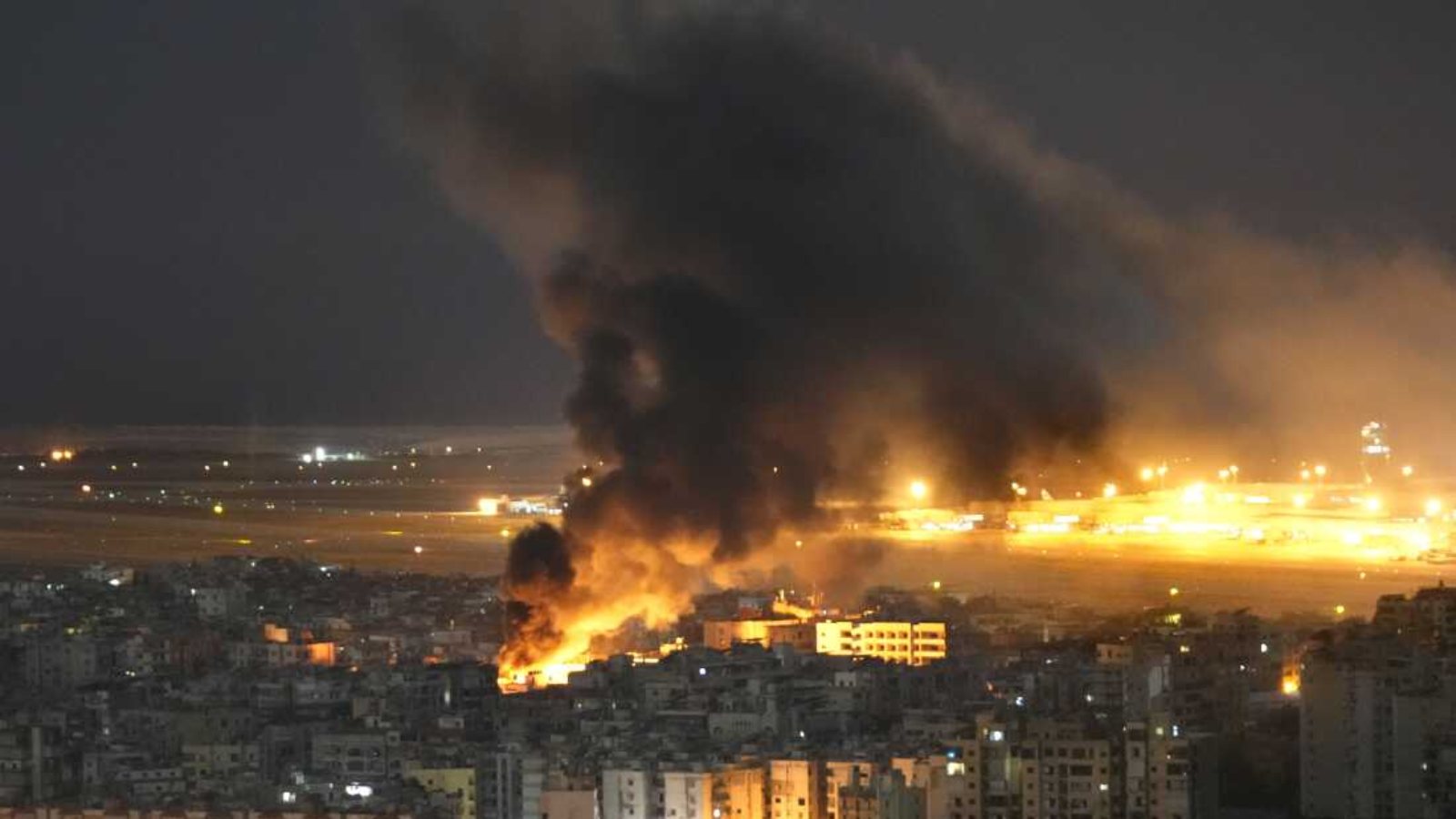
BEIRUT (Azat TV) – Israel launched extensive airstrikes on Lebanon’s capital, Beirut, on Monday, March 2, 2026, resulting in at least 31 fatalities and 149 injuries, according to Lebanon’s state-run news agency NNA. These retaliatory bombings followed a significant rocket and drone assault by the Iran-allied Hezbollah group against an Israeli military base near Haifa in northern Israel. The escalating violence represents a dangerous new phase in the protracted regional conflict, with Hezbollah stating its attack was in response to the killing of Iranian Supreme Leader Ayatollah Ali Khamenei and in defense of Lebanon.
Hezbollah’s Retaliation and Israeli Response in Beirut
Hezbollah’s early Monday assault was explicitly linked by the group to the recent assassination of Ayatollah Ali Khamenei, framing it as a defensive measure for Lebanon and its people, and a response to what it termed “repeated Israeli aggressions.” The group stated that “The resistance leadership has always affirmed that the continuation of Israeli aggression and the assassination of our leaders, youth and people gives us the right to defend ourselves and respond at the appropriate time and place,” further adding that “The Israeli enemy cannot continue its 15-month-long aggression without a warning response to halt this aggression and withdraw from the occupied Lebanese territories,” as reported by Al Jazeera. This marks a departure from Hezbollah’s previous stance of refraining from direct retaliation to daily Israeli strikes, which had been ongoing despite a November 2024 ceasefire.
Israel swiftly responded with air strikes targeting southern Beirut and several villages in south Lebanon, as well as the Bekaa Valley in the east. The Israeli military confirmed it was “vigorously attacking Hezbollah” throughout Lebanon, stating it “will not allow the organization to pose a threat to [Israel] and harm the residents of the north.” The military also asserted that “The Hezbollah terror organization is destroying the state of Lebanon. Responsibility for the escalation lies with it, and the [Israeli military] will respond forcefully to this harm.” Later statements from the Israeli military indicated that “senior” Hezbollah members in Beirut and a “key” figure in south Lebanon were targeted, though specific details were not provided.
Potential Ground Offensive and Lebanese Government’s Stance
Amidst the escalating conflict, Israel issued evacuation warnings to residents in over 50 villages in south Lebanon and the Bekaa Valley, including Bint Jbeil, urging them to stay at least one kilometer from buildings. This broad directive has drawn comparisons to mass displacement orders issued by Israel during its war on Gaza. An Israeli source indicated to The Times of Israel that the current operation in Lebanon “could include a ground offensive,” emphasizing that there would be “no immunity for any Hezbollah members.”
The Lebanese government has strongly condemned Hezbollah’s actions. Lebanese Prime Minister Nawaf Salam described the attack as “an irresponsible and suspicious act that jeopardizes Lebanon’s security and safety and provides Israel with pretexts to continue its aggression.” Speaking on X, Prime Minister Salam pledged, “We will not allow the country to be dragged into new adventures, and we will take all necessary measures to apprehend the perpetrators and protect the Lebanese people.” This public rebuke underscores the deep internal divisions within Lebanon regarding Hezbollah’s independent military operations, especially given the country’s ongoing economic and political crises.
Broader Context of Lebanon’s Escalation
Lebanon has been grappling with severe internal challenges for years, exacerbated by the 2024 war which significantly weakened Hezbollah by eliminating most of its military and political leadership. Despite a government decree in 2025 to disarm Hezbollah, the group rejected the decision, maintaining that its weapons are essential for national defense against perceived Israeli expansionism. Beirut had previously filed a complaint with the United Nations in January, documenting 2,036 Israeli violations of Lebanese sovereignty in the final quarter of 2025, underscoring the long-standing tensions that preceded this latest eruption of violence.
The recent exchange of hostilities between Israel and Hezbollah marks a critical turning point, moving beyond the routine violations of the 2024 ceasefire to a direct, retaliatory confrontation with significant casualties. This escalation not only deepens Lebanon’s existing domestic crises but also firmly embeds the Lebanese front into the broader regional conflict, highlighting the precarious balance of power and the severe implications of external geopolitical events, such as the killing of a major Iranian figure, on already volatile local dynamics.