


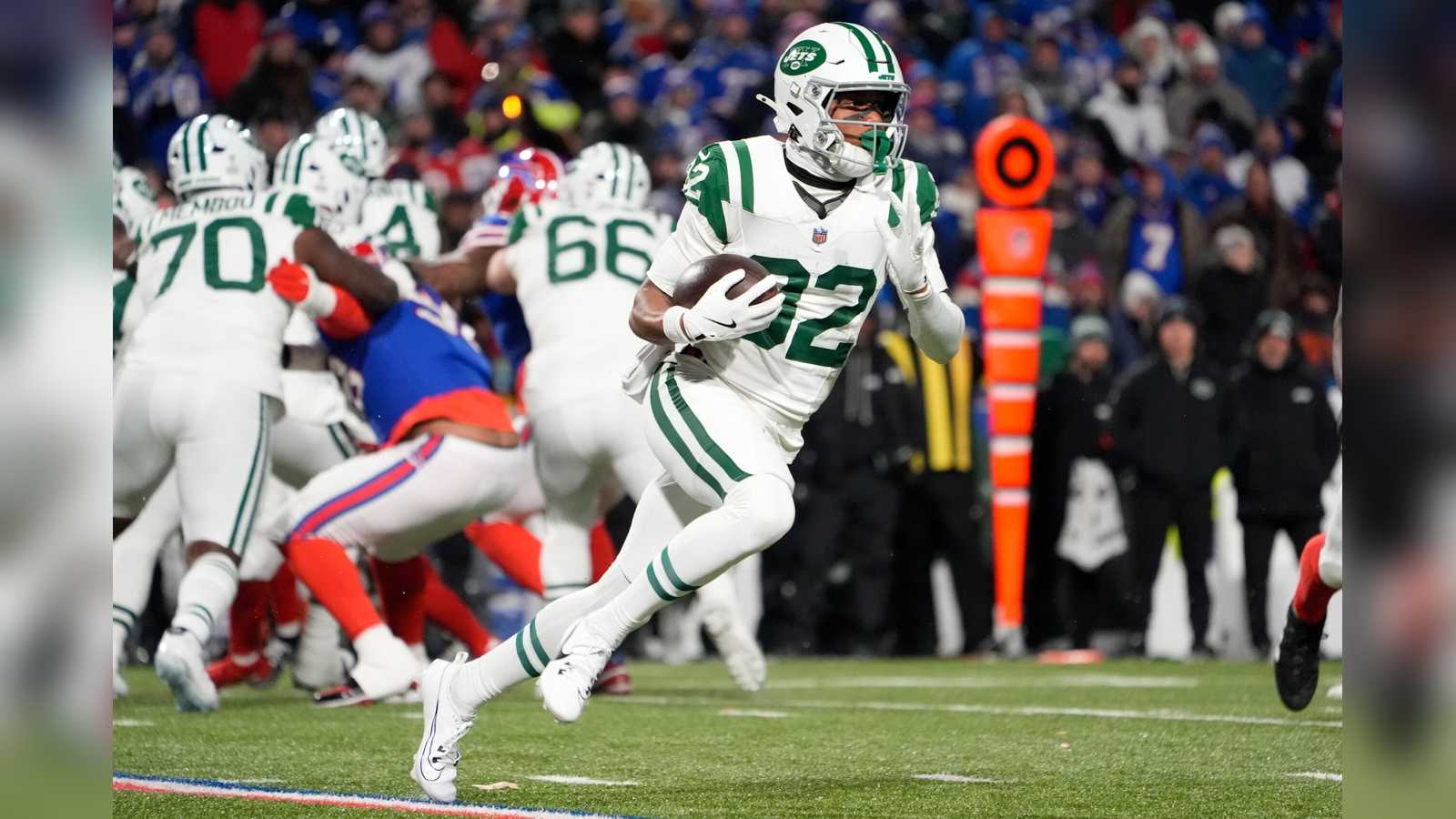
Two weeks before their highly anticipated 2026 NFL regular-season opener against the Tennessee Titans, the New York Jets have officially set their initial 53-man roster—or more accurately, a 52-man roster, leaving exactly one spot open for impending waiver-wire acquisitions. Head coach Aaron Glenn and general manager Darren Mougey collaborated to trim the summer squad down from 90 players, executing a series of calculated roster calculations that reflect a clear, long-term organizational vision. At the absolute center of this strategy is the careful, highly monitored recovery timeline of superstar running back Breece Hall, whose Week 1 readiness remains the defining storyline of the Jets’ offensive outlook.
Glenn’s Patient Strategy: Managing Breece Hall’s Workload
Breece Hall remains the undisputed focal point of the Jets’ offensive identity. However, as the team transitions into the 2026 campaign under the leadership of Aaron Glenn, the coaching staff is prioritizing long-term durability over short-term acceleration. Rather than rushing Hall into a heavy workload for the season opener, Glenn and the medical staff have implemented a “patient” recovery strategy. This conservative approach is designed to ensure Hall reaches peak physical condition for the stretch run of the season, rather than risking a setback in September.
This deliberate patience is directly mirrored in the structure of the running back room. By keeping five players at the position—including fullback Andrew Beck—the Jets have insulated themselves against early-season volatility. If Hall’s snaps are monitored or limited in the opening weeks, the coaching staff has assembled a diverse committee capable of executing the playbook without a dramatic drop-off in efficiency. This approach signals a shift toward modern sports-science management, where a player’s season-long high-value availability outweighs the immediate optics of a Week 1 start.
The Backfield Equation: Allen, Davis, and the Trayanum Factor
To execute this patient strategy, the Jets will rely heavily on their newly established depth. Rookies Braelon Allen and Isaiah Davis are poised to shoulder significant responsibilities early in the year. Allen, known for his physical, downhill running style, offers a perfect short-yardage complement, while Davis provides versatility in both the running and passing games. Additionally, the acquisition of return specialist Kene Nwangwu adds explosive speed to the unit, giving offensive coordinators multiple chess pieces to deploy.
The backfield dynamics underwent a sudden shift during the preseason finale against the New York Giants. Running back Chip Trayanum, who had put together a solid summer with 21 carries for 62 yards and a touchdown, suffered a frightening injury that required him to be carted off the field on a stretcher. While the team confirmed that Trayanum was awake, alert, and possessed full movement in his extremities before being transported to the hospital, he has officially been placed on the reserve/injured list. This unfortunate development solidified the roster spots for the remaining depth pieces and emphasized the harsh reality of NFL physical tolls, reinforcing why Glenn and Mougey opted to carry a deeper backfield.
Under the Hood: Klubnik’s QB2 Status and the Veteran Search
Beyond the backfield, the most scrutinized position battle of the summer concluded with former Clemson standout Cade Klubnik securing the backup quarterback job behind veteran starter Geno Smith. Klubnik’s preseason performance was a rollercoaster of flashes and rookie mistakes, highlighted by a shaky showing in the finale. Despite his struggles, the Jets chose to carry only two quarterbacks on the active roster, designating Klubnik as the immediate QB2.
However, league sources indicate that Klubnik’s hold on the backup role may be temporary. General manager Darren Mougey is expected to actively monitor the waiver wire and veteran market for an experienced signal-caller. The ideal candidate would serve as a locker-room mentor for the young Klubnik while providing a proven insurance policy should Geno Smith miss any time. For now, the Jets are embracing youth at the game’s most critical position, but the open 53rd roster spot suggests that further adjustments are imminent before the team travels to Tennessee.
Trenches and Defensive Depth: The Meredith Trade and Front-Seven Calculus
On the offensive line, the Jets made a series of intriguing choices, keeping eight players on the initial list. Kohl Levao secured a spot over Marquis Hayes, who had put together an impressive preseason. However, this group is already scheduled for reinforcement. A pending trade with the Las Vegas Raiders for offensive lineman Jordan Meredith is expected to be finalized shortly, which will bring the total number of offensive linemen to nine. This move underlines the coaching staff’s commitment to protecting Geno Smith and establishing a dominant run-blocking unit to support Breece Hall’s eventual full-time return.
Defensively, the Jets boast one of the deepest fronts in the league. Rookie edge defender David Bailey, a legitimate contender for Defensive Rookie of the Year honors, headlines a pass-rushing group that includes Will McDonald IV, Kingsley Enagbare, Joseph Ossai, and Braiden McGregor (who earned his spot over Nate Lynn). Up front, the interior is anchored by veterans Harrison Phillips and David Onyemata, alongside the massive rookie defensive tackle T’Vondre Sweat. To manage early-season injuries, linebacker Tyler Baron was placed on the reserve/PUP list, meaning he will miss at least the first four games of the season. This transaction allowed the Jets to preserve depth elsewhere, particularly in the secondary, where safety Malachi Moore secured a roster spot after rookie VJ Payne was placed on short-term injured reserve with a bone bruise.
Waiver Wire and the Open 53rd Roster Spot
As the NFL’s 6:00 p.m. ET roster deadline passed on Sunday, the Jets made it clear that their current roster is a fluid document. With one spot left completely vacant, Darren Mougey has positioned the franchise to be highly aggressive on the waiver wire, which processes at 1:00 p.m. ET on Monday. Whether that spot is used on a veteran backup quarterback, an additional offensive lineman, or a specialist to push kicker Jason Sanders—who struggled with consistency during training camp—the Jets’ front office is prepared to react quickly. Glenn’s patient, long-term philosophy has established a balanced foundation, but the final touches of the 2026 New York Jets are still being written.