


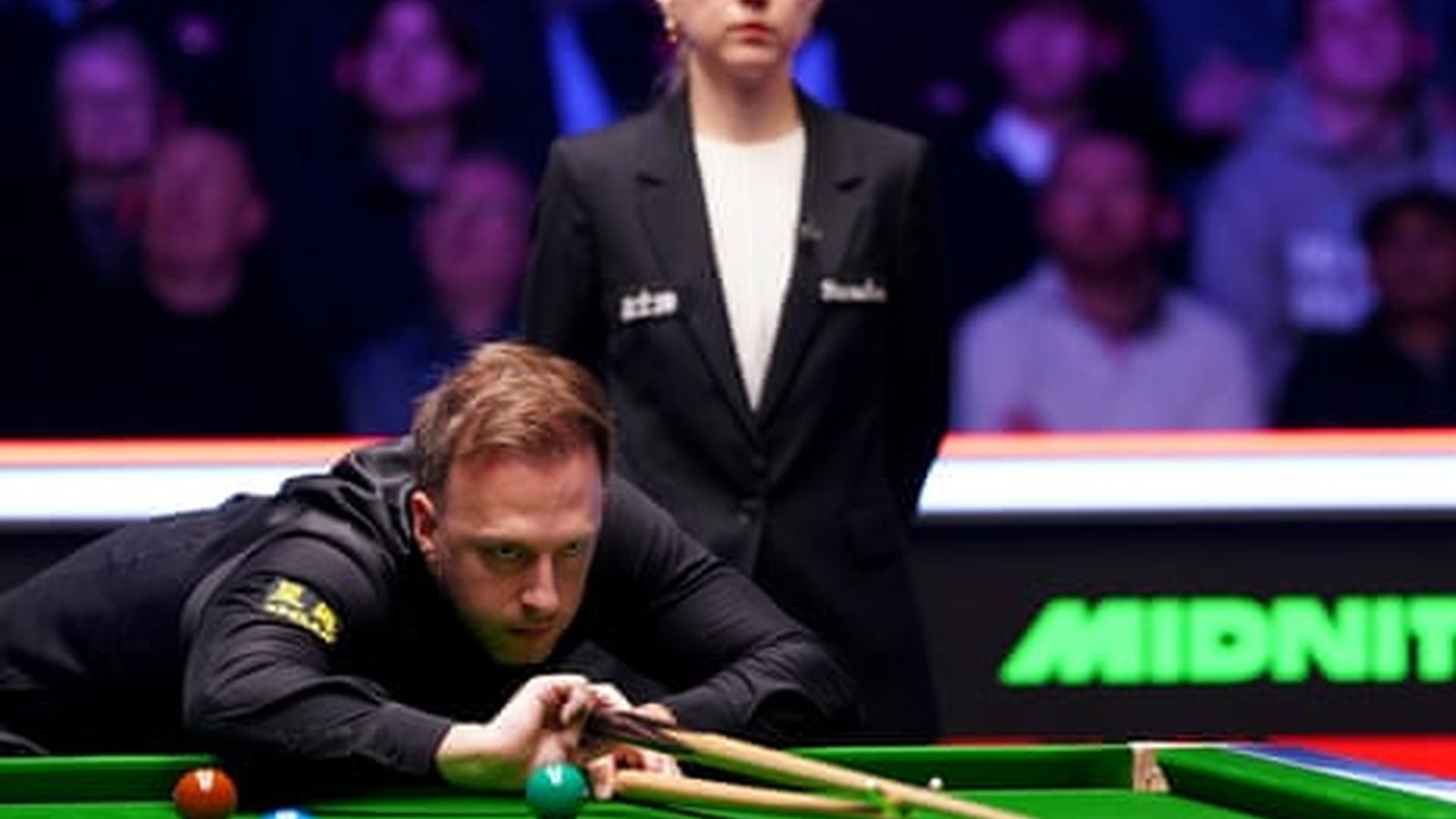
The hallowed halls of Alexandra Palace reverberated with anticipation on Wednesday afternoon as two titans of the baize, Judd Trump and Ding Junhui, locked horns in a highly anticipated first-round clash at snooker’s most prestigious invitational event, the Masters. With a rich history of compelling duels and a shared legacy as former Masters champions, the stage was set for an enthralling best-of-11 frames contest, which would determine who earned the right to face Mark Allen in the quarter-finals.
Trump’s Season of Near Misses and Strategic Shifts
Judd Trump, a two-time Masters champion having hoisted the coveted Paul Hunter Trophy in 2019 and 2023, arrived in London with a distinct point to prove. The 2025-2026 season had, by his own high standards, been one of near-misses. Despite reaching the finals of significant tournaments like the Northern Ireland Open, UK Championship, and Champion of Champions, a major title had eluded him. The Bristol potter, celebrated for his audacious attacking flair, had also embarked on significant personal and professional changes off the table, including a relocation to Dubai and the adoption of a new cue. While these strategic shifts were envisioned for long-term gains, they had, in the short term, introduced uncharacteristic early exits in high-profile events such as the Saudi Arabia Masters and International Championship.
Ding Junhui’s Resurgence and Masters History
Across the green felt, Ding Junhui brought his own formidable ambitions and a storied history at the Masters. The 38-year-old Chinese maestro, who first graced the Masters stage in 2004, famously etched his name into the history books in 2011 as the first Asian player to claim the title. However, his subsequent record at Alexandra Palace had been a mixed bag, marked by a notable semi-final run in 2019 amidst nine first-round eliminations. This season, Ding had judiciously chosen to skip several lower-profile tournaments, yet still demonstrated his enduring class by reaching the last eight of the UK Championship and securing the International Championship trophy in 2024. His recent quarter-final appearances at the Xi’an Grand Prix, UK Championship, and Shanghai Masters all pointed towards a significant resurgence in form, making him a dangerous opponent.
The head-to-head record between Trump and Ding only intensified the intrigue surrounding their encounter. Heading into this match, Trump held a 13-9 advantage in their career meetings, having won their last four clashes. These included a decisive 6-3 victory in the 2025 Masters quarter-finals and a commanding 6-2 triumph in the UK Championship quarter-finals just a month prior. Nevertheless, Ding’s nine victories, notably a semi-final success at the 2023 UK Championship, served as a stark reminder of his capability to defy the odds.
Clinical Performance Secures Trump’s Quarter-Final Spot
As the match commenced at 13:00 GMT, broadcast live on *BBC Two* and streamed across multiple digital platforms, fans braced themselves for a tactical masterclass. The opening exchanges were tight, with both players displaying their intent. Ding had early opportunities to seize the first frame but narrowly missed out, overrunning position on the brown and allowing Trump to capitalize. As *BBC Two*’s live coverage reported, “Ding Junhui has chances to win the first frame but Judd Trump gets over the line. A decent start from both players but Ding will rue overrunning when trying to get position on the brown and allowing his opponent to pinch that frame.”
Trump’s clinical execution swiftly became the dominant narrative of the contest. He was in imperious form, sinking pots with ruthless efficiency and controlling the table with masterful positional play. Six-time world champion Steve Davis, offering his expert commentary on *BBC Two*, lauded Trump’s performance: “Pretty clinical. You can’t really do much better than that. He didn’t miss anything easy. Positional play was superb and that made the game look so easy. It wasn’t like his opponent collapsed. Ding had 90% pot success. To destroy a player with that is astonishing.” Indeed, Trump’s performance was highlighted by his exceptional scoring, including three centuries, as noted by *The Guardian*, a testament to his attacking prowess.
Despite the relentless pressure exerted by Trump, Ding Junhui demonstrated flashes of his renowned break-building artistry. He crafted a brilliant 98 break to pull a frame back and showcased strong safety play throughout the encounter. In one pivotal frame, after a “brilliant long red” from Trump followed by a break of 54, Ding responded with a half-century of his own, ultimately winning a tense safety battle on the yellow to narrow the gap. Yet, the Englishman’s unwavering consistency and formidable scoring power kept him firmly in command as he continued to accumulate frames.
By the mid-session interval, Trump had established a comfortable lead. Still, Ding, ever the competitor, refused to concede easily, securing another frame with a composed display. But as the match progressed, Trump’s confidence visibly surged. After sealing his 6-2 victory, he shared his thoughts with *BBC Two*, expressing his comfort and belief: “I am comfortable. In the UK I was comfortable. I think everything is fine. I feel confident and have got to a few finals recently and it has taken some good players to stop me. I am full of confidence and hopefully I can go one better this tournament. It’s my favourite tournament to play. The crowds are unbelievable, and I love coming back here. Every game is a belter here, let’s hope the next game is not 6-2.”
This decisive win marked Trump’s seventh consecutive Round of 16 match victory at the Masters since 2020 and continued a remarkable trend of 6-2 scorelines in this year’s tournament. It also further solidified his dominance over Ding in their recent encounters, cementing his reputation as one of snooker’s most formidable and consistent competitors.
For Ding, the defeat, while frustrating, was not without its silver lining. Despite his high pot success rate and moments of brilliance, he simply ran into an opponent playing at the peak of his powers. As Steve Davis astutely observed, “Ding has not done a lot wrong but such is the way in top-class play if your opponent is on point. He looked very strong in the first frame and that is something to keep hold of. The longer Judd can keep Ding in his chair, the more chance you’ve got of getting a player to go cold.” Ding’s performance, though insufficient on the day, clearly indicated that he remains a potent threat at the highest echelons of the sport.
The match also underscored snooker’s burgeoning global accessibility, with live coverage on *BBC Two*, *BBC iPlayer*, the *BBC Sport* website, and app, ensuring that fans worldwide could immerse themselves in every twist and turn of the action. The “Masters Snooker Extra” program, scheduled for later that evening, promised deeper analysis and highlights for enthusiasts eager to relive the spectacle.
As the echoes of cue balls faded at Alexandra Palace, Trump’s commanding victory set the stage for a tantalizing quarter-final showdown against the 2018 Masters champion, Mark Allen. With Trump’s form seemingly peaking and his confidence soaring, the snooker world is left to ponder: could this be the year he adds a third Masters crown to his already glittering résumé? One thing is unequivocally clear: the drama at the Masters is far from over, and all eyes will be fixed on London as the tournament progresses.
In a season marked by promising runs but elusive major titles, Judd Trump’s dominant performance against Ding Junhui at the Masters opener serves as a powerful statement of intent. His ability to produce three centuries and maintain clinical precision under pressure, particularly after significant off-table adjustments, underscores not just his immense talent but also a renewed mental fortitude. This victory suggests Trump is not merely seeking a title but is actively reasserting his position at the pinnacle of the sport, transforming near-misses into a potentially decisive breakthrough.