


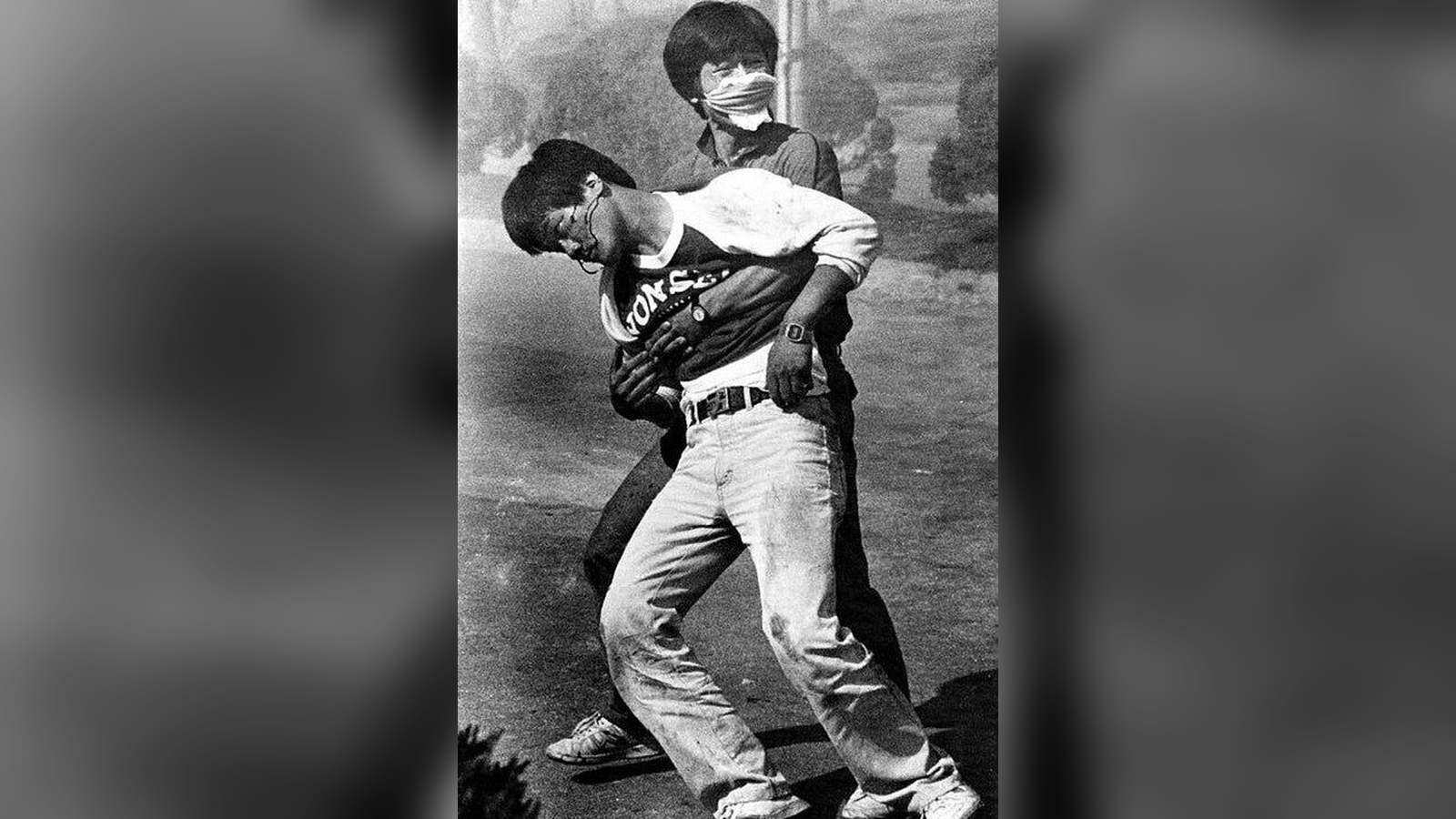
In the stark black-and-white frame, gravity seems to be dragging a young man out of consciousness while another desperately tries to anchor him to life. His head is bowed, eyes half-lidded and vacant, his jaw slack as a dark stream of blood drips down his temple, cheek, and neck onto his torn sweatshirt. Behind him, another young man in a white athletic shirt clutches him tightly beneath the arms, grimacing in anguish and panic as he screams for help into the smoky haze of tear gas. Captured on June 9, 1987, outside the front gate of Yonsei University in Seoul, this photograph did more than record a fatal injury—it shattered the collective silence of South Korean society and transformed 21-year-old student Lee Han-yeol into the catalyst for an unstoppable democratic revolution.
What the photograph shows
The photograph presents an unbearable moment of human fragility amid state-sanctioned violence. Lee Han-yeol, a sophomore majoring in business administration at Yonsei University, is visibly losing motor control. His knees have buckled, his torso sags forward, and his hands hang limply at his sides. The contrast between the two men tells a devastating story: the rescuer, fellow student Lee Jong-chang, strains every muscle in his neck and shoulders to keep his companion from striking the asphalt, while Lee Han-yeol drifts toward oblivion. In the background, the paved approach to the university gate is strewn with rocks and clouded by chemical fumes. The composition is unvarnished, raw, and unposed, captured at eye level with the immediacy of a battlefield document.
The moment behind the image
On that Tuesday afternoon, students at Yonsei gathered for a rally ahead of the nationwide Great Democratic March scheduled for the following day. President Chun Doo-hwan’s military regime had banned the planned assemblies and deployed tens of thousands of riot police across the capital. As students pushed toward the university gate shouting slogans for constitutional reform and free elections, combat police fired barrages of SY-44 tear gas canisters. Standard police protocol required launchers to be aimed at an upward arc exceeding 30 degrees to disperse gas overhead; instead, officers fired directly into the crowd at chest and head level. A direct-fired metal canister struck Lee Han-yeol squarely in the back of his skull, fracturing his cranium and causing massive internal hemorrhaging. He collapsed instantly, remaining in a critical coma at Severance Hospital until his death on July 5, 1987.
Photographer and provenance
The shot was made by Jung Tae-won, an experienced Korean photojournalist working for Reuters who was covering the campus clashes alongside local newspaper photographers. Operating under dangerous conditions—dodging rocks hurled by students and suffocating under dense clouds of pepper gas while evading aggressive police batons—Jung maintained his focus on the front gate. When the canister struck Lee, Jung fired off a sequence of exposures within seconds. Recognizing the explosive political significance and immediate human tragedy of the image, the photograph moved quickly onto the Reuters international wire and was printed the following morning on the front page of the domestic daily JoongAng Ilbo. Under the Chun regime’s strict press censorship guidelines, publishing such explicit evidence of police brutality was an act of extraordinary defiance that broke open official narratives.
Historical context: From torture scandal to national revolt
The photograph did not emerge in a vacuum; it landed upon a country already primed for revolt. Five months earlier, in January 1987, Seoul National University student activist Park Jong-chol had been tortured to death during police interrogation, drowned in a bathtub while authorities attempted a botched cover-up. Chun Doo-hwan’s announcement on April 13 that he would suspend constitutional debate and retain the indirect electoral college—effectively handpicking former general Roh Tae-woo as his successor—had infuriated the public. When images of Lee Han-yeol’s bleeding head hit newsstands, grief turned into universal fury. The outrage brought millions into the streets, joined not only by radical students but by ordinary citizens, middle-class salaried workers known as the ‘necktie brigade,’ and church leaders. The continuous mass mobilization, known as the June Democratic Struggle, forced the regime on June 29 to concede direct presidential elections and restore civil liberties.
Why it still matters
On July 9, 1987, more than one million citizens filled the streets from Yonsei University through Gwanghwamun to Seoul City Hall for Lee Han-yeol’s national funeral procession, carrying giant banners bearing the very photograph Jung Tae-won had taken. Today, the photograph remains an immutable pillar of South Korean collective memory. In 2024 and 2025, South Korea’s Korea Heritage Service formally recognized Lee’s bloodstained grey sweatshirt, blue jeans, and reconstructed sneaker as official preliminary national cultural heritage alongside President Kim Dae-jung’s Nobel Peace Prize medal. Decades after the shutter clicked, the image continues to remind the world that democratic institutions are not gifts handed down by rulers, but rights bought with the blood of citizens willing to stand in the street.