


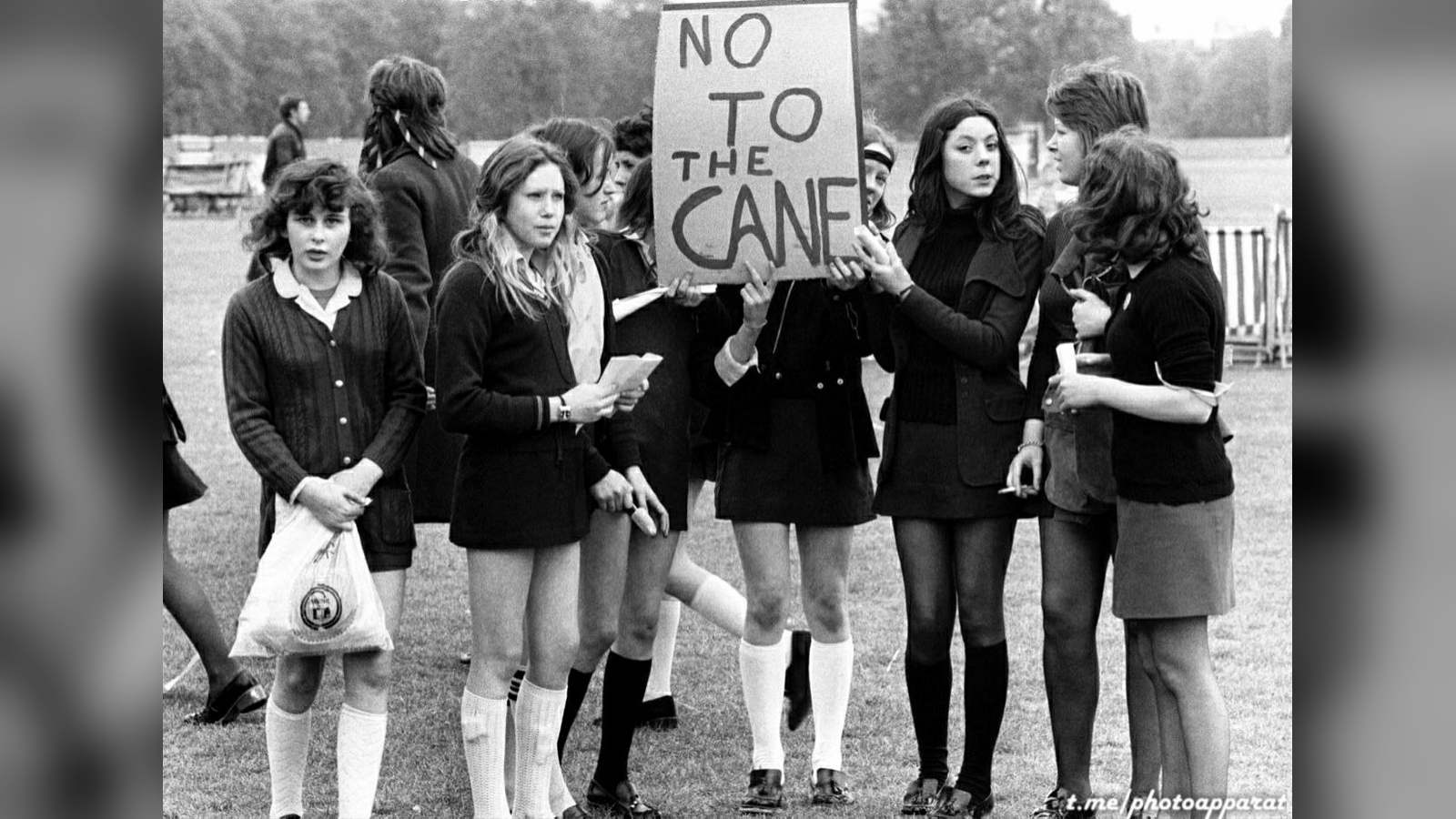
The photograph captures a sea of youthful faces, a dense, swirling mass of students navigating the gray, narrow streets of 1970s London. Their expressions range from intense, focused anger to the exhilarating realization of collective power. In the foreground, a handmade sign, its lettering hurried but bold, reads simply: “No to the Rod.” This image is not merely a record of a street march; it is a visual manifesto of a generation that decided, quite suddenly, that they had had enough. The photograph acts as a time capsule, preserving the tension, the dust of the urban environment, and the palpable shift in the power dynamic between the British educational establishment and those it sought to discipline.
What the photograph shows
Looking closely at the frame, one notices the diversity of the crowd—young teenagers, mostly in their early secondary school years, dressed in the informal attire of the era. Their posture is defiant; they are not standing still for a portrait but are caught in the act of movement, suggesting the momentum of a march that felt unstoppable in the moment. The background is blurred, emphasizing the sheer scale of the protest, with signs bobbing like buoys in a human ocean. The composition highlights the individual humanity of the students against the backdrop of an indifferent city, capturing the specific, gritty texture of 1972 London.
The moment behind the image
The event took place on May 17, 1972, a day when the British school system was rocked by a wave of student strikes that appeared almost spontaneous. Approximately 10,000 students across London abandoned their desks, taking to the streets to voice their grievances. The strike was organized by the Schools Action Union, a radical student organization that had been gaining traction. The students were not just protesting against the cane, though that was the most emotive issue; they were also railing against the quality of school meals—often described as inedible—and the restrictive nature of mandatory uniforms. The tension had been building for months, fueled by a growing sense that students were treated as second-class citizens within the walls of their own schools.
Photographer and provenance
While the specific photographer of this frame remains uncredited in many archival circulations, the image belongs to the broader visual record of the 1972 student strikes, often held in the collections of the National Archives or press agencies like Getty. The working conditions for photographers during this event were likely chaotic; the march was not a sanctioned parade but a disruptive protest. Journalists and photographers had to navigate the erratic flow of thousands of teenagers who were, for the first time, experiencing the thrill of political agency. The survival of this image is due to the media’s sudden interest in what was then a shocking phenomenon: the organized student strike.
Historical context
In 1972, the British educational system was arguably one of the most hierarchical in the Western world. Corporal punishment was not just common; it was a legal right for teachers to inflict physical pain as a form of discipline. The “cane” was a symbol of absolute authority. The 1972 march was one of the first times this authority was openly, publicly, and en masse challenged by the students themselves. The authorities were caught off guard. Schools scrambled to regain control, and many student leaders faced swift disciplinary repercussions, including suspensions and expulsions. However, the genie could not be put back in the bottle. The image captures the beginning of a long erosion of the authoritarian model of schooling.
Why it still matters
This photograph serves as a vital reminder that institutional change is rarely granted; it is almost always seized. The path from this protest to the 1998 ban on corporal punishment was long and fraught with resistance. By 1974, London had moved to ban the practice, followed by a national ban in state schools in 1986. Today, we look back at this image and see the faces of the children who stood up to a system that thought it could use pain to instill order. It is a testament to the resilience of the youth voice and a reminder that even the most ‘traditional’ practices are subject to the moral evolution of the society that sustains them.