


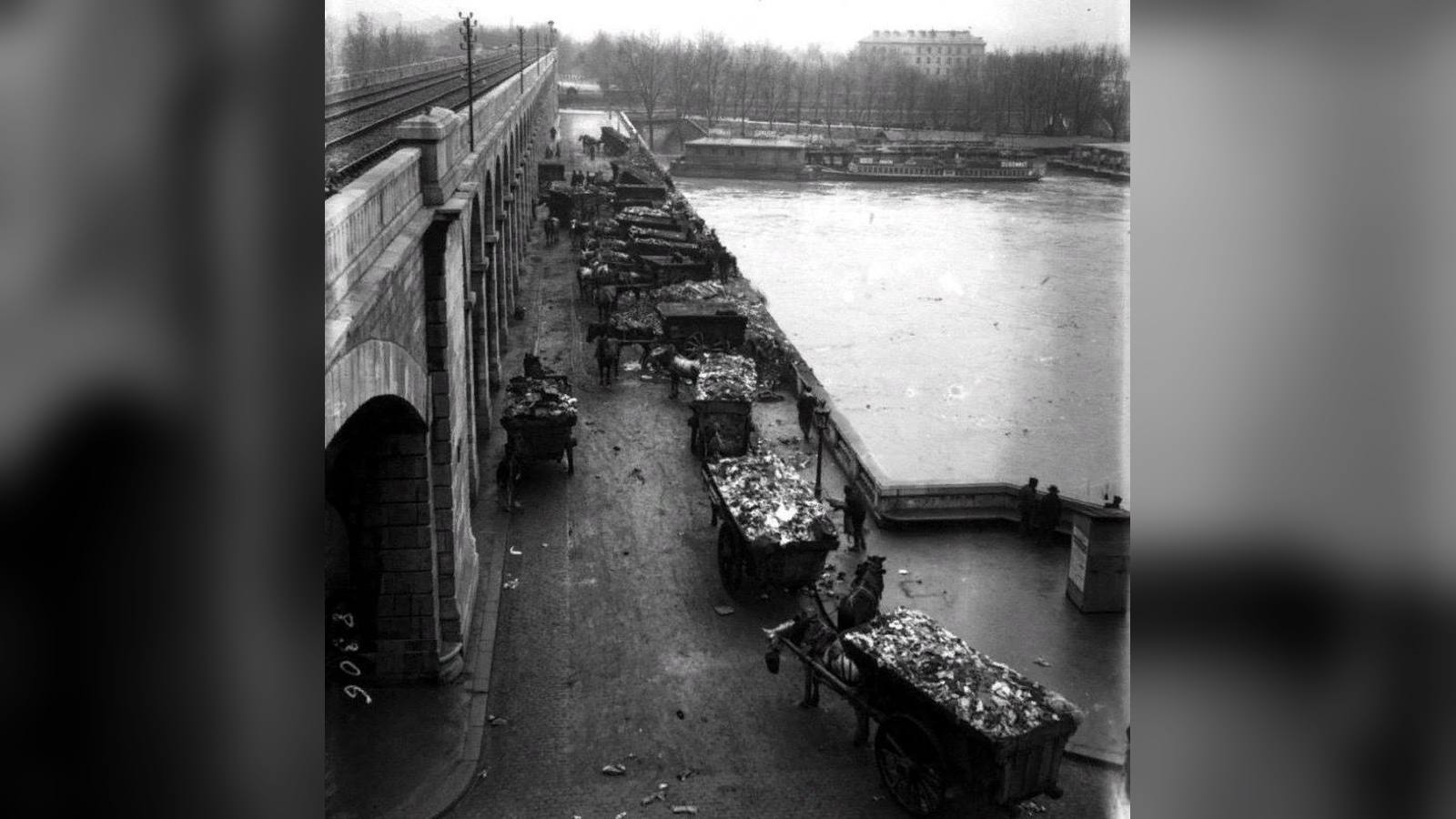
This arresting historical photograph captures a stark, forgotten reality of early twentieth-century urban life: a worker casually tipping household waste directly over the stone embankment into the murky waters of the Seine. Long before the river became an internationally romanticized symbol of French culture, poetry, and leisurely strolls, it served as an open-air sewer and a giant municipal dumping ground. The photographic frame freezes a fleeting, everyday gesture that reveals the sheer scale of indifference toward ecological health during the height of the industrial age, inviting modern viewers to confront the stark contrast between historical sanitation practices and contemporary environmental awareness.
What the photograph shows
Within the composition, a human figure stands near the river’s stone parapet, captured mid-action as debris spills from a container into the slow-moving water below. The surrounding architecture reflects the classic Haussmannian aesthetic of Paris, yet the foreground subverts any notions of scenic beauty, focusing instead on the gritty mechanics of daily survival and waste disposal. The monochromatic tones emphasize the heavy, soot-laden atmosphere of the Belle Époque, where the romanticized gas lamps and grand boulevards coexisted with uncollected refuse and polluted waterways. Every visual element—from the rough texture of the discarded refuse to the damp, heavy stones of the quay—underscores a utilitarian approach to nature that treated municipal rivers as bottomless sinks.
The moment behind the image
Taken in Paris in 1910, the photograph documents a period when systematic municipal waste management was still in its infancy. With a burgeoning population of approximately 2.8 million residents, the French capital generated an estimated 120 tons of waste daily. Without comprehensive collection networks or high-capacity incinerators, citizens, merchants, and commercial carters routinely relied on the nearest natural drainage basin. The Seine absorbed not only domestic garbage and horse manure from the city’s vast carriage transit, but also untreated chemical runoff and industrial discharge from upstream dyeworks, tanneries, and factories. The photographer caught a routine morning or afternoon chore, transforming a mundane act of urban neglect into an enduring visual indictment.
Photographer and provenance
While the exact identity of the photographer remains uncredited in many archival registers, images of this genre were typically produced by press agencies, municipal chroniclers, or early documentary photographers aiming to record the physical transformation and infrastructural struggles of European capitals. Such glass-plate negatives were preserved in municipal archives and press collections, later serving as vital historical evidence. The working conditions for photographers during this era involved heavy, cumbersome equipment, long exposure times, and hazardous environments, yet their lenses managed to pierce through the romantic veneer of the Belle Époque to capture the unvarnished realities of labor, poverty, and urban sanitation.
Historical context and sanitary crisis
The consequences of treating the Seine as an open sewer were devastating for public health. Throughout the nineteenth century and into the early 1900s, Paris suffered recurring outbreaks of cholera in 1832, 1849, and 1892, alongside staggering infant mortality rates driven by waterborne intestinal infections. By 1900, the river’s ecosystem had effectively collapsed, driving away nearly all native fish populations and turning sections of the waterway into biological dead zones. The situation reached a breaking point during the catastrophic Great Flood of Paris in January 1910, when the swollen, polluted river overflowed its banks, washing accumulated filth and garbage directly into the flooded streets of the metropolis.
Why it still matters
The survival of this evocative photograph offers a vital historical bridge, reminding us that even the world’s most celebrated cultural capitals endured profound ecological crises during their modernization phases. The 1910 disaster and visual documentation like this catalyzed the monumental ‘Sanitary Paris’ project, leading to the construction of advanced underground sewer networks, strict bans on direct river dumping, and the establishment of early waste treatment facilities. More than a century later, as modern sanitation projects strive to restore the Seine for public swimming, this vintage frame endures as a sobering testament to how far urban civilization has evolved—and how fragile natural ecosystems can become under the weight of unbridled industrial growth.