


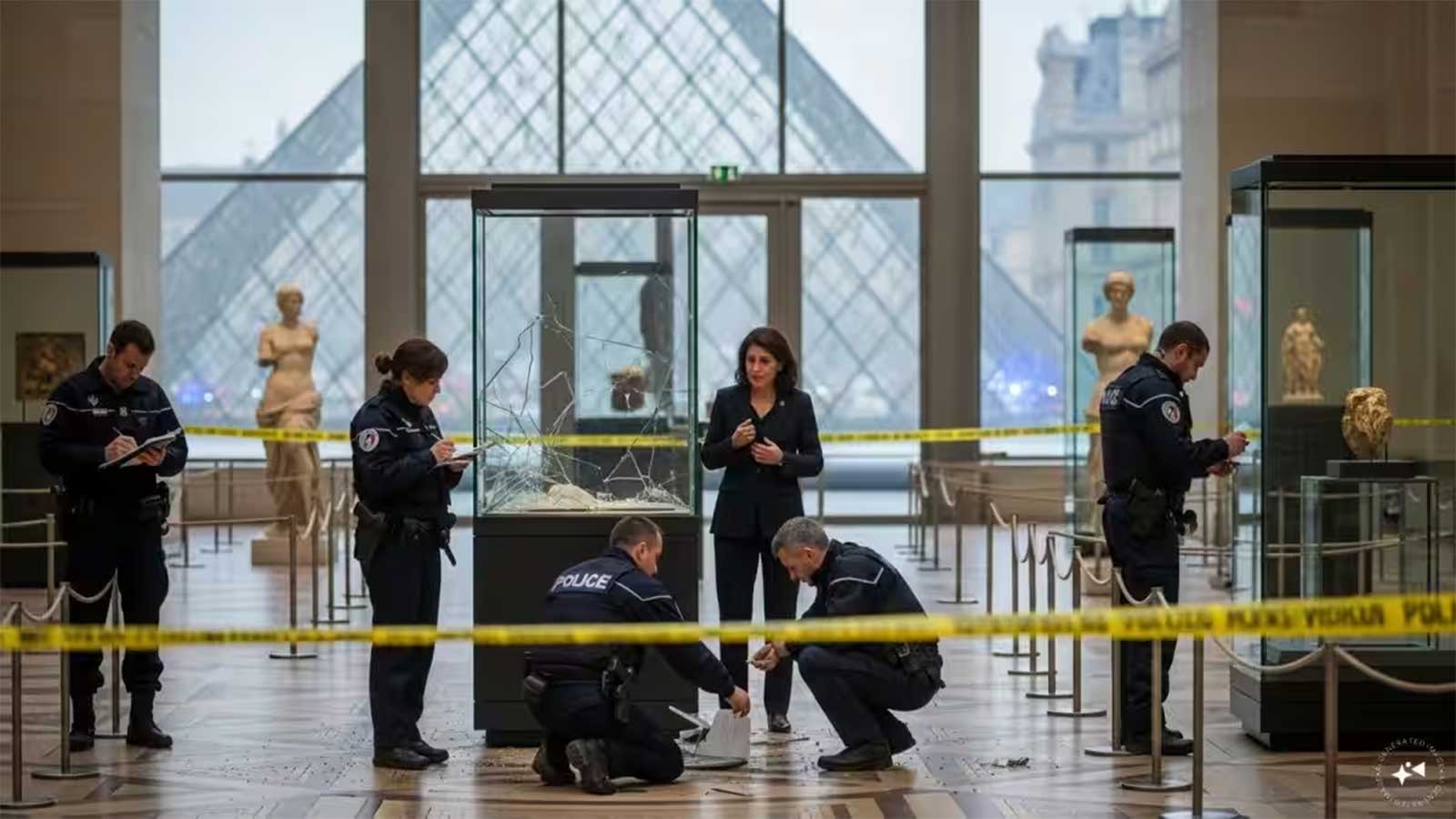
Louvre’s Security Under Scrutiny After Staggering Jewel Heist
On a quiet Sunday morning, in less than ten minutes, a gang of four managed to slip into the Louvre Museum and escape with eight pieces of French crown jewels worth an estimated €88 million. The theft, now being called one of the most audacious in France’s modern history, has triggered waves of disbelief, anger, and soul-searching across the country.
The museum’s director, Laurence des Cars, appeared before the French senate’s culture committee just days after the heist. She did not mince words. “We failed these jewels,” she said, acknowledging that the Louvre had been “defeated.” In a rare moment of candor for a public institution, she admitted that the museum’s security cameras were “aging” and “far from satisfactory,” with critical blind spots that left the building vulnerable.
How Did the Thieves Succeed?
The details of the break-in read like a movie script: a truck with an extendable ladder and furniture hoist parked right outside the museum on a busy Parisian street near the Seine River. According to The Guardian, the thieves posed as maintenance workers, setting up bollards and carrying out their plan in broad daylight. In just seven minutes, they scaled the wall, broke through a window to reach the ornate Gallery of Apollo, and targeted the jewel display cases.
Senators grilled des Cars on the glaring gaps in security. Why was there only one camera on the external wall facing the river, and why was it pointed away from the vulnerable balcony? The answer was as troubling as the question: budget constraints, aging infrastructure, and slow investment in modern security technology. Des Cars herself had been warned about the “obsolete” equipment when she assumed the role in 2021.
As the heist unfolded, alarms did sound, and security guards acted quickly to evacuate the building. But it wasn’t enough. The thieves had already disappeared into the Paris morning, leaving behind a damaged 19th-century diamond crown belonging to Empress Eugenie. The crown, crushed as the thieves pried it from its display case, was later recovered, but the loss—both material and symbolic—was enormous.
France’s Cultural Pride Wounded
The Louvre isn’t just any museum; it is the showcase of French heritage. Housing treasures like the Mona Lisa and ancient Egyptian relics, it welcomes nearly nine million visitors a year. The theft struck a heavy blow to French pride, already shaken by political turmoil and social unrest. Culture Minister Rachida Dati called the incident “a wound for all of us.”
While Dati insisted that the museum’s security “did not fail,” others were less forgiving. Interior Minister Laurent Nuñez described the event as a “failure,” despite the fact that the alarms functioned as intended and police arrived within three minutes. The problem, it seemed, was not the response, but the system itself: “The weakness of our perimeter protection is known,” des Cars admitted.
Tourists lined up outside the Louvre as it reopened, some expressing shock, others a sense of intrigue. “It doesn’t feel real, that they could do it in broad daylight like that,” said a visitor from London to NBC News. The Apollo Room, where the jewels were stolen, remained closed as investigators combed for clues.
Inside the Museum: Outdated Technology and Staffing Cuts
The hearing revealed deeper issues. Over the past decade, surveillance and security staff have been cut, and the museum’s infrastructure has struggled to keep up with the demands of new technology. Some areas were simply too old to accommodate advanced video surveillance or thermal cameras. Even the display cases, recently updated to withstand gunfire, were vulnerable to more basic tools—an angle grinder was all it took for the thieves to cut through the glass.
Des Cars defended her actions, noting that she had raised concerns about security repeatedly. She even tendered her resignation to the culture ministry after the heist, but it was refused. “I am wounded as chair and director that the warnings I was raising, as a whistle-blower, in a sense, have come to pass,” she said. She hopes to double the number of CCTV cameras and begin extensive upgrades by early 2026, but admits the process will be challenging given the museum’s historic structure.
The government, meanwhile, is under pressure to accelerate security improvements. President Emmanuel Macron has called for a six-year renovation plan for the Louvre, including funds for modern security upgrades. A police post inside the museum is now being considered.
The Hunt for the Thieves and the Fate of the Jewels
As investigators work to track down the gang—believed to be acting on orders from a criminal organization—the future of the stolen jewels remains uncertain. Paris Prosecutor Laure Beccuau told NBC News that about 100 investigators are involved in the search, racing against time before the thieves try to melt down or sell the pieces. Experts warn that if the jewels are disassembled, their true value will never be realized.
The theft has also brought renewed attention to the international market for stolen art and antiquities, raising questions about how museums can protect their collections in an era of increasingly sophisticated crime.
For the Louvre, this is more than just a financial loss. It is a test of resilience and responsibility—a moment that demands reflection and reform. As tourists once again stream into its halls, the museum faces the challenge of restoring not just its damaged crown jewels, but the trust of a nation and the world.
The Louvre jewel heist stands as a stark reminder that even the world’s most renowned cultural institutions are only as secure as their weakest link. The director’s frank admission of failure marks a turning point, but unless promises of reform are matched by real investment and modernization, the vulnerabilities exposed by this theft will remain—and with them, the risk of history repeating itself.