


Gen Z’s Uprising: From Discord to the Streets
Across Morocco, a new energy is pulsing through the streets. Over one restless weekend in late September, thousands of young Moroccans—most in their teens and twenties—marched from Casablanca’s boulevards to the bustling heart of Rabat. Their rallying cry? “We don’t want a World Cup, we want a functioning health system.” This leaderless movement, organized under the digital banner “Gen Z 212,” has emerged as the most significant youth uprising the country has seen in years, sparking both hope and anxiety as Morocco braces for elections and global sporting events.
Digital Roots, Real-World Frustrations
Unlike traditional protests orchestrated by political parties or unions, the Gen Z demonstrations are born of digital communities and social media. The movement’s nucleus is a Discord server, named after Morocco’s +212 country code, with over 9,000 members. Organizers coordinate on platforms like TikTok, Instagram, and X (formerly Twitter), where memes, livestreams, and videos of hospital strikes rapidly go viral. On these channels, debate is lively, grievances are shared, and volunteers are recruited for everything from content creation to on-the-ground logistics.
“We don’t have a leader, we are not backed by anyone,” a 23-year-old graduate told Barlaman Today. “This came out of frustration. Even the earliest moderators quit—they didn’t expect it to grow this big.” The movement’s raw, decentralized energy echoes similar Gen Z mobilizations in Nepal, Indonesia, and beyond, all fueled by a loss of faith in mainstream politics and a burning sense of injustice.
Against Injustice, Not the System
What sets these protests apart is not just their scale, but their clarity of purpose. Demonstrators insist they are not against Morocco’s system itself, but rather the “injustices of daily life”—a phrase repeated by Nabila Mounib, a prominent leftist lawmaker who joined the crowds. Their demands are direct: jobs, better schools, functioning hospitals, and social justice. Placards reading “health before football” and chants like “stadiums are here, but where are the hospitals?” draw a stark contrast between Morocco’s multibillion-dollar investments in the upcoming Africa Cup (AFCON) and World Cup, and the chronic underfunding of essential services.
The recent tragedy in Agadir—where eight pregnant women reportedly died in a public hospital—has become a flashpoint for public outrage. “To ask for health and education is to ask for life itself… to be met with arrests and violence is a betrayal,” wrote one protester on Instagram. Videos of police dispersing crowds, arresting young men and women, and deleting footage from their phones have only fanned the flames of indignation.
Clashes, Arrests, and the Call for Dialogue
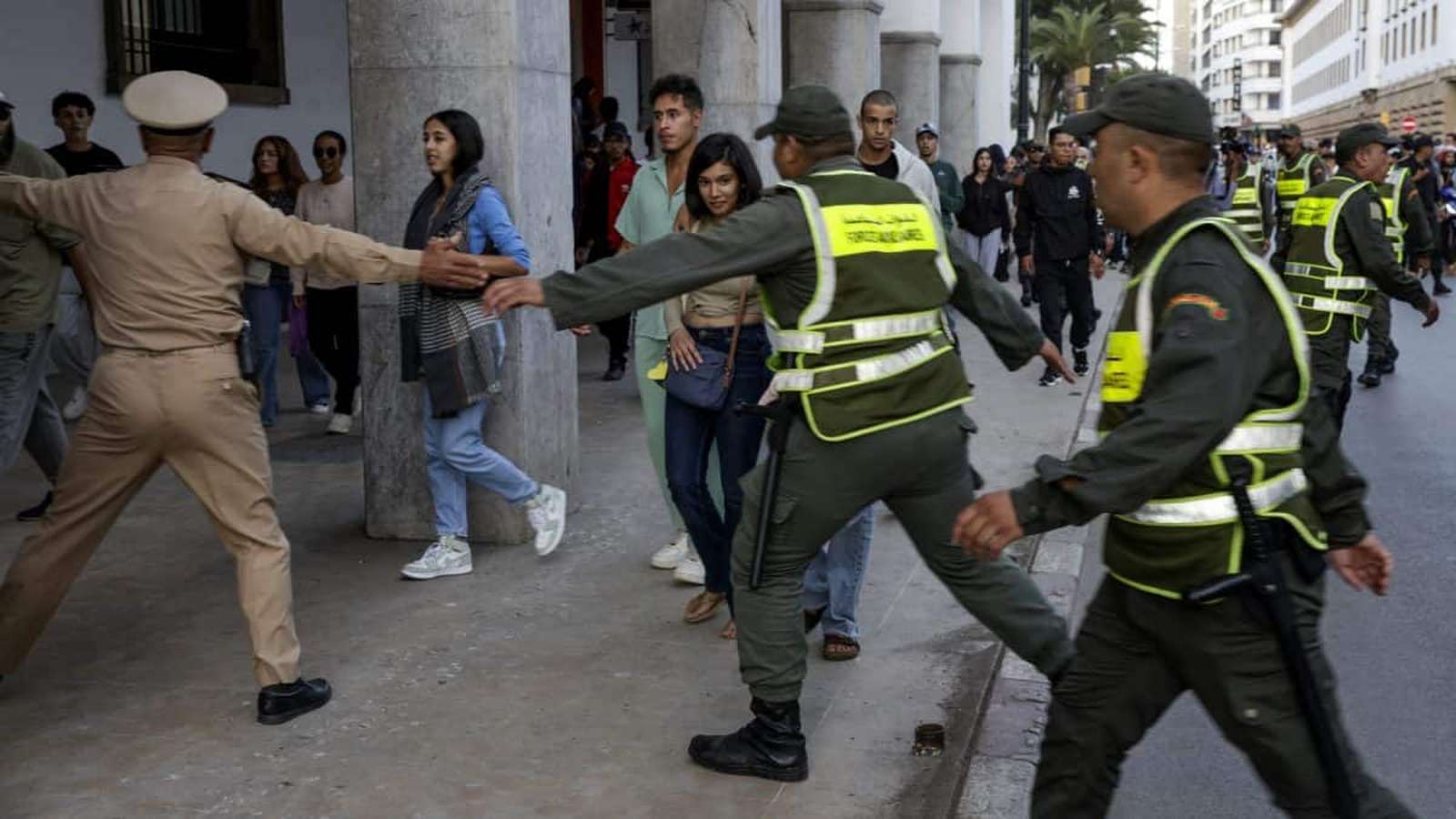
The government’s response has been forceful. Over the weekend, police in plainclothes and riot gear dispersed gatherings in at least 11 cities, from Rabat and Marrakech to Tangier and Agadir. More than 120 people were detained, according to the Moroccan Association for Human Rights (AMDH), though most were released soon after. Protesters and bystanders alike reported arbitrary arrests, with some being taken away simply for speaking to the press or holding a placard. Several videos showed police moving in before crowds could even chant their first slogans.
Unlike previous years’ anti-normalization protests—which authorities largely tolerated—the Gen Z rallies have been met with a heavier hand. Opposition parties, including the Islamist Justice and Development Party (PJD) and the Socialist Unified Party, have condemned the crackdown. The PJD blamed the government for “deteriorating social conditions” and urged young people not to turn away from politics, but to participate in elections and defend their dignity. The Socialist Unified Party even hinted at a potential boycott of the 2026 vote, warning that the arrests “took us back to years we thought we had left behind.”
“After parties were weakened, and civil society emptied of its real roles, these young people were forced to self-organize,” Mounib told The New Arab. “They are not against the system; they are against the injustices of daily life.”
The Generation in Crisis
Numbers tell a stark story. Morocco’s Generation Z—aged roughly 15 to 29—numbers about 8.2 million, nearly a quarter of the population. Expand that to include those up to 34, and youth represent almost 30%. Yet their prospects are bleak. Official data shows youth unemployment at nearly 37% for ages 15-24 in cities, and 26% for ages 25-34. A report by the Economic, Social and Environmental Council found that 4.3 million Moroccans, including 1.5 million young people, are neither in work, education, nor training. Each year, 250,000 students leave school with no diploma or clear path forward.
Economic growth has hovered around 3%—far short of the 6% envisioned by Morocco’s development plans. The government has promised to create a million jobs over five years, but so far, most efforts have relied on short-term programs like “Forsa,” leaving many young people feeling abandoned.
“There is no hope,” said Youssef, a 27-year-old engineer in Casablanca, speaking to NBC News on the condition of anonymity. “I not only want health and education reforms, I want a whole system reform. I want better salaries, better jobs, low prices and a better life.”
Public Services or Prestige Projects?
The heart of the protests is a debate over priorities. Morocco is building at least three new stadiums and renovating half a dozen more, preparing to co-host the 2030 FIFA World Cup and the Africa Cup of Nations. Officials say these investments are necessary for national pride and economic growth. But young Moroccans see a disconnect: billions for stadiums, while schools are overcrowded and hospitals under-equipped. World Health Organization data from 2023 shows Morocco has only 7.7 medical professionals per 10,000 inhabitants—well below the WHO’s recommended 25 per 10,000, and far fewer in regions like Agadir.
Prime Minister Aziz Akhannouch has defended the government’s record, insisting that reforms are underway and that health sector challenges are inherited from previous administrations. After the Agadir hospital deaths, the health minister fired several regional officials, but critics argue that systemic underfunding and lack of oversight remain.
A Movement Without a Roadmap?
Despite the mass arrests, Gen Z 212 and allied groups like Morocco Youth Voices have vowed to continue their campaign. “Protesting is the only way to win our rights,” one demonstrator told an older man trying to dissuade him. Organizers have called for future rallies, leveraging their digital networks to mobilize supporters and spread their message.
As Morocco approaches parliamentary elections in 2026, and with the world’s eyes set on its stadiums, the government faces a stark choice: open dialogue and address youth grievances, or risk further unrest. Several celebrities and television presenters have joined the call for dialogue, emphasizing that protesters’ demands fall squarely within their constitutional rights.
For now, the streets—and the Discord servers—remain alive with debate, frustration, and hope. The story of Gen Z 212 is still being written. But one thing is clear: Morocco’s young generation has found its voice, and it refuses to be ignored.
Analysis: The Gen Z protests mark a seismic shift in Morocco’s political landscape. Unlike earlier, party-driven movements, this digitally native generation is leaderless, persistent, and laser-focused on social justice over ideology. Their demands—jobs, healthcare, dignity—are universal, echoing global youth frustrations. As Morocco prepares for elections and international scrutiny, the government’s willingness to listen and adapt may well determine whether these protests become a catalyst for meaningful reform or a harbinger of deeper disillusionment.