


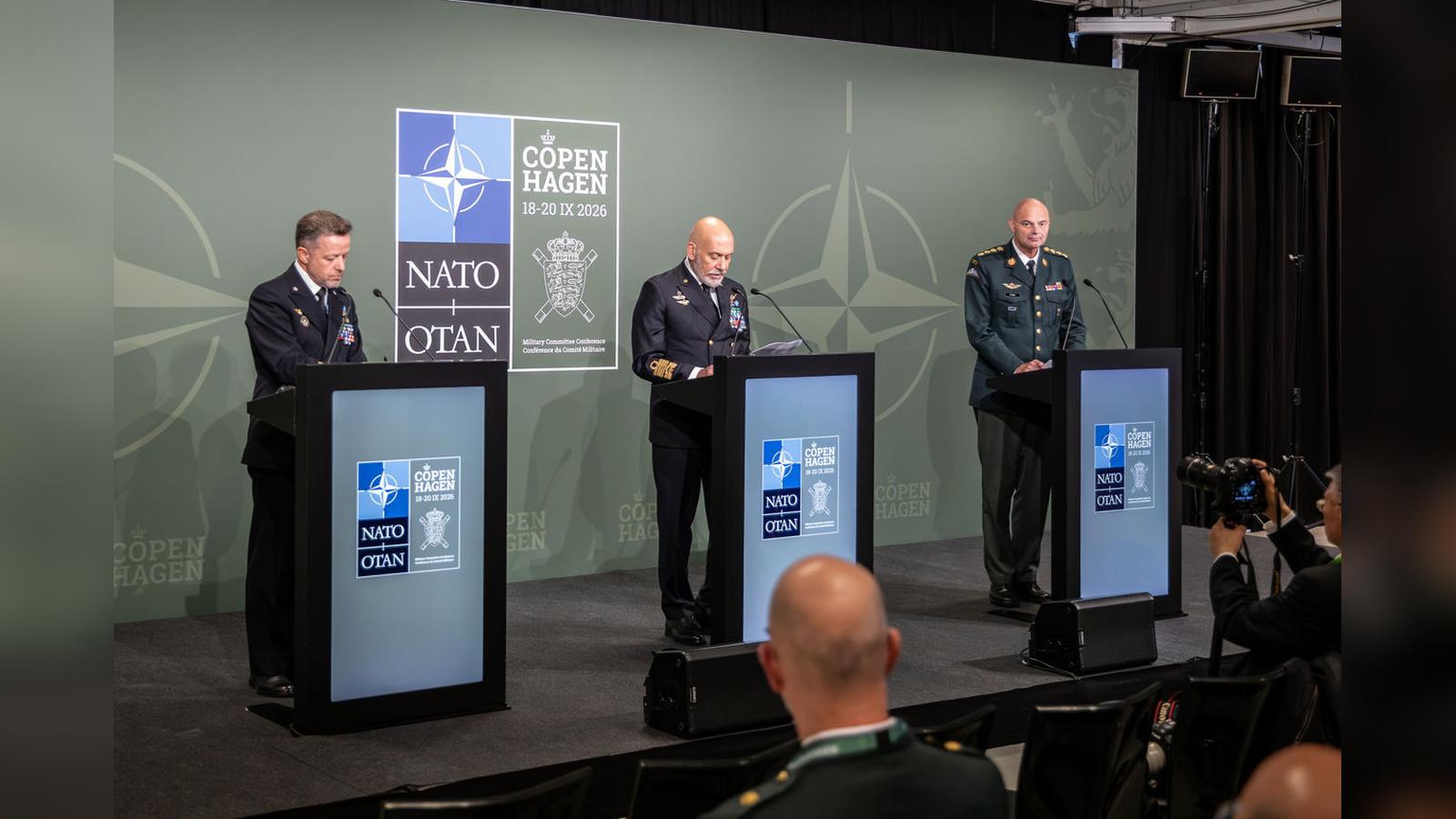
The convergence of 32 allied chiefs of defense in Copenhagen on September 18–19, 2026, marked a critical pivot in NATO’s operational posture. Historically, military summits of this caliber conclude with carefully parsed diplomatic communiqués. However, the NATO Military Committee Conference report reveals that this gathering produced what was effectively a massive, coordinated military shopping list. Under the leadership of Admiral Giuseppe Cavo Dragone, Chair of the NATO Military Committee, and flanked by Strategic Commanders General Alexus Grynkewich (SACEUR) and Admiral Pierre Vandier (SACT), the alliance issued an unprecedented ultimatum to the Western defense industry: deliver military hardware with speed, scale, and long-term predictability.
The Industrial Bottleneck and the Air Domain
The core tension of the Copenhagen summit centered on the gap between political commitments and industrial reality. While the previous Ankara Summit set ambitious targets to expand manufacturing capacity, remove trade barriers, and establish the “Front Door for Industry,” military commanders are finding that these initiatives have yet to yield sufficient production. Admiral Cavo Dragone emphasized that the alliance is “ready to buy at scale,” but noted that manufacturers require predictable, multi-year order books rather than rhetorical encouragement to justify expanding their production lines.
This delivery crisis is most acute in the air domain. Modern combat aircraft ordered today require years to manufacture, and the pilot training pipeline is heavily constrained by the availability of trainer jets. This bottleneck directly impacts European airspace security, which has experienced a sharp increase in Russian provocations, including scrambled fighter jets over the Baltic region, unexplained incursions along the eastern flank, and drone activity that temporarily closed a commercial airport in Luxembourg.
The Shadow of Russian Hybrid Warfare
The operational urgency in Copenhagen was further heightened by intelligence assessments detailing an escalating wave of Russian hybrid campaigns across Western Europe. According to a report by The Jerusalem Post, Western intelligence agencies warn that Russian President Vladimir Putin is preparing for a significant escalation following the State Duma elections. This expected surge is projected to involve stealth mobilization inside Russia alongside intensified sabotage, cyberattacks, and espionage across NATO territory.
European defense officials have documented a steady rise in these non-traditional security threats. Recent examples include a drone incident at Leipzig airport, which German Foreign Minister Johann Wadephul described as part of a broader pattern of Russian hybrid actions. In the United Kingdom, legal proceedings recently commenced against a British national accused of gathering intelligence on drone manufacturing facilities for Russian intelligence services. In response to these developments, French President Emmanuel Macron directed officials to draft comprehensive protection plans for critical national infrastructure, while Polish Prime Minister Donald Tusk warned that Russia may execute direct provocations against European nations supporting Ukraine to test the alliance’s collective resolve.
The Transatlantic Rift and the Drive for Autonomy
Adding to the strategic complexity is the shifting relationship between Europe and its primary security guarantor, the United States. Reports indicate that the Pentagon is considering withdrawing up to one-third of the roughly 100,000 U.S. troops currently stationed in Europe, along with associated air defense assets and naval vessels. This follows a previous decision by U.S. President Donald Trump to withdraw 5,000 troops from Germany, a move driven by demands that European allies assume a greater share of the defense burden and demonstrate stronger strategic alignment on global issues, such as U.S. policy toward Iran.
This potential reduction in U.S. military presence has accelerated European efforts to diversify defense procurement away from American suppliers. European governments are increasingly investing in domestic defense industries to build conventional military capability. Germany, for example, has significantly revised its defense posture since suspending mandatory conscription in 2011. Berlin now aims to expand the Bundeswehr into Europe’s strongest conventional army, targeting a force of over 500,000 active personnel. Concurrently, Germany is establishing a permanent brigade in Lithuania, constructing border infrastructure in eastern Poland, and conducting joint exercises with Sweden to secure the strategic island of Gotland in the Baltic Sea.
Securing the Eastern Flank
The immediate security challenges on the alliance’s eastern border were a primary focus for regional military leaders. General Wiesław Kukuła, Chief of the General Staff of the Polish Armed Forces, met directly with SACEUR General Alexus Grynkewich to advocate for the rapid integration of air defense systems along the joint NATO-EU eastern frontier. Polish officials remain highly concerned that Russian strikes targeting Ukrainian infrastructure near the border could lead to “accidental” incursions into Polish airspace, serving as a low-threshold test of NATO’s operational readiness.
As the Military Committee prepares for its next plenary meeting in Brussels in January 2027, the alliance faces a dual challenge: it must rapidly scale up domestic industrial production while managing immediate hybrid threats along its borders. The election of General Carsten Breuer, Germany’s Chief of Defence, as the next Chair of the Military Committee starting in summer 2027 further signals Europe’s shifting leadership dynamic, placing Berlin at the center of the continent’s evolving defense strategy.