


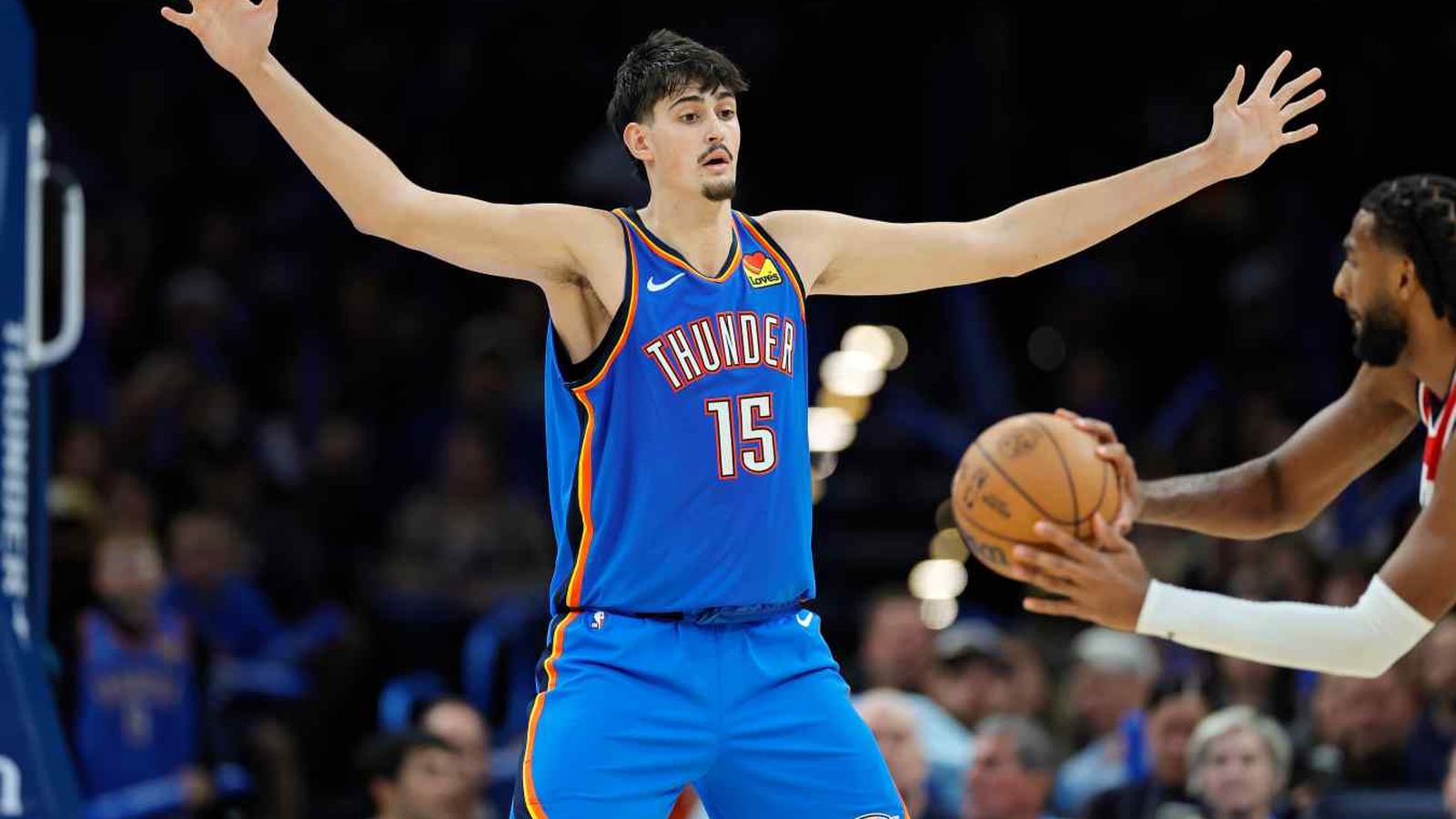
A New Setback for Oklahoma City
The Oklahoma City Thunder are navigating a deepening roster crisis as the team grapples with an mounting injury report. Most recently, 7-foot-3 rookie center Aday Mara has been ruled out of upcoming action due to a left shin contusion. This injury, sustained during an NBA Cup victory over the New Orleans Pelicans on Friday, November 21, 2026, serves as a stark reminder of the team’s current vulnerability. Despite fighting through the discomfort to record a career-high 22 points and 16 rebounds in that specific contest, Mara experienced lingering soreness that forced the organization to scratch him from their subsequent matchup against the Miami Heat. Furthermore, his status remains day-to-day, confirming his absence for the upcoming game against the Indiana Pacers.
Mara’s current injury represents a significant blow to a frontcourt that was already struggling to compensate for the long-term absence of Chet Holmgren. Drafted 12th overall out of Michigan, the Spanish center was thrust into a starting role far earlier than many analysts initially projected. Across 16 games this season, he has averaged 10.0 points, 7.1 rebounds, and 1.7 blocks in 22.4 minutes per game, while shooting a highly efficient 64.9% from the field. His physical presence and defensive versatility under head coach Mark Daigneault were intended to be a cornerstone of the team’s identity, particularly in pick-and-roll sets alongside Shai Gilgeous-Alexander. However, his current unavailability leaves the Thunder in a precarious tactical position, forcing the coaching staff to rely on less experienced options to anchor the paint.
The Fragility of Modern Depth
The current injury situation underscores the broader volatility of the Thunder’s roster construction, which has faced immense strain throughout the early months of the 2026-27 campaign. As detailed in coverage by CBS Sports, the organization is navigating a difficult transition period following the departure of key rotational players such as Lu Dort, Aaron Wiggins, and Isaiah Joe. These departures, largely necessitated by payroll constraints and the rigid financial implications of the league’s second-apron restrictions, have effectively eliminated the massive, interchangeable depth that once defined the franchise’s competitive advantage. The team is now experiencing the direct consequences of moving away from a high-depth model toward one that requires significant production from unproven rookies.
The depth issue reached a critical inflection point during the recent game against Miami, where the Thunder were without eight rotation players. Beyond the long-term absences of Jalen Williams—who suffered a season-ending leg injury—and Cason Wallace, who is undergoing surgery to repair a torn labrum in his left shoulder, the team has had to manage minor injuries for major stars. Shai Gilgeous-Alexander has battled back and neck issues, while others like Jaylin Williams (low back spasms) and Alex Caruso (hip soreness) have forced the front office to scramble. The reliance on rookies like Mara to carry heavy minutes in the paint was a high-variance strategy that has now been severely tested by the relentless physical toll of an early-season schedule.
Tactical Adjustments and Future Outlook
For head coach Mark Daigneault, the immediate goal is to stabilize a rotation currently forced to integrate unproven talent under extreme duress. While Mara has expressed a clear desire to improve and contribute, his developmental trajectory is now interrupted by the very physical demands he was tasked with managing since training camp. The coaching staff has focused on Mara’s defensive potential, utilizing him as a rim protector and a vertical lob threat, but the transition to the NBA level is compounded when such a significant share of the team’s core is sidelined simultaneously.
The organizational philosophy, spearheaded by Sam Presti, continues to face scrutiny as the season progresses. While the front office maintained that the roster was built for long-term sustainability, the current injury crisis has forced a shift in focus. The team is now essentially in a holding pattern, hoping that rest will prove sufficient to return their rookie center to the floor while evaluating whether current internal solutions are enough to remain competitive in the Western Conference. With trade rumors beginning to swirl regarding potential mid-season acquisitions, the upcoming stretch of games will be crucial in determining whether Oklahoma City stands pat or seeks reinforcements.
As it stands, Shai Gilgeous-Alexander remains the team’s lighthouse, with potential MVP-caliber production required to keep the team in the top four of the conference. His ability to elevate the play of the remaining roster members will determine the urgency of any front-office moves before the trade deadline. The hope remains that once Holmgren returns from his right knee procedure in early 2027, the team can re-integrate its defensive identity. Until then, the Thunder must continue to navigate this thin-margin environment, characterized by rapid adaptation and the development of young players under pressure.