


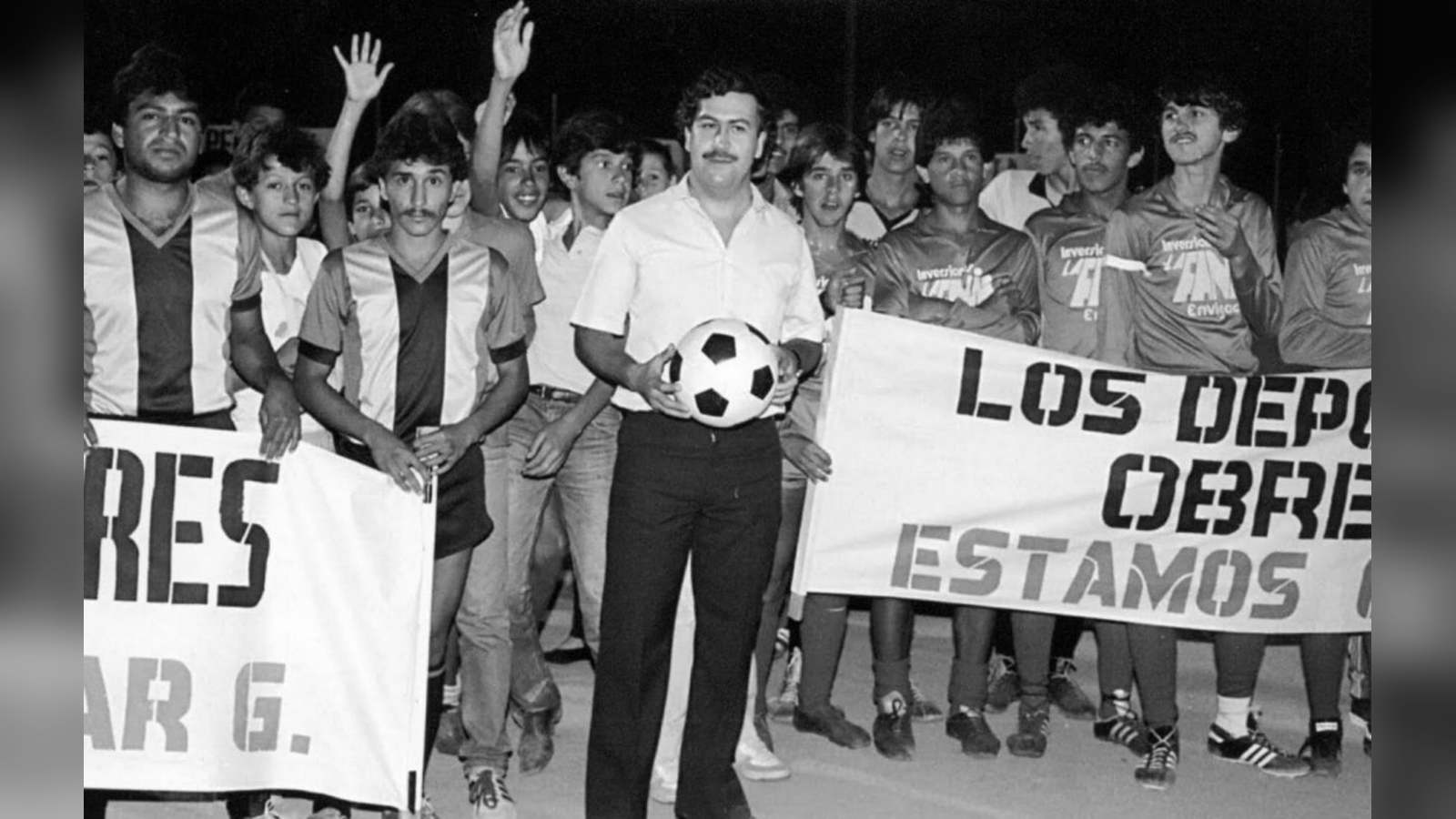
In this photograph from 1982, Pablo Emilio Escobar Gaviria does not look like the fugitive narco-terrorist who would later bring Colombia to its knees. Instead, the frame captures an affable, smiling neighborhood patron standing before a packed crowd in one of Medellín’s marginalized hillside barrios. Surrounding him are local residents, wide-eyed neighborhood boys, and community organizers gathered for the inauguration of a freshly built, floodlit soccer field. The image captures a pivotal instant in modern Colombian history: the exact threshold where illicit drug wealth transformed into civic populism, masquerading as public redemption just months before the veneer collapsed into total war.
What the photograph shows
The composition centers entirely on Escobar, who commands the gathering with effortless familiarity. Dressed in the modest, open-collared casual attire of an aspiring populist politician—complete with his trademark thick mustache and dark, parted hair—he appears approachable rather than menacing. There are no visible weapons, no heavily armed bodyguards in the immediate foreground, and no ostentatious displays of billionaire excess. Around him, the crowd presses close: working-class men in simple shirts, women holding children, and young boys gazing at the dirt pitch with genuine excitement.
Behind the central figures stands the infrastructure itself—a level clearing fitted with soccer goalposts and tall metal poles carrying electrical floodlights, a luxury virtually unheard of in Medellín’s impoverished comunas at the time. The lighting of the scene, whether under the glare of those newly wired bulbs or the harsh midday sun of Antioquia, illuminates faces shaped by poverty looking toward a man who brought them electricity and sport when the municipal government offered nothing. The direct visual evidence shows an authentic celebration of civic progress, masking entirely the criminal enterprise funding every grain of soil beneath their feet.
The moment behind the image
In 1982, Pablo Escobar was orchestrating an audacious dual campaign. As the undisputed mastermind of the Medellín Cartel, he was already smuggling dozens of tons of cocaine each month into the United States, generating tens of millions of dollars weekly. Yet rather than hiding in the shadows, Escobar hungered for social legitimacy and institutional power. He launched an aggressive philanthropic offensive under the civic banner of Medellín sin tugurios (Medellín Without Slums), funding the construction of homes for more than five hundred families living in the Moravia municipal garbage dump, opening health clinics, and laying dozens of illuminated soccer pitches across the city’s poorest sectors.
This photograph captures the opening ceremony of one of those athletic grounds. In the neglected barrios of Medellín, where nightfall usually meant pitch darkness and soaring street crime, floodlit sports fields were a revolutionary gift. They allowed young men to play evening tournaments, brought families outdoors after working hours, and established Escobar as a living folk hero. That same year, riding this wave of local adulation, Escobar secured election to the Colombian Chamber of Representatives as an alternate member for the Liberal Party, gaining parliamentary immunity and a seat in the national capitol in Bogotá.
Photographer and provenance
Many of the defining images of this political and civic era were captured by Edgar Jiménez, widely known by his childhood moniker ‘El Chino’. Jiménez had been a high school classmate of Escobar at the Liceo Antioqueño in Medellín during the 1960s. After losing touch for fifteen years, the two crossed paths again in 1980 at Escobar’s lavish ranch, Hacienda Nápoles. Recognizing his old friend, Escobar promptly dismissed his existing camera operators and hired Jiménez as his trusted, exclusive personal photographer.
Working without a fixed contract, Jiménez accompanied Escobar everywhere from private family baptisms and exotic wildlife enclosures to congressional campaign rallies, press conferences, and barrio inaugurations. Many of these photographs were taken on 35mm film specifically for local campaign materials, community flyers, and Medellín Cívico, a neighborhood newspaper edited by Escobar’s uncle to burnish his public image. While hundreds of Jiménez’s negatives were later lost, burned by paramilitary enemies, or destroyed by neglect, surviving rolls preserved in his modest Medellín home preserve this chilling visual chronicle: the photographic record of a mass murderer engineering his reputation as an untouchable savior.
Historical context: Football and the cartel state
Escobar’s investment in soccer pitches was far more calculated than mere sentimental generosity. The sport was Colombia’s national obsession, and by building pitches where national scouts visited and future professional athletes trained, Escobar created deep social roots. Several legendary Colombian footballers who emerged from these impoverished comunas grew up playing on fields leveled and lighted by cartel money.
Simultaneously, these pitches served as the primary recruiting pipeline for the cartel’s violent apparatus. The teenage boys who spent their evenings kicking balls on Escobar’s fields were the exact demographic targeted by cartel lieutenants to serve as sicarios—motorcycle-riding hitmen who received loyalty, money, and weapons from the man they revered as ‘El Patrón’. When Escobar faced pressure, the residents of these barrios formed a civilian wall of silence, providing safe houses and early warnings against police raids.
Why it still matters
The facade documented in this 1982 photograph did not last. Shortly after taking his seat in Congress, Escobar was confronted by Minister of Justice Rodrigo Lara Bonilla and investigative journalists from the newspaper El Espectador, led by editor Guillermo Cano. They unearthed a 1976 police mugshot documenting Escobar’s early arrest for drug smuggling, shattering his political legitimacy. Expelled from Congress in 1984, Escobar ordered the assassination of Lara Bonilla, initiating an era of assassinations, car bombs, and airplane bombings that claimed thousands of lives until his own death on a Medellín rooftop in December 1993.
The photograph of the soccer pitch inauguration remains indispensable because it captures the deceptive anatomy of narco-populism. It serves as an unsettling historical document of how illicit wealth exploits the failures of the state, demonstrating why millions of people were willing to celebrate a ruthless criminal baron simply because he brought floodlights and a ball to a forgotten neighborhood.