


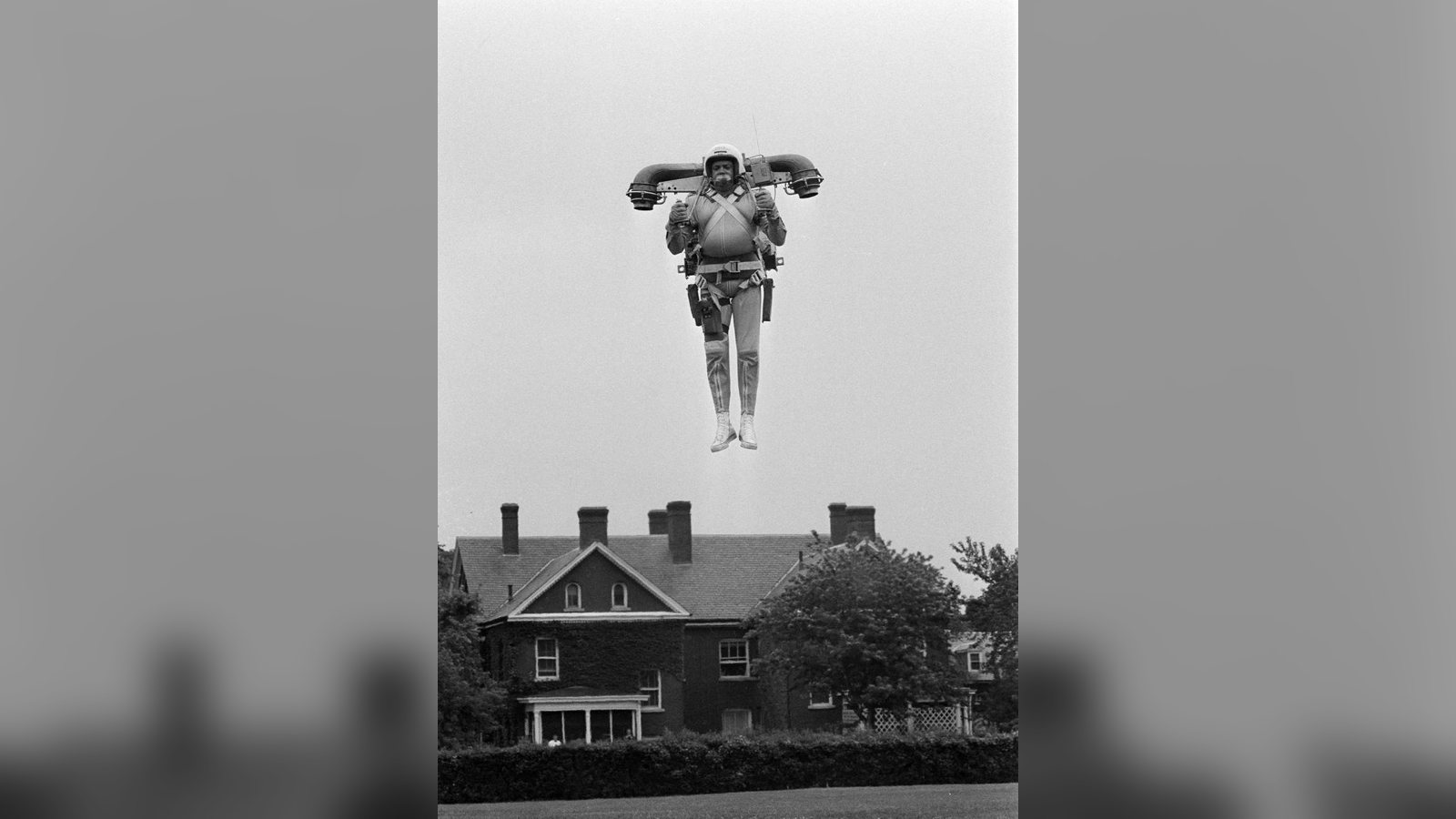
What the photograph shows
The photograph captures a moment of mechanical defiance against gravity: pilot Robert Courter is suspended several meters above the ground, his body braced within the harness of the Bell Jet Belt. The image emphasizes the raw, industrial nature of the device, with its prominent fuel tanks, exposed turbojet engine, and the visible exhaust plumes that hint at the immense power required to lift a human into the air. Courter’s posture is one of intense focus, his hands gripping the control levers that directed the thrust, while the backdrop of the airfield suggests a controlled, sterile testing environment far removed from the futuristic sky-high dreams the device was meant to inspire. The composition highlights the stark contrast between the pilot’s fragile human form and the complex, heavy machinery strapped to his back, creating a visual tension that defines the era’s approach to aerospace innovation.
The moment behind the image
Taken on April 7, 1969, at an airfield near Niagara Falls, this image documents one of the most successful test flights of the Bell Jet Belt. During this specific demonstration, Courter managed to fly in a circular path for approximately 100 meters at a height of seven meters, maintaining a speed of 45 km/h before executing a controlled landing. This was the culmination of four years of development by Bell Aerosystems, commissioned by the Advanced Research Projects Agency (ARPA) to determine if personal jet propulsion could be a viable tool for infantry mobility. The flight was not merely a stunt; it was a rigorous engineering assessment designed to prove that a turbojet engine could be safely harnessed to a human operator. The tension of the moment is palpable in the photograph, as Courter navigates the delicate balance between thrust and stability.
Photographer and provenance
The image originated as a press photograph, likely distributed by Bell Aerosystems to news agencies to showcase their technological progress. Like many archival news photos from the era, it bears the marks of its working life in a newspaper morgue—physical creases, editorial notes, and the distinct quality of a silver-gelatin print designed for quick publication. While the specific photographer remains uncredited, the image survives as a primary historical record of the Jet Belt’s brief public visibility. The provenance of such items often traces back to newspaper archives that were liquidated decades later, leading to the preservation of these prints in private collections and online marketplaces. The lack of a named photographer is typical for corporate-commissioned media from the late 1960s, where the technology itself, rather than the artistic eye of the shooter, was the primary subject of the release.
Historical context
The Bell Jet Belt was a sophisticated evolution of earlier rocket-belt designs, replacing hydrogen peroxide thrusters with a genuine turbojet engine. It was envisioned as a revolutionary leap in military technology, with theoretical top speeds reaching 135 km/h and flight durations of up to 25 minutes. However, the project was inextricably linked to its lead inventor, Wendell Moore. When Moore passed away from an illness on May 29, 1969—less than two months after this successful test—the momentum behind the program evaporated. Without his vision and technical leadership, the project was abruptly curtailed, leaving the Jet Belt as a fascinating, if ultimately experimental, footnote in the history of aviation. The era was defined by a belief that engineering could overcome any obstacle, a sentiment that fueled the Space Race and projects like the Jet Belt, which sought to bring flight out of the cockpit and onto the individual’s back.
Why it still matters
This photograph serves as a poignant reminder of the gap between mid-century optimism and engineering reality. In 1969, as the world looked toward the moon, the Jet Belt represented the democratization of flight—a belief that personal jetpacks would soon be as common as automobiles. While the technology proved too complex, fuel-hungry, and dangerous for mass adoption, the image remains an iconic piece of aerospace history, capturing the exact moment when the dream of the human-bird seemed within our grasp. It stands as a testament to the era’s audacity, capturing the spirit of a time when the boundaries of human mobility were being pushed to their absolute limit. Even today, as modern jetpacks make headlines, the 1969 image of Robert Courter remains the foundational visual reference for the concept of personal jet flight.