


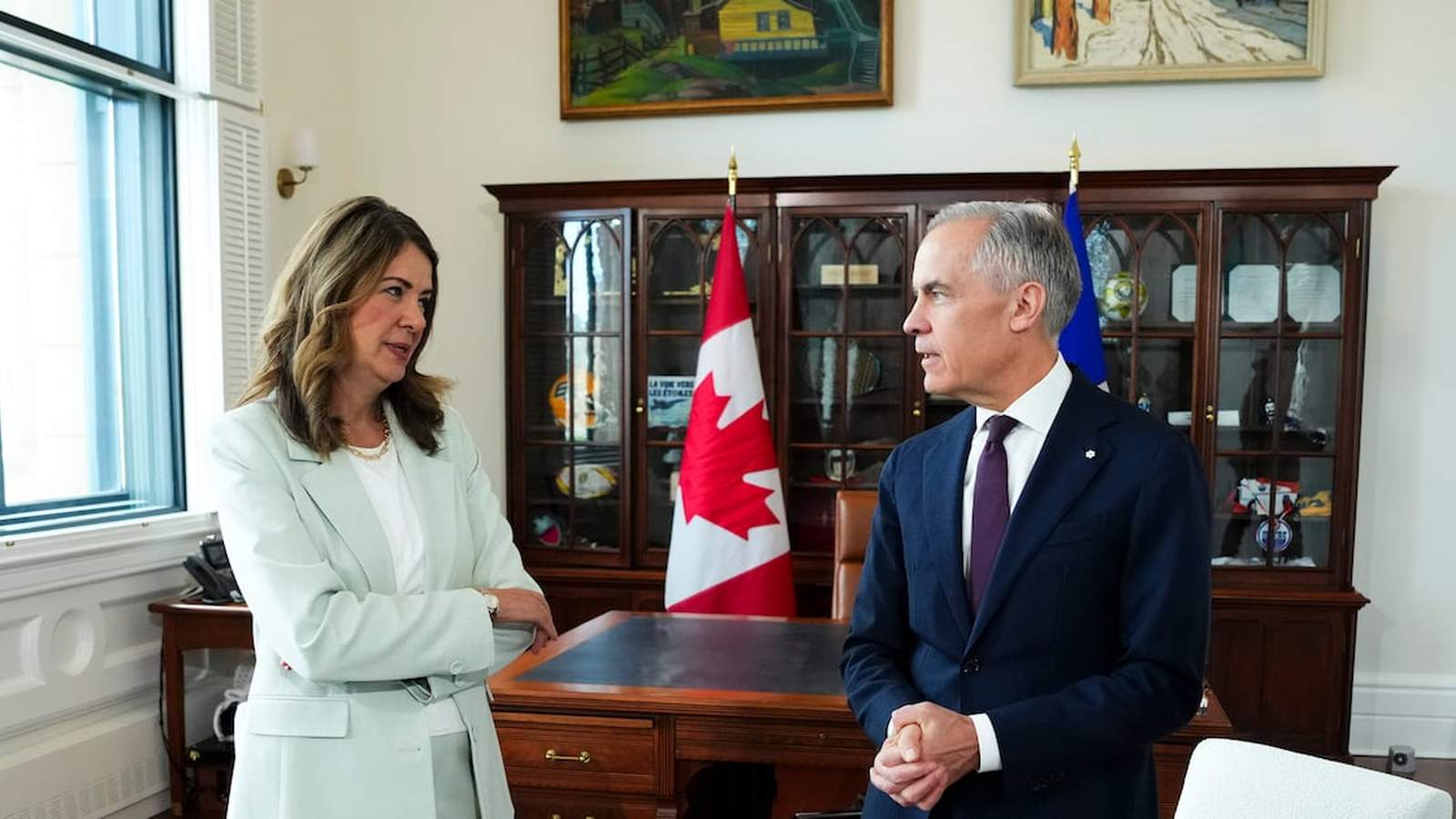
OTTAWA (Azat TV) – Alberta Premier Danielle Smith told Prime Minister Mark Carney on Friday that her province and its energy industry are growing increasingly impatient, demanding the finalization of a high-stakes energy agreement within days. Standing alongside the Prime Minister in Ottawa, Smith framed the pending Memorandum of Understanding (MOU) as a critical tool to blunt a rising separatist movement in Western Canada by proving that the federal system can still deliver results for Albertans.
The meeting, held ahead of Smith’s appearance at the 2026 Canada Strong and Free Networking Conference, focused on a cooperation pact that would outline the conditions for a new oil pipeline connecting Alberta’s landlocked resources to the Pacific Coast. While both leaders described their recent conversations as constructive, the province and the federal government have already missed an initial April 1 deadline to fulfill key elements of the agreement. Smith’s public insistence on a timeline measured in days signals a significant escalation in pressure on the Carney administration.
Premier Smith signals urgency in Ottawa talks
During the public portion of their meeting, Premier Smith was direct about the mood in her home province. She noted that while progress has been made, the lack of a finalized deal is fueling frustration among both industry stakeholders and the general public. Smith explicitly linked the completion of the MOU to the preservation of national unity, stating that a signed agreement would demonstrate to Albertans that Canada works for them. This comes as recent polling and political discourse in Alberta suggest a surge in separatist sentiment, a trend Smith appears to be using as leverage in federal negotiations.
Prime Minister Carney responded with cautious optimism, thanking Smith for her visit and asserting that his government is committed to making the federal-provincial relationship more effective. Carney stated that when Canada works well for Alberta, it benefits the entire country and the global market. However, the Prime Minister did not explicitly commit to the multi-day deadline requested by Smith, instead pointing to the track record of recent collaborative efforts as evidence that a resolution is forthcoming.
The energy MOU and Alberta’s separatist pressure
The proposed MOU is not merely a symbolic gesture but a complex framework involving billions of dollars in infrastructure and significant policy shifts. According to CTV News, the deal includes a commitment to streamline environmental impact assessments and a pledge from Alberta to reduce methane emissions by 75 percent from 2014 levels by the year 2035. The most contentious element remains the industrial carbon pricing agreement. Reports indicate that federal negotiators are pushing for Alberta to sign onto a system where credit prices would ramp up to a minimum of $130 per tonne, a figure that has historically met resistance in the oil-producing province.
The stakes for Premier Smith are internal as much as they are external. By securing a Pacific Coast pipeline route, she would deliver a long-standing priority for the Alberta energy sector. Conversely, failing to reach an agreement after months of high-profile negotiations could embolden her critics on the right who argue that Alberta’s interests are fundamentally incompatible with Ottawa’s agenda. Smith’s strategy appears to be a calculated gamble: using the threat of provincial unrest to extract favorable terms on carbon pricing and regulatory speed.
Regulatory reform and the carbon pricing impasse
The backdrop to Friday’s meeting is a broader legislative battle over how major energy projects are approved in Canada. Just this week, Alberta passed the Expedited 120-Day Approvals Act. Alberta Energy and Minerals Minister Brian Jean stated that this law is designed to put regulators on a clock, ensuring that major projects receive a decision within four months while maintaining environmental and Indigenous consultation standards. Smith has encouraged the federal government to follow Alberta’s lead in prioritizing regulatory certainty for investors.
In a parallel move, the Carney government announced consultations on Friday for proposed changes to federal environmental laws. Internal Trade Minister Dominic LeBlanc and Transport Minister Steven MacKinnon are leading an initiative to ensure that federal reviews for major development proposals take no longer than one year. While this represents a significant acceleration of federal timelines, it still lags behind Alberta’s 120-day target. The gap between these two regulatory visions remains a point of friction as both levels of government attempt to attract global capital to the energy sector.
As negotiations continue behind closed doors, the focus remains on whether the federal government will concede on carbon pricing flexibility in exchange for Alberta’s full cooperation on climate targets. For now, the clock is ticking on Smith’s self-imposed deadline, with the political stability of the West hanging in the balance. CPAC reported that the Premier is expected to provide further updates following her conference appearances, but the ultimate resolution rests on whether Carney is willing to meet the specific demands of a province that feels it has been left waiting for too long.
The strategic use of ‘impatience’ as a diplomatic tool suggests that Premier Smith is pivoting from a stance of confrontation to one of transactional urgency, betting that the Carney government fears provincial instability more than it fears compromising on carbon price specifics.