


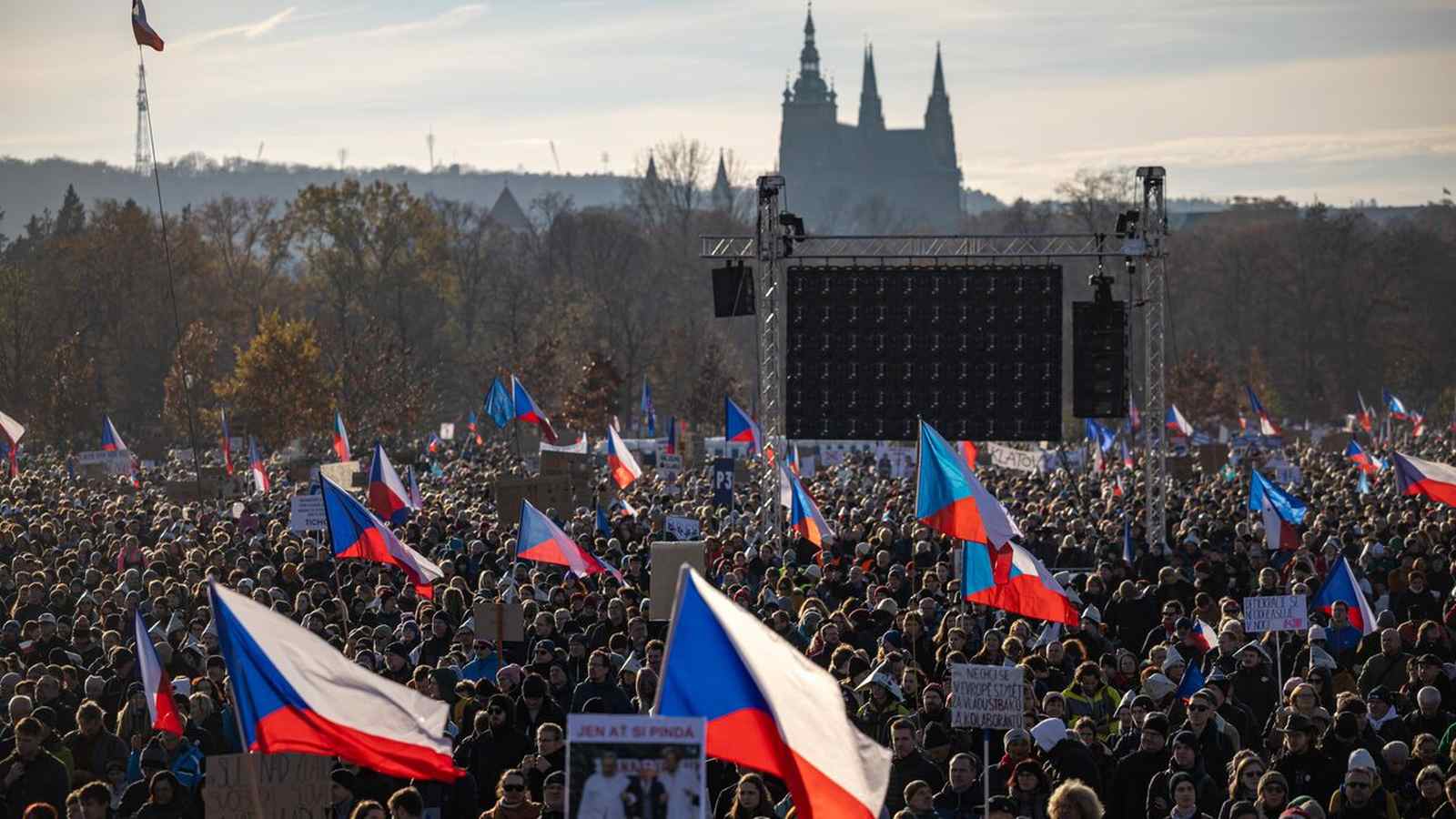
PRAGUE (Azat TV) – Tens of thousands of Czech citizens gathered in Prague’s historic Letna park on Sunday, November 15, 2026, to protest a government legislative proposal that would overhaul the funding system for public broadcasters. TVP World reported that the demonstration drew massive crowds ahead of the November 17 holiday commemorating the 1989 Velvet Revolution. Protesters clogged nearby metro stations and filled the front section near the stage, carrying signs and wearing pointed hats folded out of newspapers as a tribute to an iconic animated character from Czech Television nightly bedtime stories.
The large-scale demonstration highlights mounting public pushback against the populist government led by billionaire Prime Minister Andrej Babis. Backed by the far-right SPD and eurosceptic Motorists parties, the ruling coalition is advancing a bill that would cancel the current 205-crown ($9.26) monthly household broadcasting fee. Instead, public radio and television would receive direct financing from the state budget. Newser reported that the Million Moments for Democracy group organized the rally, with lead organizer Mikulas Minar telling the crowd, “We do witness here something extraordinary today. It’s just a beginning.”
The Legislative Battle and Budget Stakes
The controversial funding bill has already cleared a preliminary vote in Parliament, setting the stage for more intense legislative debates. The proposed overhaul carries significant financial implications for the media sector. Broadcasters would face an estimated 15% financing cut, which media organizations warn would reduce television’s nominal budget to 2008 levels and radio’s to 2005 levels. Workers and industry advocates argue these reductions are unworkable and would trigger widespread layoffs, program cancellations, and severely limited production.
Opposition lawmakers and critics argue that moving funding directly to the state budget fundamentally severs the financial link between broadcasters and paying viewers. They contend this structural shift renders public media highly susceptible to political interference. Demonstrators and civil society groups drew direct parallels to media control strategies implemented in neighboring Hungary under former Prime Minister Viktor Orban and in Slovakia under Prime Minister Robert Fico, warning that democratic checks and balances are at stake.
Government Justifications and Escalating Labor Resistance
Prime Minister Babis and his coalition defenders maintain that the policy fulfills a core electoral promise to alleviate financial pressures on citizens amidst economic challenges. The government has frequently accused both public and private media organizations of systemic bias, framing the funding reform as a corrective measure to ease household expenses.
Public media employees have actively resisted the legislative push prior to the Letna park rally. Broadcasters and technical workers staged a one-day strike earlier in November, resulting in noticeable broadcast curbs and receiving vocal backing from student and artistic communities across the country. Singer Sarka Dumisincova, speaking at the demonstration, captured the sentiment of many attendees: “For me, the media represent freedom. And the fact that someone here is trying to control that freedom is unacceptable to me.”
As the legislation moves closer to subsequent parliamentary readings, the political standoff between the populist cabinet and civil society organizations continues to deepen. The ongoing confrontation underscores fragile institutional dynamics within Central European public media ecosystems, leaving the long-term independence of Czech broadcasting hanging in the balance.