


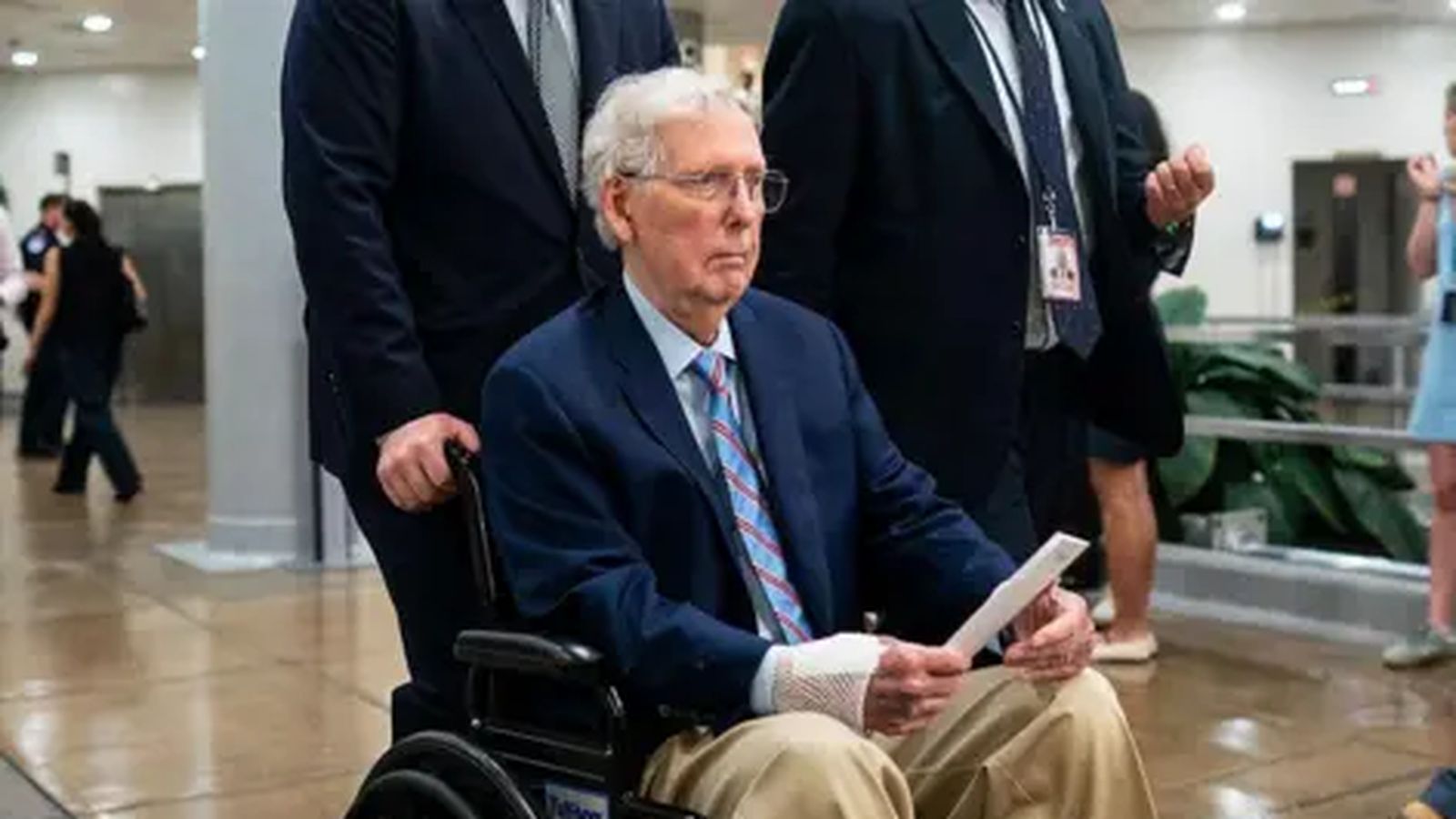
WASHINGTON (Azat TV) – U.S. Senator Mitch McConnell, the 84-year-old Kentucky Republican and longest-serving Senate party leader in American history, was discharged on Thursday from a rehabilitation center where he had been recovering for nearly two months following a severe fall in mid-June. McConnell announced that he will continue his medical recovery and intensive physical therapy from his home.
According to official statements released by his office and reported by NBC News and the BBC, McConnell expressed gratitude to his medical team, supporters, and the people of Kentucky. “Earlier today, I was discharged from the rehabilitation center to continue my recovery at home. Elaine and I are grateful for the many well wishes and support from friends, colleagues, and Kentuckians,” McConnell said, referring to his wife, former Transportation Secretary Elaine Chao. While the senator confirmed he will continue to engage with staff and colleagues on Senate business, he did not provide a specific timeline for his physical return to the Senate floor, which is scheduled to begin a five-week recess shortly.
Details of the June Fall and Medical Status
McConnell’s prolonged absence began following a hospitalization on June 14. For weeks, his office maintained strict secrecy regarding his condition, which sparked intense speculation and criticism from political opponents and transparency advocates, including Kentucky Governor Andy Beshear. On July 12, McConnell broke his silence, confirming he had fallen at home and was “briefly unconscious.” He also revealed that he had contracted a mild case of pneumonia while hospitalized, which was treated with antibiotics.
The senator’s recovery was reportedly prolonged due to complications related to having had polio as a child. Despite public concern, McConnell’s July statement sought to dispel rumors of severe neurological damage. “My doctors have confirmed that I didn’t break any bones or suffer a concussion,” he stated. “I didn’t have a heart attack or a stroke. I don’t have any tumors or hemorrhages.” However, local emergency records obtained during his absence complicated this narrative; police scanner audio obtained by NBC News indicated that paramedics had performed CPR for a “cardiac arrest” at McConnell’s residential address on the night of his fall.
Legislative Impact and Missed Votes
McConnell’s physical absence has had a measurable impact on legislative proceedings in Washington. Since his hospitalization in mid-June, the veteran lawmaker has missed 51 Senate floor votes. Among the critical actions he is expected to miss is the upcoming high-profile vote to confirm Todd Blanche for attorney general, should it proceed before the recess.
Despite his inability to attend floor sessions, McConnell has insisted that he remains actively involved in key policy discussions. His office released a photograph on July 27 showing him smiling alongside his wife, Elaine Chao, in an effort to reassure the public and his colleagues of his cognitive engagement. On the advice of his physicians, he will maintain an intensive regimen of physical therapy at home during the upcoming state work period.
A History of Health Challenges and Political Transition
This latest hospitalization is part of a series of health setbacks McConnell has faced in recent years. In February 2026, he was hospitalized for a week due to severe flu-like symptoms. In 2023, he suffered a concussion and a broken rib after tripping at a Washington hotel, an incident followed months later by two highly publicized episodes where he froze mid-sentence during press conferences, raising widespread concerns about his mental and physical fitness for office. Additionally, McConnell fractured his shoulder in 2019 after a fall at his home in Kentucky.
McConnell, who is currently one of the oldest members of the Senate alongside Chuck Grassley (R-Iowa, 92) and Bernie Sanders (I-Vt., 84), has already announced that he will not seek reelection. He is scheduled to retire from the Senate at the end of his current term in January 2027, marking the end of a highly influential legislative career that spanned over four decades.