


As the calendar turns to 2026, fans of the critically acclaimed medical drama, The Pitt, eagerly welcomed its second season with a premiere titled “7:00 a.m.” set against the backdrop of a bustling Fourth of July. The episode, which picks up roughly ten months after the harrowing events of the Pitt Fest mass casualty incident, immediately plunged viewers back into the high-stakes world of the Pittsburgh Trauma Medical Center (PTMC). But it wasn’t just the familiar faces or the holiday chaos that captured attention; it was a single, striking visual that ignited immediate conversation: Dr. Michael “Robby” Robinavitch (Noah Wyle) roaring to work on his motorcycle, conspicuously without a helmet.
This seemingly small detail became a focal point for discussion among viewers, particularly given the show’s reputation for medical accuracy. Why would a seasoned emergency room doctor, someone who regularly treats the consequences of such recklessness, engage in it himself? The answer, according to showrunner R. Scott Gemmill and executive producer John Wells, was entirely intentional. As Gemmill explained to The Hollywood Reporter, while Pennsylvania law permits riding without a helmet, Robby’s choice was designed to reflect his current, perhaps fraught, mindset.
Dr. Robby’s Risky Ride and the Adrenaline Junkie Ethos
The image of Dr. Robby on his motorcycle, helmetless, was far from an oversight; it was a deliberate narrative choice meant to peel back the layers of a character known for his leadership and dedication. “It shouldn’t be how he is,” Gemmill noted, hinting at deeper internal conflicts that will unfold throughout the season. This act of defiance, a surgeon exposing himself to unnecessary risk, serves as an immediate visual metaphor for the psychological landscape of many emergency medical professionals.
John Wells, drawing from decades of experience chronicling the lives of ER doctors and nurses, first with ER and now The Pitt, elaborated on this phenomenon. He described many emergency department staff as ‘adrenaline junkies,’ individuals who thrive on high-stakes situations not just in their professional lives but also in their leisure. “ER docs are oftentimes also skydivers, base jumpers; they dive to ridiculously low depths in ice cold water for fun. They are climbers. It’s who they are. They like the thrill of it,” Wells shared. This duality highlights a compelling hypocrisy: medical professionals who preach safety often engage in risky behaviors themselves, a sentiment Wells encapsulated as “an awful lot of doing what I say, not as I do.”
Noah Wyle, who not only stars but also contributes as a writer, producer, and director, offered a broader insight into the season’s thematic arc. He suggested that the first half of the season would see characters projecting an idealized version of themselves – ‘the people that they want to be perceived as being.’ The latter half, if successful, would then meticulously deconstruct these projections, exposing them through a ‘more intense lens’ to reveal the underlying ‘pathology that really is.’ Robby’s helmetless ride, therefore, isn’t just about a moment of recklessness; it’s the opening salvo in a season-long exploration of identity, self-perception, and the hidden struggles of those who save lives.
The AI Frontier: Dr. Al-Hashimi’s Disruptive Arrival
Adding another layer of dynamic tension to the PTMC is the arrival of Dr. Baran Al-Hashimi (Sepideh Moafi), the new attending physician slated to cover for Robby during his planned three-month sabbatical in the Badlands. From their very first encounter on Robby’s last shift before his break, the friction between them is palpable. Dr. Al-Hashimi, a proponent of artificial intelligence in medicine, arrives with a clear vision for modernizing the emergency department, a stark contrast to Robby’s more ‘old school’ approach.
Moafi described her character’s initial impression of Robby as one of being ‘taken aback… by the cowboy nature of the pit and his leadership style,’ which she perceives as ‘messy, chaotic, and by her definition, maybe a bit unprofessional.’ Yet, beneath the initial clash, there’s a mutual fascination. They are ‘diametrically opposed in so many ways,’ Moafi explained, ‘and yet the goal is the same. It’s about the patients.’ This dynamic promises a compelling exploration of differing philosophies in patient care and hospital management.
Gemmill revealed that Dr. Al-Hashimi was specifically created to introduce the ‘existential issue’ of AI’s growing influence across industries, including healthcare. Her tech-forward perspective clashes directly with Robby’s reticence, creating fertile ground for conflict. Moafi herself experienced a shift in her own views on AI while researching the role, particularly after reading Eric Topol’s Deep Medicine. She now sees AI’s potential to alleviate the severe burden on physicians, allowing them to dedicate more time to patients rather than administrative tasks. “If we’re able to delegate some responsibility, allow AI, with the supervision of nurses and doctors, to take over more of the admin responsibility, then the doctors can attend to their patients more effectively,” she asserted, highlighting the deeply human-centric motivation behind Al-Hashimi’s seemingly radical ideas.
Dr. Al-Hashimi also finds allies in the pit. Former VA colleagues, Dr. Samira Mohan (Supriya Ganesh) and Dr. Mel King (Taylor Dearden), are aligned with her progressive approach. Ganesh noted Samira’s inspiration from Al-Hashimi, while Dearden praised Al-Hashimi’s calm demeanor and succinct, encouraging words, which provide ‘ease’ to the younger doctors.
Familiar Faces, New Challenges: Growth and Redemption
The ten-month time jump between seasons one and two also brings significant shifts for other beloved characters. Young physicians like Dennis Whitaker (Gerran Howell) have matured dramatically. Once a med student, Whitaker is now an official doctor, stepping confidently into his role and even beginning to teach new medical students. Howell expressed his excitement about this progression, noting the necessity of shedding the ‘fear of that nightmare of a first shift’ to survive the demanding ER environment.
Similarly, Dr. Mel King (Taylor Dearden) has gained a new sense of composure, no longer plagued by ‘first-day jitters.’ While she now has ‘more of a hold on everything,’ the premiere hints that this newfound confidence may face an immediate test. Dr. Samira Mohan (Supriya Ganesh) continues to grapple with the emotional fallout from the Pitt Fest mass casualty incident, a ‘complicated moment’ that, despite its tragedy, has fostered a deeper sense of self-trust within her.
The premiere also marks the return of Dr. Frank Langdon (Patrick Ball), who has completed rehab for his benzodiazepine addiction. His ‘apology tour’ is met with mixed reactions; while some nurses offer a warm welcome, Dr. Robby remains unforgiving, assigning Langdon to triage rather than patient care. The tension escalates as Trinity Santos (Isa Briones) voices suspicions that Langdon may still be stealing benzodiazepines, a revelation that further fuels Robby’s fury and leads to Langdon being sent home.
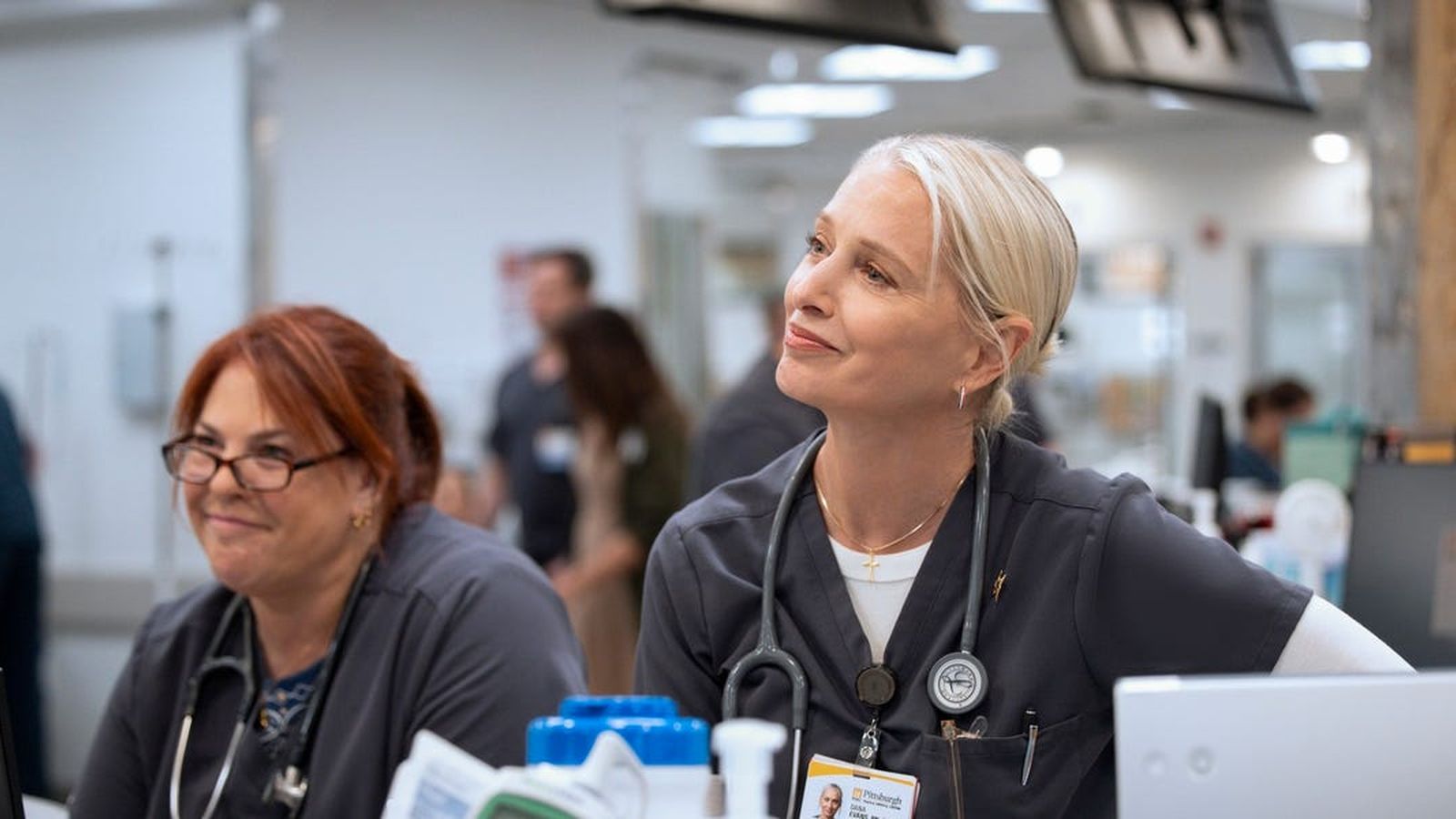
Another welcome return is that of charge nurse Dana Evans (Katherine LaNasa), whose powerful performance in Season 1 earned her an Emmy and Critics’ Choice Award. Dana, who had threatened to quit after being attacked, is back and quickly takes new nursing graduate Emma Nolan (Laëtitia Hollard) under her wing. Their dynamic is set to be a significant arc, with Emma helping Dana rediscover the core reasons she entered nursing in the first place. The episode also introduces new medical students Joy Kwon (Irene Choi) and James Ogilvie (Lucas Iverson), further expanding the PTMC family.
Through a series of intense patient cases – from a man with a kitchen knife to his chest, to a young girl with multiple injuries, an elderly woman self-medicating with marijuana, and an abandoned baby whose treatment causes Dr. Al-Hashimi to dissociate – the episode deftly weaves individual character arcs with the relentless demands of emergency medicine. These vignettes not only showcase the doctors’ evolving skills but also highlight their personal vulnerabilities and the constant emotional toll of their work.
Beyond the ER: Real-World Healthcare and Industry Seismic Shifts
The Pitt has consistently distinguished itself by grounding its dramatic narratives in real-world healthcare issues. Producers Gemmill, Wells, and Wyle have extensively consulted with experts to ensure authenticity, a commitment that continues into Season 2. Upcoming episodes are set to explore the profound impact of mass layoffs, funding cuts, and changes to Medicaid on patient care and the lives of healthcare workers. Gemmill emphasized that the show prioritizes character arcs first, then finds medical stories that organically fit, ensuring the series remains more than just a ‘medical documentary.’
Beyond the hospital walls, The Pitt itself exists within a rapidly changing media landscape. The proposed Netflix deal to acquire Warner Bros., the parent company of Warner Bros. Television (which produces The Pitt for HBO Max), casts a long shadow of uncertainty over the industry. Wells, a veteran of several Warner Bros. sales, voiced concerns about a potential ‘reduction in the number of places that we can sell shows’ and the overall instability, noting that ‘it’s a scary time in the businesses as a whole.’
Wyle echoed these sentiments, acknowledging the ‘seismic shifts’ and ‘huge pillars fall[ing]’ within the industry. While hopeful that The Pitt, an Emmy-winning series recently renewed for a third season, would be viewed as a ‘crown jewel worth maintaining,’ he also mused on the potential for this consolidation to birth a new, ‘more grassroots’ and ‘democratically run’ industry, reminiscent of the early days of cinema.
In a break from the prevalent binge-watching model, HBO Max continues its weekly rollout of The Pitt episodes, a strategy supported by both Wells and Wyle. They believe this approach fosters anticipation and allows audiences to engage with the show as ‘appointment viewing,’ building a deeper connection and facilitating weekly discussions, much like traditional network programming.
The Pitt Season 2 premiere masterfully sets the stage for a season rich in both personal and systemic conflict. By juxtaposing Dr. Robby’s internal turmoil and the disruptive arrival of Dr. Al-Hashimi’s AI-forward approach, the show not only delves into the psychological toll of emergency medicine but also courageously tackles the ethical frontiers of modern healthcare. Coupled with its unflinching look at the precarious future of the entertainment industry, the series continues to prove itself as more than just a medical drama, but a poignant reflection of a world in constant flux, where personal narratives intertwine with global shifts.