


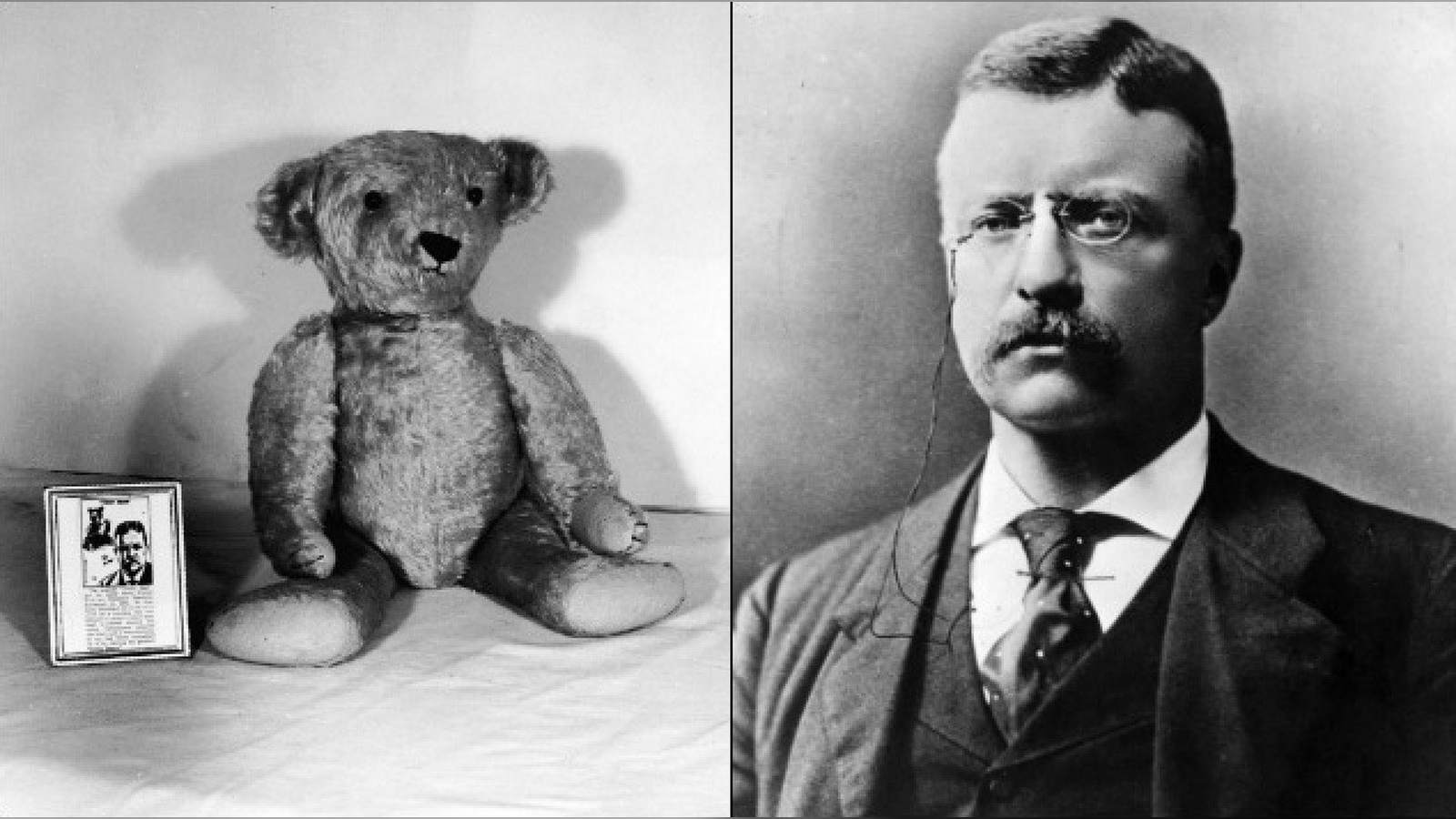
A weathered black-and-white photograph from mid-November 1902 reveals President Theodore Roosevelt stripped of Washington formality, planted firmly amidst the tangled hardwood bottomlands of Sharkey County, Mississippi. Dressed in heavy canvas field trousers, tall laced leather hunting boots, a rugged outdoor jacket, and his signature wide-brimmed slouch hat, Roosevelt holds a rifle with casual intimacy. Around him stand local guides, camp hands, and tracking hounds, framed by the dense Spanish moss and damp timber of the Mississippi Delta. The image captures an American head of state who openly identified as an explorer and frontiersman, yet it also preserves the precise expedition where a single split-second moral impulse would accidentally generate the most pervasive childhood icon of modern history: the Teddy Bear.
What the photograph shows
In this outdoor archival portrait, Roosevelt does not gaze imperiously at the camera. His posture is relaxed yet resolute, spectacles glinting against the diffused Southern sunlight filtering through the bare cypress canopy. Beside him stands Holt Collier, a legendary local African American tracker and former Confederate horseman who had reportedly slain over a thousand bears during his lifetime. Collier’s presence is unmistakable: weathered, vigilant, gripping the leashes of seasoned hunting hounds that mill restlessly around Roosevelt’s boots. The ground is churned mud and decaying leaves, bearing the visual texture of a genuine, grueling Southern swamp campaign. There is neither White House drapery nor polished mahogany; the image is entirely defined by wet earth, corduroy, gunmetal, and the quiet camaraderie of men gathered after long hours in the saddle.
The moment behind the image
The photograph documents an expedition arranged by Mississippi Governor Andrew H. Longino, who had invited the avid outdoorsman president for a private five-day black bear hunt near the hamlet of Onward, Mississippi. Roosevelt was eager to test his skills against the legendary Delta black bear, yet after several fruitless days of trudging through briars and canebrakes, the presidential party remained empty-handed. Determined that the Commander-in-Chief should not leave empty-handed, Collier and his pack of dogs pursued a 235-pound black bear until it was battered, exhausted, and cornered in a waterhole. Collier subdued the injured animal with his rifle stock and bound it securely to a willow tree, sending word for Roosevelt to ride up and claim his presidential trophy.
When Roosevelt reached the clearing and surveyed the pathetic scene—a wounded, defenseless beast chained to a trunk and savaged by dogs—he flatly refused to pull the trigger. To kill a captive, helpless animal under the guise of sport violated every canon of fair chase that Roosevelt had championed through his writing and his leadership of the Boone and Crockett Club. He declared that shooting such a target was fundamentally un-American and unsporting. Nevertheless, recognizing that the animal was severely injured and suffering, Roosevelt ordered that it be dispatched quickly with a hunting knife to end its misery. It was a raw, unglamorous moment of frontier mercy that would soon be thoroughly sanitized by the national press.
Photographer and provenance
The photographs from the 1902 Mississippi hunt were captured by photojournalists and local observers who accompanied the presidential entourage, including press photographers traveling under the auspices of major newspaper syndicates and the nascent photographic agencies of the era. The images were developed from glass-plate negatives and circulated rapidly via telegraphic news dispatches and pictorial press supplements. Today, original prints and negatives from this hunting trip are preserved across prominent repositories, including the Library of Congress, the Theodore Roosevelt Collection at Harvard University, and the Mississippi Department of Archives and History. These visual documents served primarily to bolster Roosevelt’s political identity as an authentic rough-riding statesman, contrasting sharply with the sedentary, parlor-bound image of his predecessor, William McKinley.
Historical context
When the story leaked from the Mississippi Delta to the nation’s capital, political cartoonist Clifford Berryman immortalized it in the pages of The Washington Post on November 16, 1902. Titled “Drawing the Line in Mississippi,” Berryman’s cartoon used Roosevelt’s refusal to shoot the bear as a multilayered political metaphor, touching on both conservation ethics and the tangled racial politics of the Jim Crow South. In Berryman’s initial sketch, the bear was already rendered smaller and less threatening than the fierce beast Collier had lassoed; in subsequent drawings, the creature evolved into an adorable, trembling cub with rounded ears and wide eyes.
In Brooklyn, New York, an immigrant confectioner named Morris Michtom saw the cartoon and had an entrepreneurial epiphany. Michtom’s wife, Rose, hand-stitched a small plush bear out of velvet scraps and black shoe buttons. Michtom placed the creation in his storefront window alongside a handwritten sign reading “Teddy’s Bear,” having reportedly sent a sample to the White House to request Roosevelt’s permission to use his name. The toy sold instantly. Michtom went on to establish the Ideal Novelty and Toy Company, while simultaneously in Germany, Richard Steiff independently designed mohair bears with jointed limbs, cementing the global toy craze that permanently linked the president’s nickname to the stuffed creature.
Why it still matters
The 1902 hunt photograph matters because it preserves the authentic, unadorned reality behind a heavily mythologized historical episode. Roosevelt himself never cared for the diminutive nickname “Teddy,” yet he could not halt the cultural tide unleashed by the Mississippi encounter. More significantly, the photograph highlights the foundational paradox of Roosevelt’s presidency: a man who reveled in big-game hunting, yet laid the groundwork for modern conservation by setting aside over 230 million acres of public lands, national forests, and federal wildlife reserves. When we look closely at this photograph of Roosevelt standing beside Holt Collier in the Mississippi mud, we are not looking at a nursery fable, but at the complex intersection of American wilderness culture, early civil rights realities, and the birth of modern political branding.