


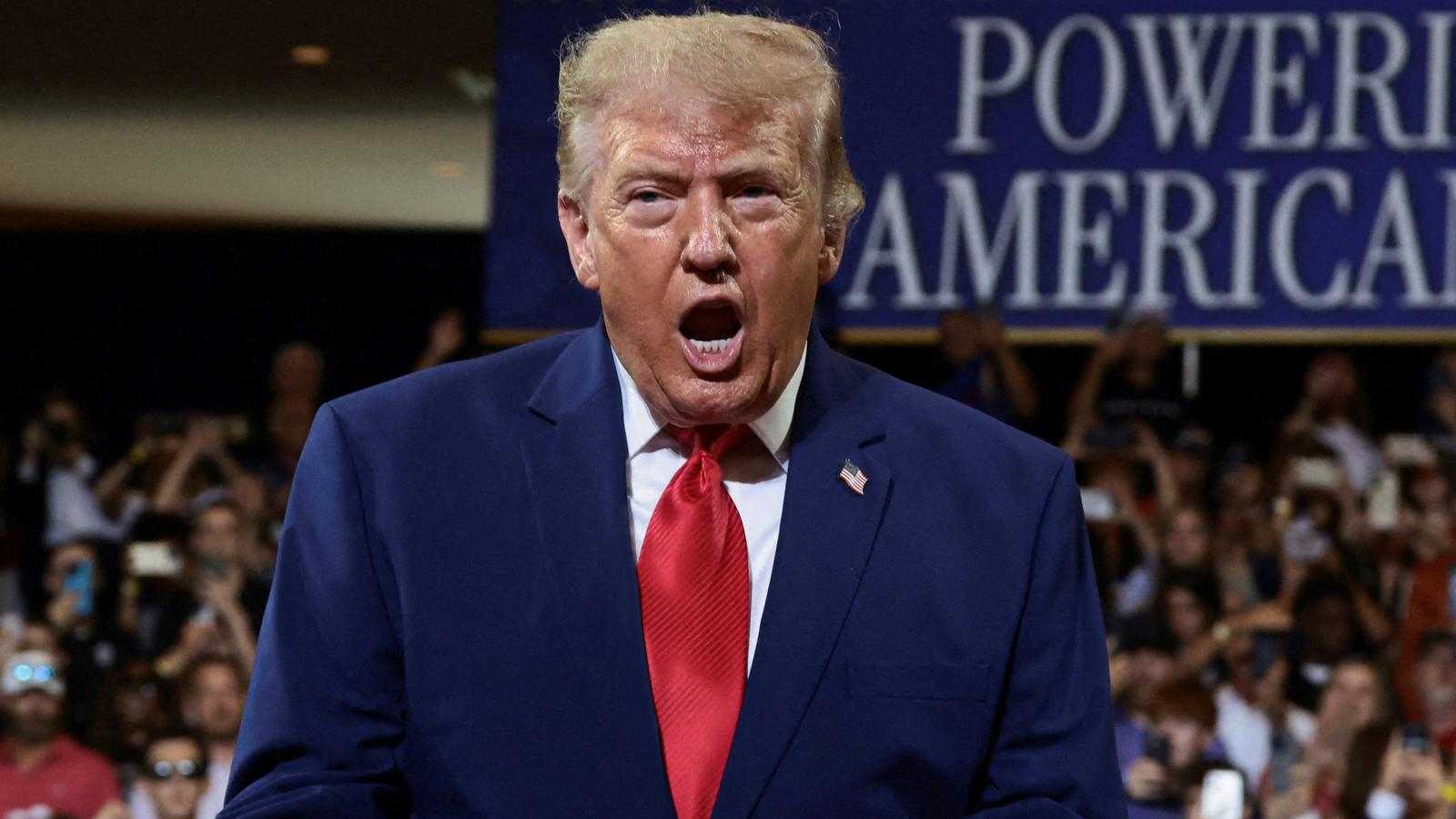
MARIETTA, Ga. (Azat TV) – During a high-profile political rally at Wheeler High School in Marietta, Georgia, on July 22, 2026, President Donald Trump made a notable verbal misstep while attempting to attack Democratic U.S. Senator Jon Ossoff. Addressing an energetic crowd in the vital midterm battleground state, Trump referred to the first-term Georgia senator as “Pinky Herman” rather than “Pee-wee Herman,” the iconic pop-culture character portrayed by the late actor Paul Reubens. “He reminds me of Pinky Herman,” Trump stated during his address, asking the attendees, “Did you ever see ‘Pinky Herman?” The slip immediately sparked significant online commentary and criticism from political opponents, momentarily overshadowing the broader institutional objectives of his visit aimed at securing Republican dominance in the upcoming midterm elections.
Approximately fifteen minutes later in his speech, Trump corrected the nickname while praising U.S. Representative Mike Collins, the Trump-endorsed Republican candidate seeking to unseat Ossoff. Addressing the absent congressman—who remained in Washington due to official legislative obligations—Trump declared that Collins was “going to beat Pee-wee Herman.” Despite the eventual self-correction, the initial moniker rapidly circulated across digital platforms, drawing sharp commentary regarding campaign discipline, rhetorical effectiveness, and public scrutiny surrounding political figures during major campaign events.
High Stakes in the Georgia Senate Battleground
Beyond the immediate media focus on Trump’s verbal error, the rally in Cobb County underscored Georgia’s pivotal role in shaping the political balance of power in Washington. Republicans currently hold a narrow 53-47 majority in the U.S. Senate, making Georgia one of the primary national battlegrounds for both parties. Flipping Ossoff’s seat is considered essential for Republicans aiming to solidify their Senate control, while Democrats view defending Georgia as indispensable for any prospective path toward regaining a legislative majority.
Ossoff won his Senate seat in a high-stakes January 2021 runoff election alongside fellow Democratic Senator Raphael Warnock, accompanying Joe Biden’s presidential victory in the state. That historic cycle marked a major political shift in a Southern state that had voted consistently Republican in presidential and Senate contests since the 1990s. Recent nonpartisan polling indicates Ossoff maintains a narrow lead in his re-election bid, demonstrating the competitive nature of the state’s changing electorate as suburban areas around Atlanta continue to evolve politically.
Historical Rivalry and Campaign Rhetoric
Trump’s appearance in Marietta reflected a long-standing political focus on Ossoff that dates back nearly a decade. During his speech, Trump referenced their historical campaign clashes, specifically citing the 2017 special election for Georgia’s 6th Congressional District, which Ossoff narrowly lost to Republican Karen Handel in what was then the most expensive House race in U.S. history. “I fought Ossoff before, and as you know, we won,” Trump told the crowd, characterizing Ossoff as “not respected at all in Washington” and accusing him and Democratic allies of advancing extreme ideological policies.
Rhetorically, Trump labeled Ossoff and fellow Democrats as “Democrat communists” who seek to “bankrupt your families” and maintain “wide open borders.” Personal nicknames have long served as a central pillar of Trump’s political communication strategy, designed to define opponents early in campaign cycles. Prior to the Marietta rally, Trump had shared memes on Truth Social comparing Ossoff to Pee-wee Herman. However, the momentary confusion during the live broadcast illustrates the risks associated with unscripted rally rhetoric, particularly in highly contested races where every public utterance receives intense media examination.
Election Integrity Focus and Midterm Strategy
In addition to targeting Ossoff, Trump used the platform to reinforce ongoing arguments regarding election administration and integrity. His remarks in Georgia followed a prime-time address delivered on July 16, in which he raised concerns regarding foreign electoral influence and voting procedures. At Wheeler High School, Trump urged his supporters to remain vigilant, repeating the phrase “make it too big to rig and watch those machines.”
The venue choice and timing highlight the broader strategic landscape governing the 2026 midterms. Georgia remains a focal point for electoral debate, following federal and state-level inquiries into the 2020 presidential vote count. By maintaining an active presence in the state, Trump seeks to mobilize conservative turnout and align local congressional candidates with his national agenda. As the midterms approach, both major parties are preparing for extensive advertising expenditures and field operations in Georgia, ensuring that the state will remain a central arena for American political conflict.