


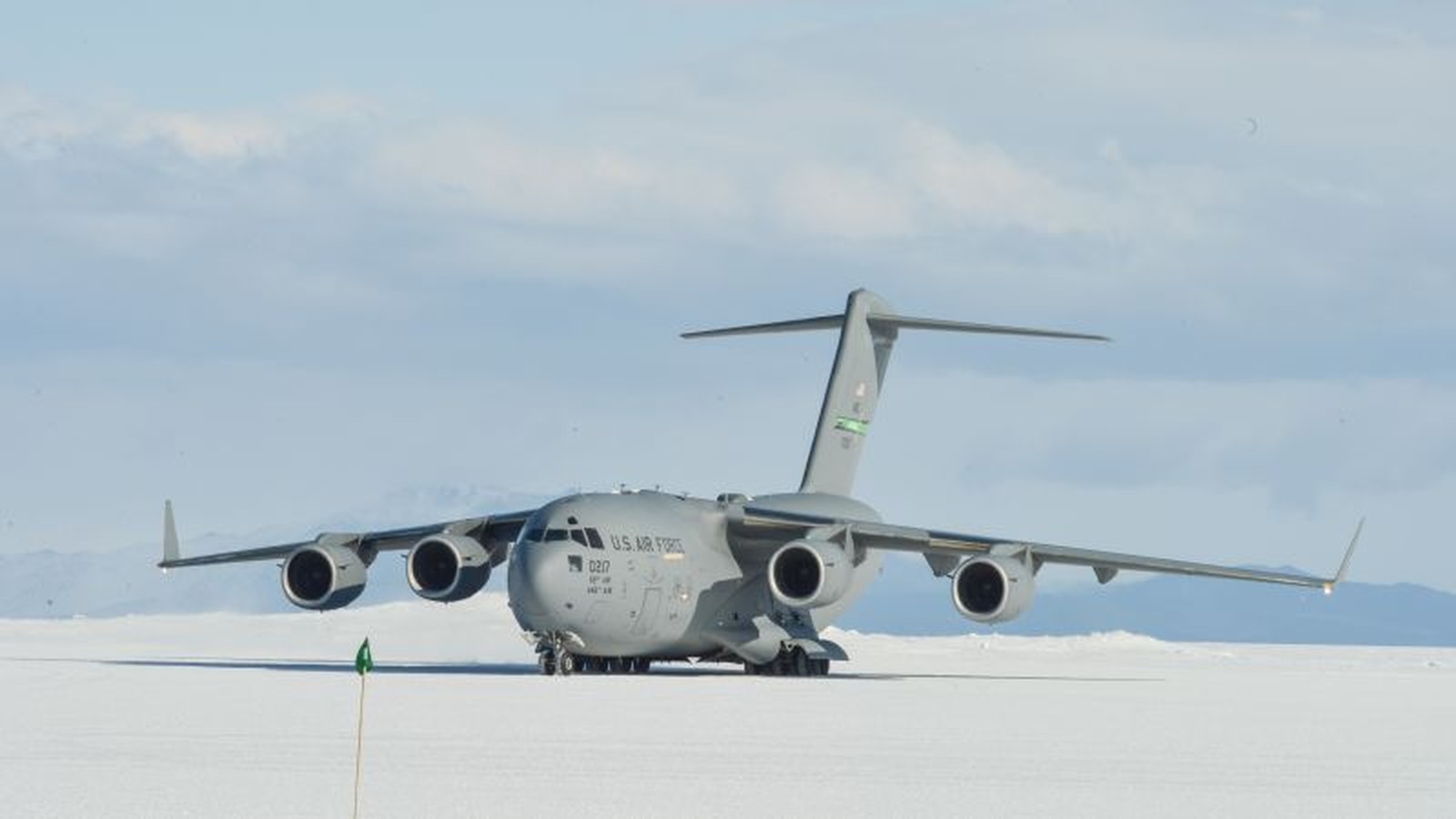
A United States Air Force transport aircraft carrying out a critical logistics mission to Antarctica was forced to abort its flight and return to New Zealand following a warning regarding potentially hazardous Russian space activity in the southern Indian Ocean. The incident highlights the growing operational friction between intensifying space operations and global aviation safety.
Aborted Mission Over the Southern Ocean
On Tuesday, August 18, 2026, a U.S. Air Force C-17 Globemaster III transport aircraft, operating under the call sign ICE28, departed Christchurch Airport on New Zealand’s South Island. The heavy-lift aircraft was bound for McMurdo Station, the primary United States research hub in Antarctica. According to flight-tracking data from Flightradar24, the aircraft turned back approximately 75 minutes into its journey, returning to Christchurch after a total of 150 minutes in the air.
This report draws on information published by CNN.
The aborted mission occurred during the annual Winter Fly-in (WINFLY) period. This is a highly critical operational window during which flights resume between New Zealand and Antarctica to transport essential personnel, scientific equipment, and supplies ahead of the busy summer research season. Disruptions during this phase can create significant logistical backlogs for both the U.S. Antarctic Program and New Zealand’s nearby Scott Base.
The Source of the Aerospace Threat
According to a statement issued by New Zealand’s Civil Aviation Authority (CAA), the decision to turn the C-17 Globemaster around was made after the Russian State Air Traffic Management Corporation issued a warning. The notice advised of “space activity, potentially hazardous to aviation en route to Antarctica.”
While the CAA emphasized that such notices do not strictly ban flights—leaving ultimate operational decisions to aircraft operators—the U.S. Air Force opted to prioritize safety and return to Christchurch. The warning appears closely linked to a Notice to Airmen (NOTAM) issued by the U.S. Federal Aviation Administration (FAA) on August 10. That notice warned of “Russian aerospace activities” and “possible debris” starting August 14 within the Melbourne Flight Information Region (YMMM), a massive airspace sector spanning parts of Australia and the southern Indian Ocean.
Rising Risks in Shared Airspace
The exact nature of the Russian space activity remains unconfirmed, as neither the U.S. Air Force nor Russian aviation authorities have released detailed statements. However, aerospace experts point to two primary possibilities: a planned weapons test or the controlled reentry of space debris.
High-altitude military testing, such as ballistic missile launches, regularly prompts temporary airspace closures. While these tests are typically coordinated and announced well in advance, sudden shifts in operational windows can catch active flights en route. Alternatively, the warning may have stemmed from the planned or uncontrolled reentry of orbital hardware. Recent history includes several high-profile incidents, such as the uncontrolled reentry of a Chinese Long March 5B rocket stage over Europe in November 2022, and debris issues following a SpaceX Starship test flight in January 2025.
The incident underscores a broader trend identified in a January 2025 study published in Scientific Reports, which calculated a 26% probability of uncontrolled space debris reentering busy global airspaces due to the exponential rise in satellite launches and orbital traffic. Mitigating these risks requires rapid, high-fidelity communication between space agencies, military command structures, and civil aviation regulators.
Logistical Fallout for Antarctic Research
For the personnel stationed at McMurdo and Scott Base, the aborted C-17 flight represents a temporary bottleneck in the transition to summer operations. The WINFLY period relies on tight scheduling to maximize the limited daylight and acceptable weather windows of the late polar winter.
While flight operations are expected to resume once the airspace warning expires or the hazard area is cleared, the event serves as a stark reminder of how remote scientific and logistical missions remain vulnerable to geopolitical and technological developments occurring thousands of miles away in Earth’s orbit.