


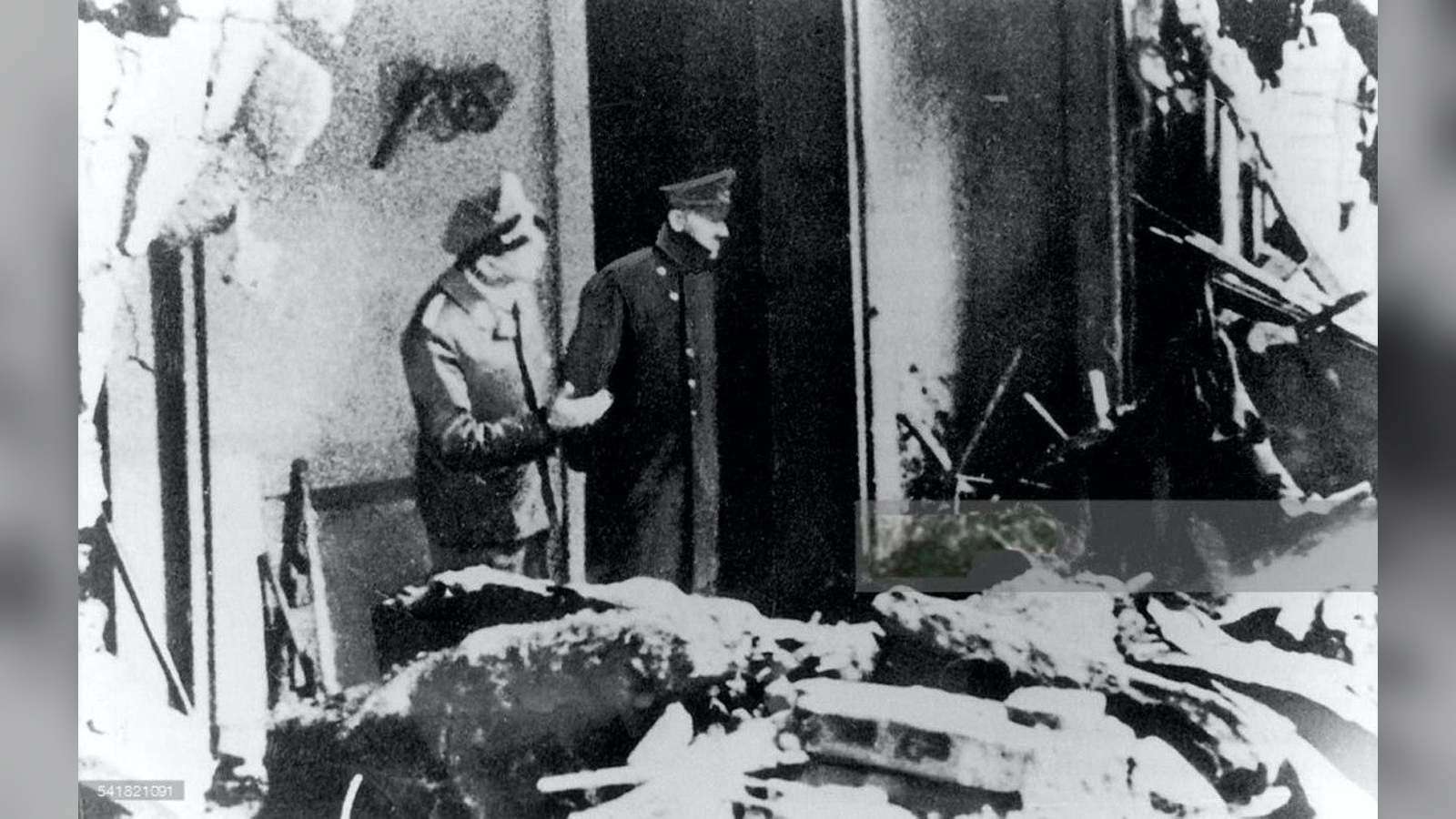
In a grainy, shadowy frame surrounded by pulverized concrete and scorched masonry, two men stand near the exit of an underground shelter, gazing out into the blasted garden courtyard of the Reich Chancellery in Berlin. On the right, bundled in a heavy coat with his collar turned up against the spring cold, is Adolf Hitler; to his left stands his personal adjutant, SS-Obergruppenführer Julius Schaub. Widely cataloged as having been taken on April 28, 1945—a mere forty-eight hours before Hitler committed suicide in the subterranean Führerbunker—this photograph stands as the final known visual record of the Nazi dictator alive. How did this haunting frame emerge from the encircled capital, who pressed the shutter amid relentless Soviet bombardment, and what does it reveal about the closing hours of the Third Reich?
What the photograph shows
The image captures Hitler largely in profile, his stooped posture and heavy winter trench coat emphasizing his rapid physical decline during the final months of the war. Beside him, Schaub stands rigid yet weary, both men looking toward the shattered remnants of Albert Speer’s sprawling New Reich Chancellery building. The foreground and background are choked with crushed concrete, twisted reinforcement wire, shattered window frames, and cratered earth—the direct consequence of months of Allied bombing and heavy Soviet artillery strikes. Absent are the theatrical swastika banners, polished marble, and disciplined military guard formations that defined official Nazi propaganda photography for over a decade. Instead, the flat, muted sunlight casts a bleak mood over two figures isolated amidst the ruins of their own political project.
The moment behind the image
By late April 1945, the Battle of Berlin had entered its final, bloody phase. Soviet troops under Marshals Georgy Zhukov and Ivan Konev had completely encircled the German capital, pressing into the central government district block by block. Deep beneath the Chancellery gardens, Hitler had spent weeks living in the cramped corridors of the Führerbunker, increasingly detached from military realities while directing imaginary counteroffensives. On rare occasions, he climbed the concrete stairs to the surface garden to get air or survey the damage above ground. It was during one of these brief ascents, likely around April 28, that this photograph was taken. Within forty-eight hours, Hitler would marry Eva Braun inside the bunker, draft his final political testament, order Schaub to burn his personal documents, and shoot himself in his private study on April 30.
Photographer and provenance
The precise identity of the photographer remains unconfirmed, reflective of the chaos inside Berlin during its final days. Heinrich Hoffmann, Hitler’s official personal photographer who had documented his political career since the 1920s, had already left Berlin for Bavaria earlier in April. Historical consensus attributes the image either to an assistant from Hoffmann’s press staff or to a propaganda cameraman attached to the Reich Film Chamber who remained stationed near the bunker command staff. Developing film under catastrophic conditions—with power failures, missing chemical supplies, and heavy shelling overhead—was a formidable task. The negative survived the destruction of the Chancellery, was secured during the Soviet occupation and Allied archival consolidation, and subsequently entered international news distribution as the definitive visual record of Hitler’s last days.
Historical context
The site of the photograph carries deep symbolic weight. Completed in early 1939, the New Reich Chancellery was designed by Albert Speer to project the absolute power and permanence of the Third Reich, featuring vast marble corridors intended to intimidate visiting foreign diplomats. Just six years later, that imperial grandiosity had been reduced to an unrecognizably charred shell. Two days after this photograph was taken, following Hitler and Eva Braun’s suicides on April 30 at approximately 3:30 p.m., their remains were carried up the very stairs visible in the background, placed in a shell crater in the Chancellery garden, doused in gasoline, and set alight by bunker staff, including Schaub.
Why it still matters
This image endures because it strips away all carefully constructed totalitarian mythologies, exposing the ultimate reality of absolute defeat. For years, Nazi state media meticulously manufactured images of Hitler as a towering, invincible leader framed by massive light displays and roaring crowds. Here, captured unposed beside a loyal sycophant amidst smoking rubble, he appears as a diminished figure standing inside the physical destruction he brought upon Europe and Germany. The photograph remains a vital visual document of the end of World War II in Europe, marking the precise historical moment when the Nazi regime collapsed into ruin.