


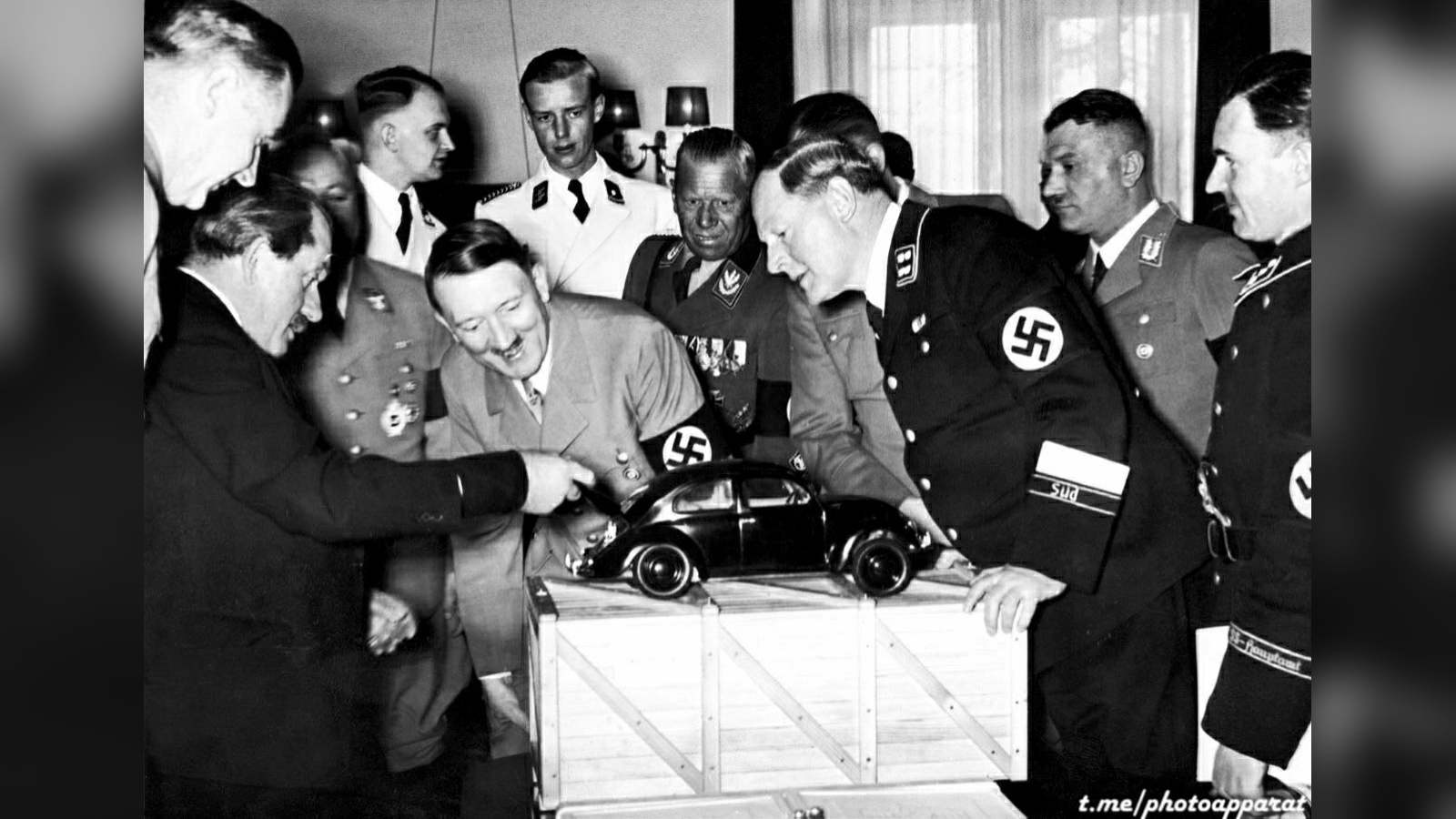
This photograph, captured in late 1935, presents a chillingly quiet moment of design review: Adolf Hitler bending over a table to inspect a small, streamlined model of what would eventually become the Volkswagen Beetle. This instant is historically meaningful because it captures the exact intersection of totalitarian propaganda, military ambition, and engineering genius. The image raises a fundamental question for the modern viewer: How did a vehicle conceived in the shadow of dictatorship, designed to serve a regime’s war machine, successfully shed its dark past to become a global symbol of counterculture, peace, and economic recovery?
What the photograph shows
In the frame, we observe Adolf Hitler focusing his attention entirely on the miniature physical model of the car. The model displays the distinctive, rounded, aerodynamic silhouette that would define the Beetle for decades—the curved roofline, the sloping hood, and the integrated fenders. The setting is formal and sterile, characteristic of official Nazi state presentations where industrial designs were vetted by the dictatorship. The lighting casts soft shadows across the model, emphasizing its clean, futuristic lines. There are no crowds or grand backdrops, only the quiet, calculated inspection of a prototype that was destined to mobilize an empire. The direct visual focus is on the object itself, representing a physical manifestation of political promise and technical execution.
The moment behind the image
The photograph was taken in Germany in late 1935, around the time Hitler personally approved the prototype of “his Volkswagen” on December 29, 1935. The project was the result of a calculated partnership between Hitler and the brilliant engineer Ferdinand Porsche, who had founded his design office in Stuttgart in April 1931. Hitler, who famously never held a driver’s license, understood the immense propaganda value of a “people’s car” (Volkswagen). Porsche, on the other hand, was an ambitious engineer who sought a powerful political patron to fund his advanced automotive concepts without financial or bureaucratic constraints. Historians describe this relationship as a classic “deal with the devil,” where professional opportunism overrode all moral considerations.
Photographer and provenance
This image was produced as an official state or press record within the German Reich in 1935. While the specific photographer’s identity remains uncredited in many archival records, the composition aligns with the highly curated propaganda photography of the era, often managed by Heinrich Hoffmann or state press agencies. The image was designed to be circulated in German newspapers and magazines to demonstrate the Führer’s personal involvement in the country’s industrial modernization. It survived the war in state archives and private collections, serving post-war historians as undeniable proof of the close collaboration between Ferdinand Porsche and the Nazi leadership.
From propaganda to military reality
Just weeks after becoming Reich Chancellor in early 1933, Hitler had announced a grand plan for “people’s motorization.” By the summer of 1934, the Reich Association of the German Automobile Industry officially commissioned Porsche to develop the vehicle under the state-sponsored “Strength through Pleasure” (Kraft durch Freude) program. However, the promise of an affordable family car for the German public was largely a deception. A 1934 Porsche brochure had already noted that the vehicle must be suitable for “particular military purposes.” When the factory cornerstone was laid in Wolfsburg in May 1938, the production lines were quickly pivoted to manufacture military all-terrain vehicles (Kübelwagen) for the Wehrmacht, leaving ordinary German citizens who had paid into state savings schemes empty-handed.
Why it still matters
The photograph remains highly significant because it documents the birth of a global icon from the depths of authoritarian planning. Following the Allied victory, the British military administration took control of the heavily damaged Wolfsburg plant. In December 1945, the first civilian models rolled off the assembly line, rebranded simply as the “Beetle” to distance the vehicle from its National Socialist origins. The car went on to become the ultimate symbol of West Germany’s post-war economic miracle (Wirtschaftswunder) and a global commercial triumph, with nearly 22 million units produced before production finally ceased in Mexico in 2003. Ferdinand Porsche himself was arrested by French authorities in late 1945 and imprisoned until 1947, a stark reminder of the legal and moral reckonings that followed the collapse of the regime that had financed his greatest design.