


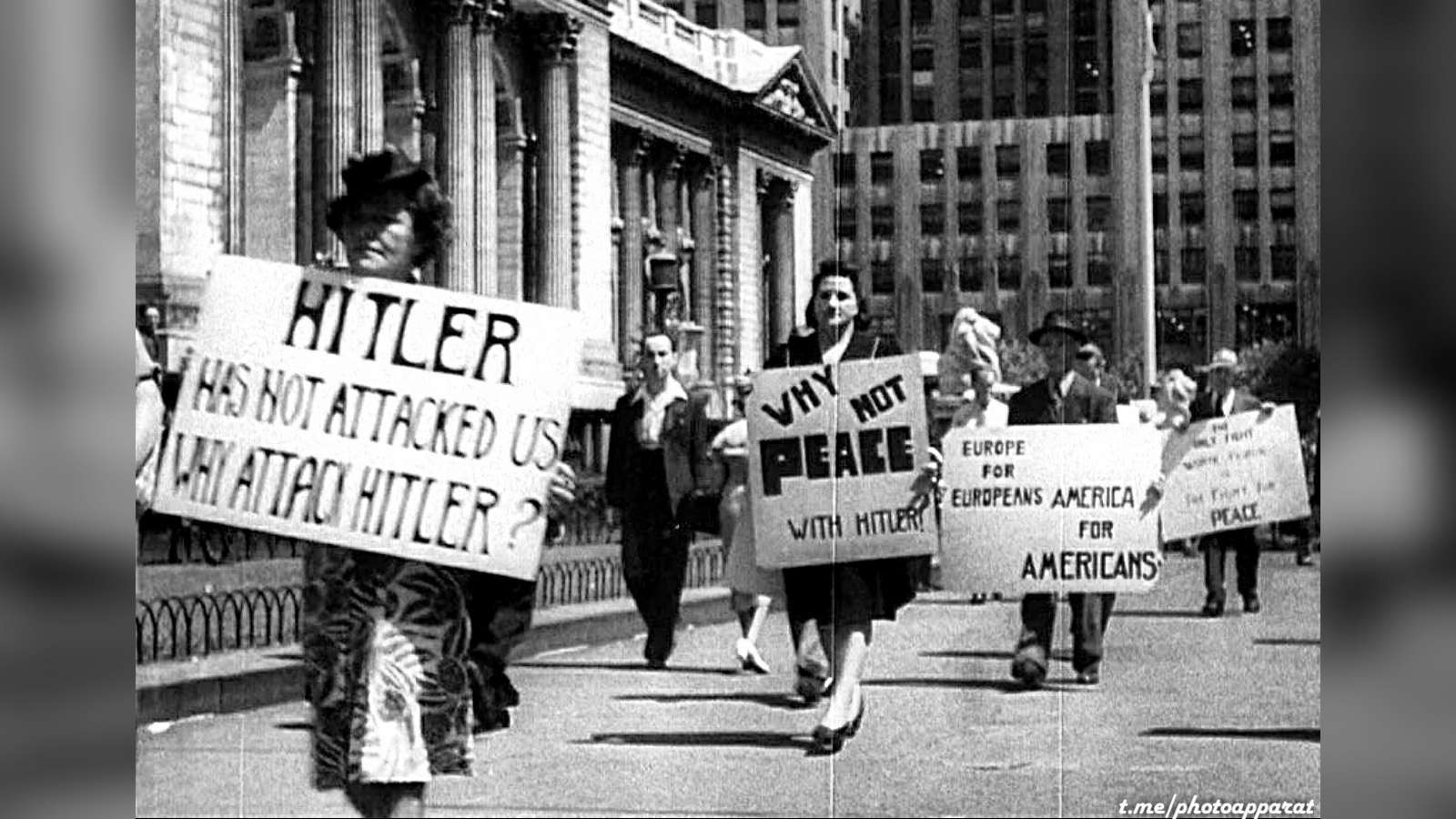
This photograph captures a tense, claustrophobic street scene in New York City in 1941, where a gathering of citizens holds aloft hand-painted placards that challenge the inevitability of American entry into World War II. In the frame, the faces of the protesters—some grim, others seemingly earnest—are framed by the stark, bold lettering of their messages: ‘Hitler does not attack us, why should we attack Hitler?’ and ‘Why not make peace with Hitler?’ The image is a chilling artifact of a moment when the United States stood at a crossroads, deeply divided between the desire to remain insulated from the chaos of Europe and the growing reality of global conflict.
What the photograph shows
The visual composition of this photograph is defined by the proximity of the crowd. The protesters are huddled together, their signs raised high, creating a wall of text that dominates the visual field. We see a mix of middle-aged men in fedoras and overcoats, reflecting the typical demographic of the America First Committee (AFC) at the time. The signs themselves are not professionally printed; they are crude, hand-lettered sheets of cardboard or wood, suggesting a grassroots, perhaps desperate, attempt to influence public opinion. The expressions on the faces of the individuals in the foreground range from defiant to wary, capturing the intense polarization of the American public in the months before the nation’s formal entry into the war.
The moment behind the image
In 1941, the United States was technically neutral, yet the Roosevelt administration was increasingly involved in supporting the Allied powers through the Lend-Lease Act. The AFC, which boasted high-profile members like aviator Charles Lindbergh, believed this support was a slippery slope toward total war. This protest was likely one of many held in urban centers across the country. The atmosphere was charged with a mixture of fear, patriotism, and, in some corners, overt antisemitism. The protesters believed they were the true patriots, protecting American lives from being ‘wasted’ in a European power struggle. They did not see the rise of Nazi Germany as an existential threat to the American way of life, but rather as a regional conflict that the U.S. should ignore to preserve its own prosperity.
Photographer and provenance
The photograph originates from the archives of mid-20th-century news agencies, though the specific photographer often remains uncredited in many historical collections. Such images were typically captured by wire service photographers—men working for organizations like the Associated Press or Acme Newspictures—who were tasked with documenting public sentiment during the lead-up to the war. These photographers operated under strict deadlines, often finding themselves in the middle of heated political demonstrations. The survival of this image is a testament to the importance of the press in documenting the internal dissent that characterized the American home front. It serves as a stark reminder of how public opinion was mobilized and expressed before the era of digital saturation.
Historical context
The America First Committee was a complex, often contradictory entity. While it began with a genuine desire to keep the U.S. out of a foreign war, it inevitably drew in those who admired the efficiency of the Nazi regime or harbored deep-seated xenophobic and antisemitic views. Lindbergh’s infamous Des Moines speech in September 1941, where he explicitly blamed Jewish groups for pushing the U.S. toward war, marked the beginning of the end for the movement’s mainstream credibility. The photograph captures the movement before this final, ugly turn, when the arguments still maintained a veneer of ‘neutrality’ and ‘continental defense.’ The political landscape shifted instantaneously on December 7, 1941, when the attack on Pearl Harbor turned the isolationist platform into a liability, causing the AFC to disband within days.
Why it still matters
This photograph is more than a record of a forgotten protest; it is a mirror to the cyclical nature of American isolationism. The rhetoric seen on these signs—the skepticism toward foreign alliances and the belief that the U.S. should focus solely on its own interests—has echoed through decades of American political discourse. By looking at these faces, we are forced to confront the reality that the decision to engage with the world has never been a settled matter in American history. The image reminds us that the path to global leadership was paved with intense domestic struggle and that the arguments for ‘America First’ have deep, often uncomfortable, roots in the American experience.