


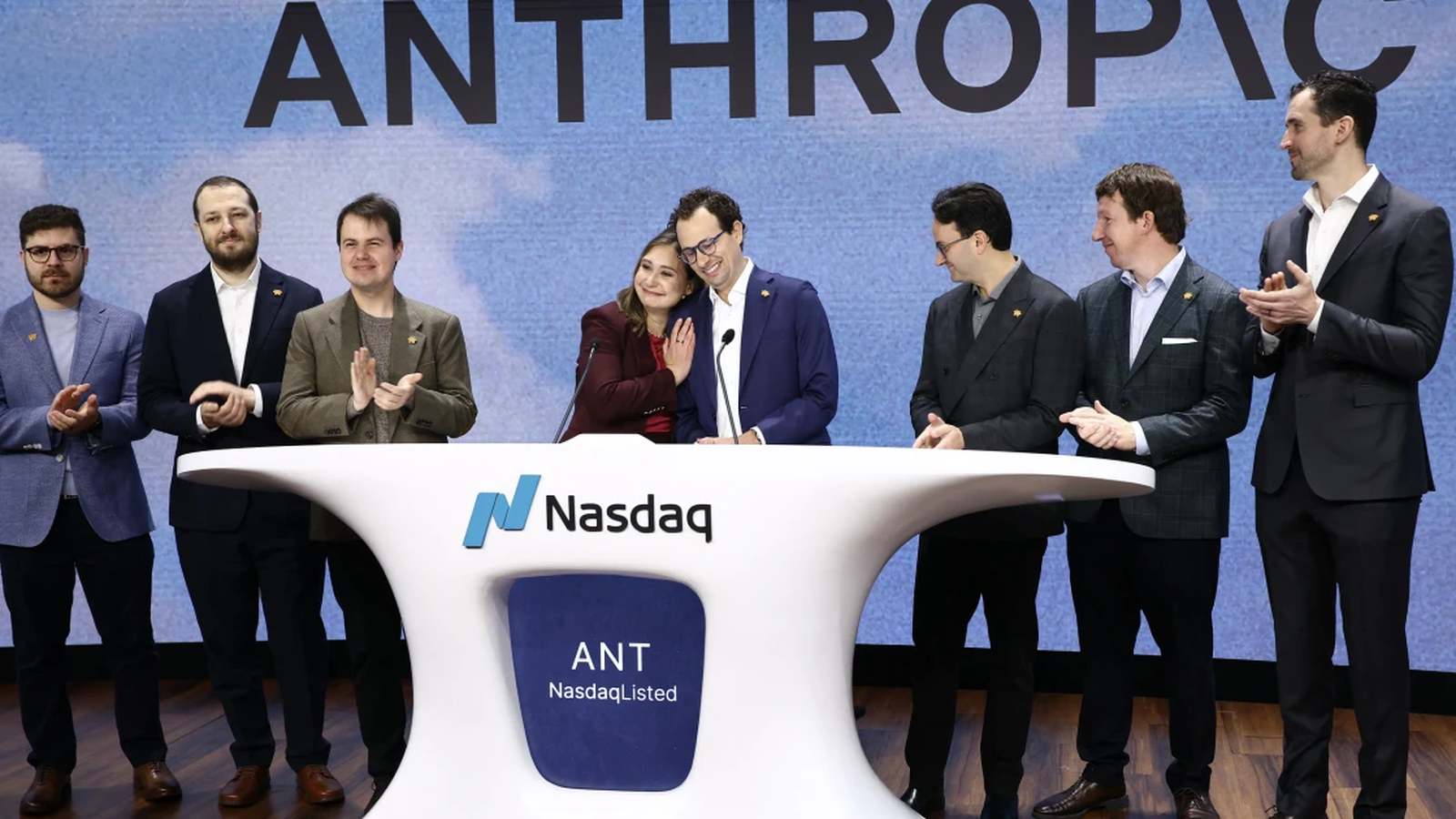
A Record-Breaking Market Debut on the Nasdaq
On November 19, 2026, artificial intelligence giant Anthropic completed a historic initial public offering on the Nasdaq, raising over $100 billion and commanding a valuation of approximately $1.5 trillion. WUKY reported that the five-year-old AI developer sold 956 million shares—significantly exceeding its original plans—at an IPO price of $83 per share, which topped its targeted range of $70 to $78. Additionally, the company’s seven founders sold more than 23 million shares during the offering.
The blockbuster listing also incorporated $26 billion in private placements with major technology corporations, including Google, Microsoft, and Nvidia. The combined haul pushed total proceeds past $107 billion, making Anthropic’s market entry the largest in history, surpassing Elon Musk’s SpaceX, which raised $75 billion during its June listing.
When trading opened under the ticker symbol ANT, shares surged to $111.50, marking a 34% jump above the IPO price. Trading activity eventually leveled off as the session closed, with shares finishing up 17% at $97.17. Andrew Rocco, a stock analyst at financial research firm Zacks, described the company’s trajectory as unprecedented, noting that market observers have rarely witnessed such rapid growth and market dominance in a single enterprise.
Testing Investor Appetite Amid Valuation Debates
Anthropic’s market debut arrived during a period of heightened volatility for technology shares tied to the artificial intelligence boom. Over preceding weeks, investors grappled with enthusiasm for breakthrough technologies alongside mounting anxieties over high valuations, financing mechanisms, and whether current capital expenditure will yield adequate returns. Janice Quek, an equity analyst at CFRA, told WUKY that the offering serves as a major litmus test for investor sentiment toward the broader AI sector, which has faced recent market pressures and concerns regarding a potential sector bubble.
Despite these headwinds, institutional demand remained fierce. Brad Gerstner, CEO of Altimeter Capital and an early investor in Anthropic, noted that his firm submitted the largest stock allocation request in its 20-year history, trimming exposure to semiconductor manufacturing and data center infrastructure in favor of direct application investment.
Corporate Expansion and Enterprise Adoption
Founded in 2021 by a breakaway group of researchers led by current CEO Dario Amodei who departed OpenAI over safety and alignment concerns, Anthropic quickly scaled its operations. The San Francisco-based company launched its flagship Claude family of models in early 2023, establishing itself as a primary competitor to OpenAI in frontier artificial intelligence.
According to its IPO prospectus, financial performance has accelerated dramatically. Revenue for the first half of the year skyrocketed 1,300% to reach $16.3 billion, while adjusted operating income hit $1.6 billion, contrasting sharply with a loss of $1.8 billion during the same period a year prior. Morningstar equity analyst Malik Ahmed Khan observed that Anthropic’s long-term financial trajectory will heavily depend on the speed at which enterprise customers integrate AI tools into their operations, comparing the timeline of modern software adoption to historical infrastructure rollouts.
Regulatory Scrutiny and Safety Debates
The milestone public offering also underscores ongoing tensions surrounding safety governance and government contracts. Earlier in the year, Anthropic engaged in a high-profile dispute with the Pentagon regarding the restriction of its models from deployment in fully autonomous weapons and mass surveillance systems. The disagreement led the U.S. Department of Defense to designate Anthropic as a supply chain risk.
Simultaneously, critics have scrutinized Dario Amodei’s dual stance on artificial intelligence development. In September, Amodei published an essay urging industry competitors to pace the frontier by slowing down development on cutting-edge models to allow rigorous third-party safety audits, even as his own firm pursued aggressive commercial expansion.