


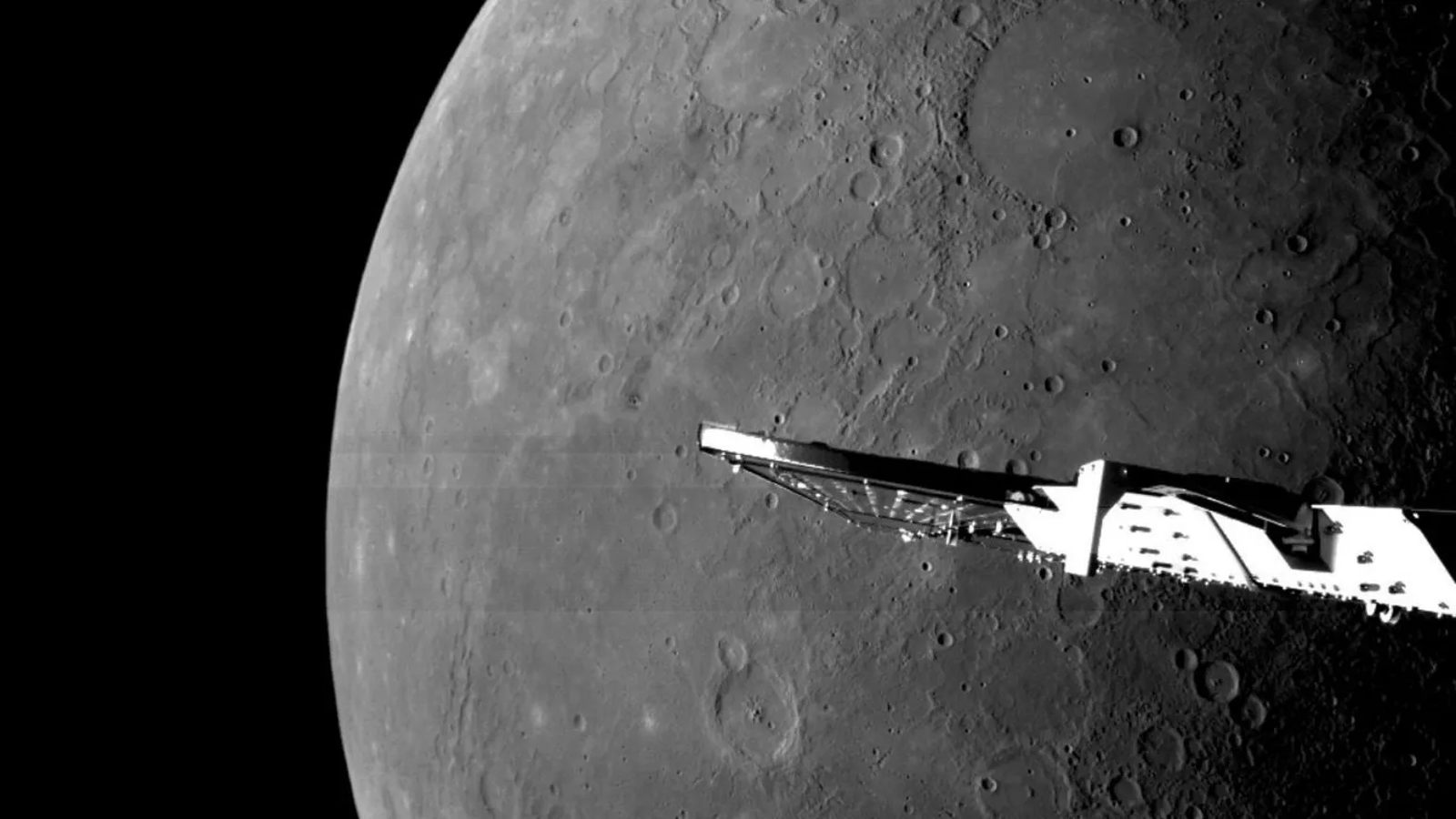
An Epic Interplanetary Journey Reaches Its Final Phase
After an exhaustive eight-year journey spanning nearly six billion miles, the joint European-Japanese BBC mission has arrived at Mercury and is preparing to enter orbit around the innermost planet. The spacecraft, a collaborative venture between the European Space Agency and the Japan Aerospace Exploration Agency, launched in 2018 from French Guiana. Navigating deep into the inner Solar System required the spacecraft to constantly battle the Sun’s immense gravitational pull, utilizing a convoluted trajectory that included one loop around Earth, two around Venus, and six around Mercury to shed momentum. While the voyage was originally scheduled to take seven years, a propulsion system issue extended the mission by an additional year.
The upcoming orbital insertion represents a high-stakes moment for the mission team. The spacecraft must execute a precise 37-minute braking maneuver to allow Mercury’s gravity to capture it; any failure during this phase could cause the probe to hurtle past the planet. Once securely in orbit, BepiColombo will face an exceptionally hostile environment characterized by intense solar radiation and extreme thermal swings, with temperatures ranging from a scorching 430 degrees Celsius down to minus 180 degrees Celsius.
Unlocking the Mysteries of the Innermost Planet
Mercury remains one of the least explored terrestrial bodies in the inner Solar System, having been visited by only two previous NASA spacecraft: Mariner 10, which flew past in the 1970s, and Messenger, which spent four years in orbit starting in 2011. Scientists hope the dual-probe configuration of BepiColombo—consisting of separate European and Japanese orbiters designed to separate a few weeks after arrival—will answer long-standing questions regarding the planet’s formation, composition, and evolution. Researchers are particularly eager to investigate why ice exists within polar craters despite the planet’s intense proximity to the Sun, as well as the origin of thousands of shallow, steep-sided geological hollows dotting the surface that are estimated to be roughly 100,000 years old.
Another major scientific focus is Mercury’s disproportionately large metal core. Prof Emma Bunce, a principal investigator on the mission from Leicester University, noted that the planet may have lost its outer mantle early in its history due to a catastrophic “hit and run” collision or a series of impacts. Alternatively, the planet may have simply formed within a metal-rich region of the early Solar System. By studying the surface up close and observing the planet from a distance simultaneously, the mission aims to resolve these planetary anomalies and shed light on extreme space weather dynamics.
Complex Separation and Next Operational Steps
Before science operations can begin in earnest, the mission faces a delicate mechanical hurdle. Jessica Marshall, a systems engineer at Airbus who worked on building the spacecraft, described the upcoming separation of the two orbiters as a nerve-wracking procedure. The spacecraft were tightly secured together to withstand launch stresses and years of harsh space exposure. To initiate independent observations, a specially designed spring mechanism must release gently while simultaneously imparting a twist to begin the secondary spacecraft’s spin.
As the mission transitions into its orbital phase, researchers anticipate not only resolving existing mysteries about Mercury’s unique geology and space environment but also uncovering entirely new questions about this compelling, under-studied world.
Historical Context and Planetary Dynamics of Mercury
Examining Mercury’s deep space environment requires accounting for extreme physical conditions that distinguish it from every other rocky world in the inner Solar System. The planet is only a fraction larger than Earth’s Moon, yet it packs immense mass into its small volume, dominated by its oversized core. Furthermore, time behaves in unusual ways on the innermost planet. Because Mercury zips rapidly along its eccentric path around the Sun, a full mercurian year lasts just 88 Earth days. At the same time, its axial rotation is exceptionally sluggish, stretching a single day-night cycle across roughly 59 Earth days. This protracted exposure means that any given location on the surface experiences intense daylight for approximately three months followed by three months of absolute darkness.
These severe conditions have historically limited exploration efforts, leaving researchers reliant on sparse data gathered by NASA’s historic flybys and orbital missions. The introduction of BepiColombo’s advanced instrumentation changes this dynamic completely by deploying two distinct assets into complementary polar orbits. The European spacecraft, the Mercury Planetary Orbiter, will focus heavily on high-resolution surface mapping, detailed geochemical analysis via instruments such as the Mercury Imaging X-ray Spectrometer, and interior gravity profiling. Meanwhile, the Japanese spacecraft, the Mercury Magnetospheric Orbiter, will concentrate on tracking the planet’s dynamic magnetic field and analyzing its tenuous sodium exosphere and the constant buffeting of solar wind particles.
Technical Challenges of Interplanetary Navigation
Achieving this level of detailed observation required overcoming monumental engineering hurdles throughout the eight-year cruise phase. Because objects falling inward toward the Sun accelerate rapidly under intense gravitational attraction, spacecraft must continuously apply braking force rather than simply coasting to their targets. BepiColombo’s trajectory demanded precision gravity assists across multiple planetary bodies to continuously bleed off excess velocity. The propulsion anomalies encountered midway through the mission added operational complexity, requiring flight controllers to meticulously manage remaining propellant reserves to ensure the spacecraft stack retained enough delta-v for final capture.
The subsequent deployment phase will test the resilience of hardware that has endured years of relentless solar radiation and fluctuating thermal extremes. The spring-loaded separation mechanism, engineered to gently part the European and Japanese orbiters while imparting a controlled spin, must perform flawlessly after enduring deep-space dormancy. Once separation is successfully achieved and instrument commissioning concludes, formal science operations slated to begin in April will provide unprecedented insights into the origin and evolution of the Solar System’s most elusive terrestrial planet.