


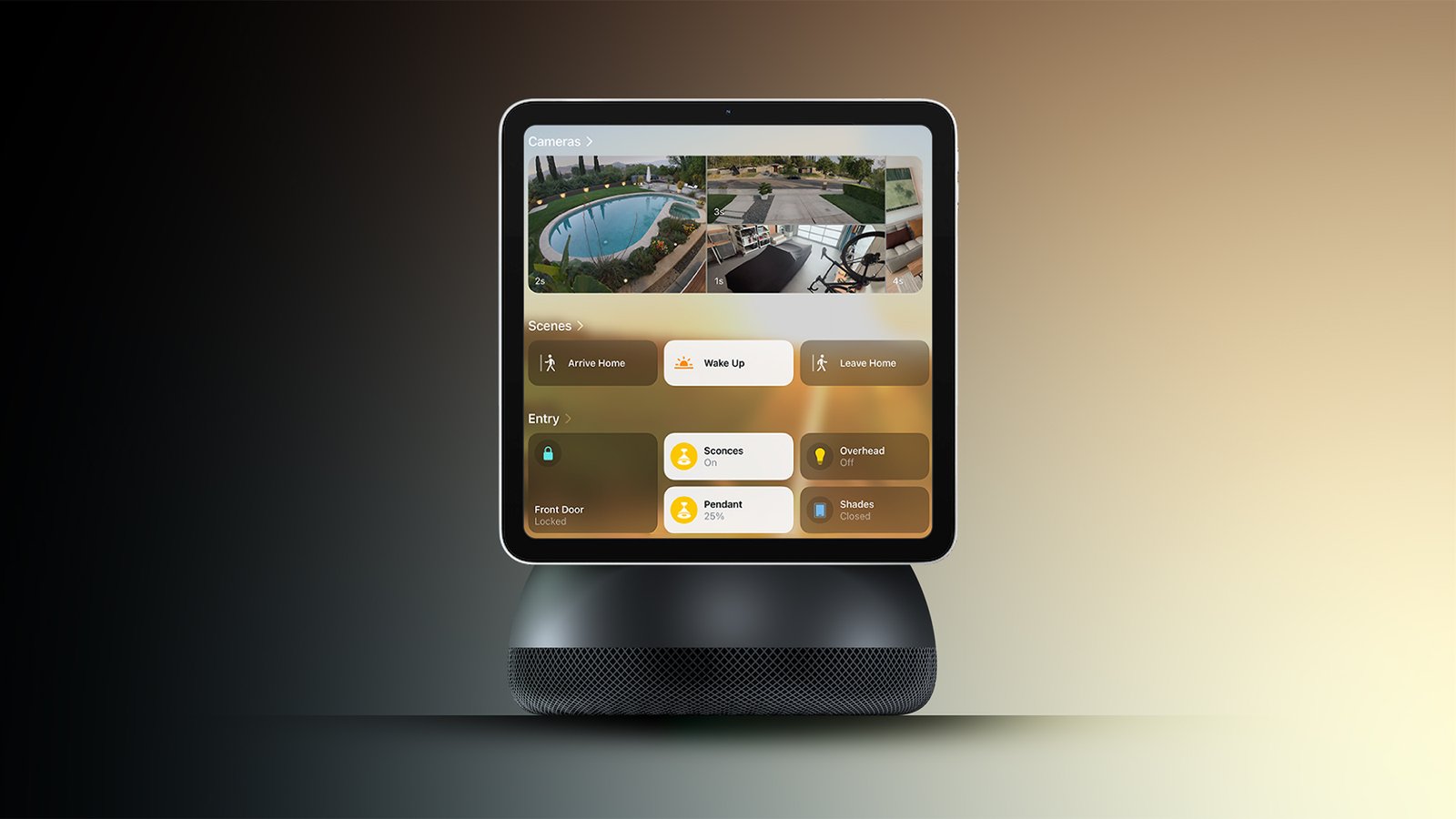
Bloomberg reporter Mark Gurman detailed the upcoming hardware lineup in his ‘Power On’ newsletter, noting that the ecosystem push also includes refreshes for the Apple TV and HomePod mini. Alongside hardware developments, Apple has reportedly partnered with major appliance manufacturers such as LG to establish a unified range of compatible smart home accessories, including thermostats, smart locks, and doorbells.
Design Options and Color Configurations
The HomeView will be offered in two distinct physical configurations tailored to different room layouts and mounting preferences. The primary countertop model features a floating touch screen mounted above an integrated speaker base, which MacRumors notes will deliver superior sound quality compared to the standard HomePod mini. This tabletop version will be available in four color options: space gray, silver, starlight, and pink.
For users seeking a more integrated installation, Apple has designed a wall-mountable alternative that replaces the speaker base with a flat, square mounting bracket. This second variant will be restricted to a monochrome palette of space gray and silver finishes. Both versions derive their product designation from the trademark discovery reported previously by MacRumors, reflecting its primary function as a wall- or desk-mounted display meant to be viewed from across a room.
Performance, Siri Integration, and Software Limitations
Under the hood, the HomeView will be powered by Apple’s A18 chip, providing the computational capacity necessary to manage voice processing and connected accessories locally. According to The Mac Observer, the device is built to operate primarily through voice input centered around an advanced Siri AI interface. Although the screen accepts touch inputs, it is not engineered for heavy manual web browsing or traditional application management.
The operating software will support a limited selection of first-party Apple applications without including a dedicated App Store for third-party software downloads. To bridge the gap, developers and users may rely on projecting widgets from nearby iPhones directly onto the HomeView screen. This voice-first, streamlined approach aims to keep the hardware functioning quietly in the background while unifying automated home controls.