


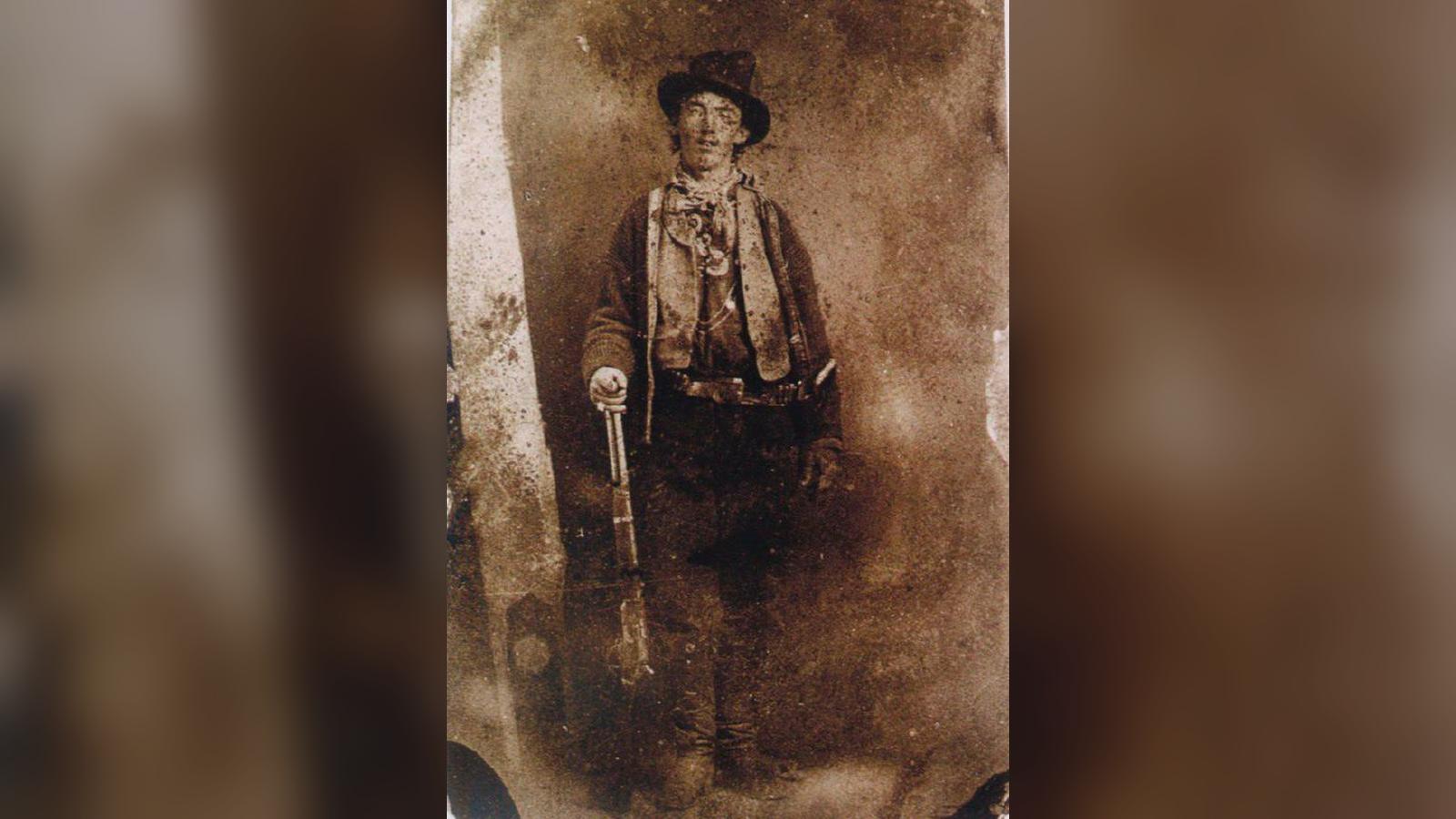
This small, imperfect metal plate captures history’s most famous frontier outlaw just as he lived, far away from Hollywood mythology and sanitized legends. In the frame stands Henry McCarty—better known as Billy the Kid—dressed in rumpled frontier clothing, wearing a distinctive slouch hat, and resting his hand on an 1873 Winchester carbine while a Colt revolver hangs at his hip. Often called the Holy Grail of Western memorabilia, this singular tintype not only preserves the authentic likeness of a 19-year-old gunman, but it also anchors a complex story of 19th-century itinerant photography, family preservation, and modern auction records that this article explores.
What the photograph shows
The visual details of the tintype offer a remarkably unvarnished look at life on the American range. Billy the Kid appears relaxed yet vigilant, standing outdoors near a Fort Sumner saloon with a bulky sweater, worn boots, and his heavily relied-upon firearms clearly visible. Historians and rare photography collectors have noted that it is far from a flattering portrait, yet that raw authenticity is precisely what captivates viewers. The reverse-image nature of the tintype process placed his holster and rifle on what appeared to be the left side, sparking a decades-long misconception that the outlaw was left-handed—a myth famously popularized by Paul Newman’s 1958 film “The Left Handed Gun.” Every wrinkle in his heavy clothing, the careless tilt of his hat, and the awkward stance speak of a transient existence on the rugged frontier rather than a staged studio portrait.
The moment behind the image
The photograph was captured around 1879 or 1880 in Fort Sumner, New Mexico, during a turbulent period in the outlaw’s brief life. Using a multi-lens camera, a traveling photographer produced four simultaneous original tintypes during a casual moment on the frontier. Immediately before and after the shutter clicked, the Kid was simply moving among friends, rustlers, and locals, completely unaware that this fleeting pose would become his defining historical icon. Just months later, on July 14, 1881, Sheriff Pat Garrett tracked down and fatally shot the 21-year-old outlaw in Fort Sumner, forever freezing his legacy at the age captured in the metal plate. The atmosphere surrounding the exposure was mundane, yet it preceded an era of relentless manhunts and eventual legendary status.
Photographer and provenance
While the exact identity of the itinerant photographer remains lost to history, the provenance of the physical object itself is remarkably well-documented and undisputed. Billy the Kid gave the tintype to his friend and rustling associate Dan Dedrick. In the early 1930s, Dedrick passed the artifact to his nephew, Frank Upham. For generations, the photograph remained safely in the hands of the Upham family. In 1986, descendants publicly announced its existence when they donated it to the Lincoln County Heritage Trust, before eventually reclaiming it and bringing it to the open market in the summer of 2011. This chain of custody ensures that despite the anonymous photographer, the journey of the physical plate from the pocket of an outlaw to the hands of family guardians is fully traceable.
Historical context
The 1870s and 1880s in the American Southwest were characterized by land wars, cattle rustling, and informal justice systems. The Lincoln County War in New Mexico provided the crucible in which Billy the Kid earned his notoriety. Tintypes, introduced in the mid-19th century, were remarkably popular among working-class individuals and frontiersmen because they were durable, inexpensive, and produced quickly without the need for delicate glass negatives. Unlike polished studio portraits of wealthy easterners, tintypes captured the rough-and-ready reality of frontier life. This specific image encapsulates the precarious existence of outlaws who operated outside the reach of formal law enforcement while rubbing shoulders with everyday ranchers and townsfolk.
Why it still matters
The extraordinary journey of the tintype reached a dramatic climax on June 25, 2011, at Brian Lebel’s 22nd Annual Old West Show & Auction in Denver. Originally estimated to sell for a modest $300,000 to $400,000, fierce bidding erupted and drove the price to an astounding $2.3 million within minutes. Retired billionaire industrialist and Western artifact collector William Koch secured the winning bid, later expressing his intent to share the historic piece discreetly with small museums. As the most expensive Western photograph ever sold, the tintype endures not merely as a collector’s prized possession, but as the single undeniable window into the human reality behind the myth of the American Wild West.