


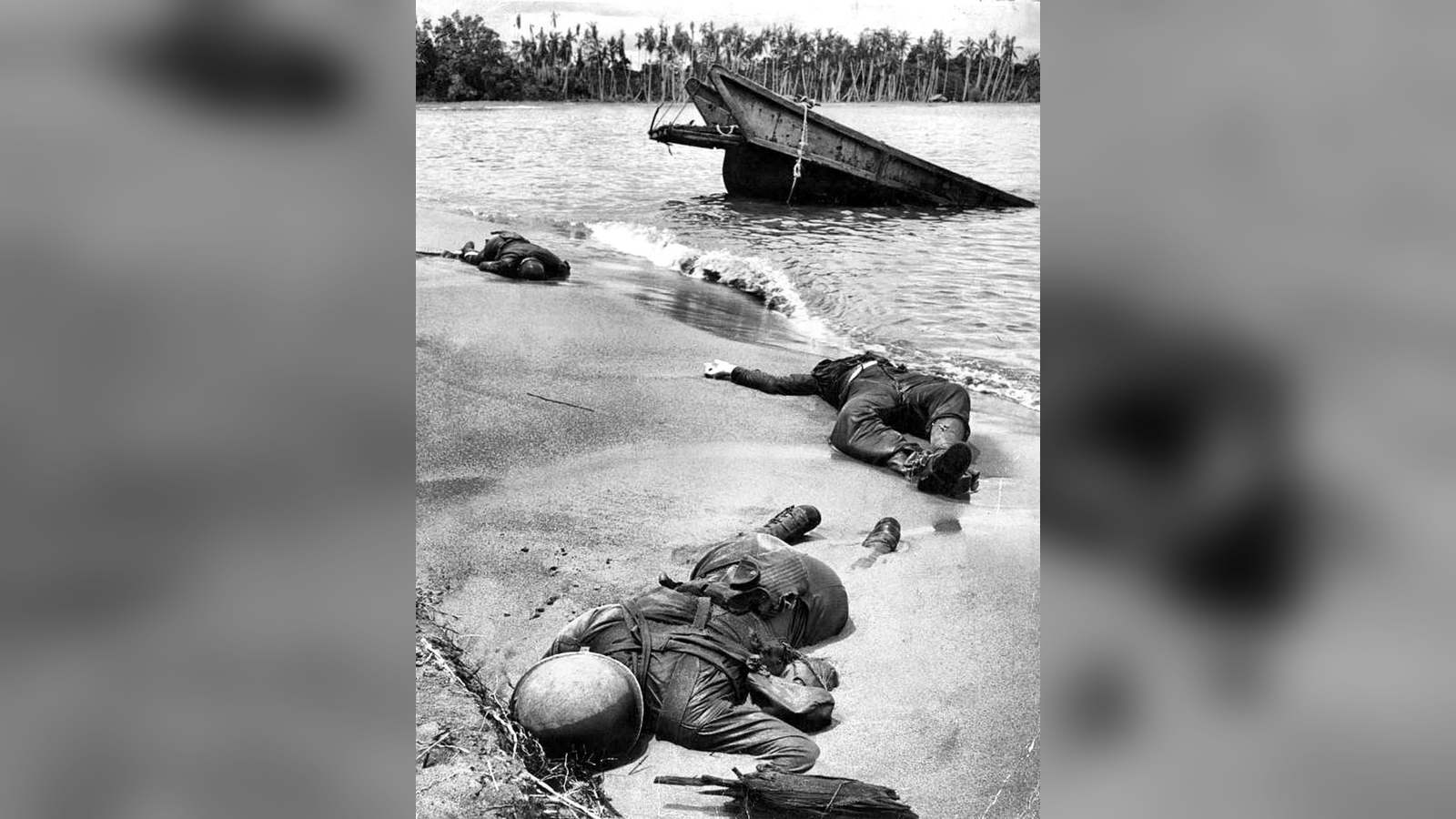
In the foreground of the frame, the wet, dark sand of Buna Beach in New Guinea holds the bodies of three American soldiers. They lie where they fell, washed by the Pacific tide, half-buried near the wreckage of a landing craft. None of their faces are visible; one lies on his side, his gear scattered, while the others are prone, face-down in the earth. Captured by LIFE magazine photographer George Strock in early 1943, this quiet and devastating image did not capture a moment of heroic action, but rather the cold, silent aftermath of combat. It is an image that shattered a strict military taboo, raising a vital question for a nation at war: how did a photograph of three nameless, fallen soldiers bypass intense government censorship to change the course of American media history?
What the photograph shows
The composition of Strock’s photograph is remarkable for its stark, unromanticized realism. The horizon is low, dominated by a gray, overcast sky that casts a flat, somber light across the beach. In the background, the skeletal remains of a destroyed landing craft and scattered military debris break the shoreline, hinting at the violence of the amphibious assault that had taken place hours before. The three soldiers are positioned diagonally across the frame. The lack of visible faces is a crucial detail; it preserved the anonymity of the deceased, sparing their families the shock of recognizing them before official notification. Yet, this anonymity also lent the image a universal power. These were not specific, named casualties; they represented any American mother’s son, making the loss deeply personal for every reader who looked upon the page.
The moment behind the lens
The photograph was taken in January or February of 1943 during the Battle of Buna-Gona, a exceptionally brutal phase of the New Guinea campaign. Allied forces, primarily consisting of American and Australian troops, fought under grueling tropical conditions to dislodge deeply entrenched Japanese forces. The terrain was a nightmare of swamps, dense jungle, malaria, and oppressive heat. George Strock, an experienced photojournalist working for LIFE, was embedded with the troops on the beachhead. He repeatedly risked his life to document the offensive, nearly dying when an artillery shell exploded near his position. Strock’s camera captured the raw, unvarnished truth of the Pacific theater—a contrast to the sanitized, heroic imagery that dominated the media back home.
The battle with the censors
Although Strock captured the image in early 1943, it would not see the light of day for nearly nine months. Since the attack on Pearl Harbor, the U.S. government, through the Office of Censorship and the Office of War Information (OWI), maintained a strict ban on publishing photographs of dead American servicemen. The official stance was that such graphic depictions would damage civilian morale, spark panic, and undermine the war effort. Strock’s negative was immediately impounded by military censors. However, editors at LIFE magazine, convinced of the image’s profound journalistic and national importance, began a quiet but relentless campaign to get the photo cleared. Cal Whipple, a young, 25-year-old LIFE correspondent in Washington, refused to accept the censors’ denials. He systematically took the case up the chain of military command, moving from captains to majors, colonels, and generals, until the issue finally reached the highest levels of the Roosevelt administration.
Why the White House relented
By mid-1943, the political and social landscape of the United States was shifting. The Roosevelt administration and military leadership were growing deeply concerned about a different kind of threat on the home front: complacency. With major victories in North Africa and Guadalcanal, many Americans had begun to believe that the war was practically won. This optimism led to a dangerous drop in war bond sales, absenteeism in defense factories, and a general relaxation of the national war effort. President Franklin D. Roosevelt ultimately realized that the public needed to understand the true, agonizing cost of victory if they were to sustain the long struggle ahead. In September 1943, the ban was lifted, and FDR personally approved the publication of Strock’s photograph.
The legacy of Strock’s masterpiece
On September 20, 1943, LIFE published the photograph on a full page, accompanied by a powerful, soul-searching editorial titled “Why print this picture, anyway?” The editors argued that to hide the deaths of American soldiers was to treat the public like children, whereas sharing the harsh reality of the battlefield honored their sacrifice and united the country in its resolve. The public response was overwhelming. While some readers were shocked and saddened, the vast majority appreciated the honesty. Strock’s photograph did not demoralize the nation; instead, it galvanized it, boosting war bond drives and industrial production. By bringing the damp, cold reality of Buna Beach into millions of American living rooms, George Strock established a precedent for honest war photojournalism that would shape the coverage of subsequent conflicts, from the shores of Normandy to the jungles of Vietnam.