


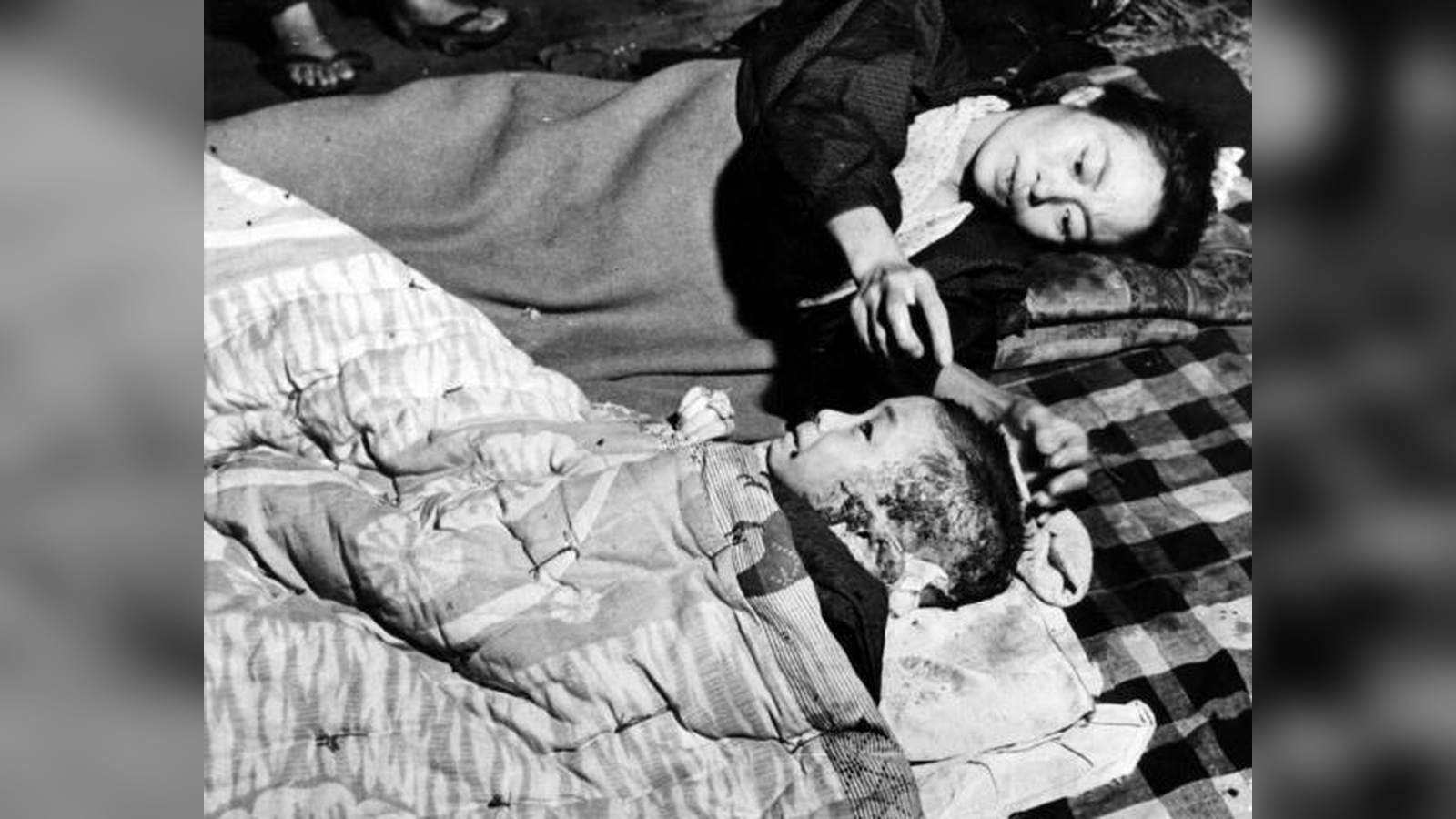
In the scorched aftermath of the world’s first wartime nuclear detonation, a camera lens documented an encounter that strips military technology down to its unbearable human truth: a mother bent over her injured child, offering tender care in a landscape stripped of shelter, medicine, and mercy. Against an expanse of ash, charred timber, and makeshift bandages, her hands cradle the fragile body of an infant burned or lacerated by the blast. This photograph does not depict military targets or mushroom clouds rising into the stratosphere; instead, it anchors the dawn of the atomic age in the quiet, desperate vigil of a woman trying to keep her child alive in the ruins of Hiroshima and Nagasaki in August 1945.
What the photograph shows
The visual composition is dominated by the stark contrast between visceral human intimacy and comprehensive material annihilation. In the foreground, the mother is positioned close to the earth, her posture protective and bowed, shielding the child from the harsh sunlight and blowing dust. Her clothing, like the makeshift cloths or swaddling around the baby, bears the visible wear of a catastrophe: frayed fabric, signs of soot, and rudimentary dressing applied to raw flesh. Depending on the archival print, the infant’s skin shows the cruel signature of the thermal pulse and debris spray—blistering burns, puncture wounds from flying glass, or the swollen quietude of a child in shock. Surrounding them is not a hospital ward, but an improvised relief corner or shelter carved out of absolute debris, where light falls indiscriminately over splintered beams and scorched ground.
The moment behind the image
When the atomic bomb detonated over Hiroshima at 08:15 on August 6, 1945—followed three days later by the plutonium bomb over Nagasaki on August 9—temperatures at the hypocenter soared to several thousand degrees Celsius. Tens of thousands of civilians were instantly vaporized or crushed as blast waves flattened entire neighborhoods within seconds. For those who survived the initial blinding flash and collapsing ceilings, the immediate aftermath was a waking nightmare. Surviving mothers emerged from crushed wooden homes to search for trapped infants, often digging through smoldering beams with bare hands. Survivors recalled how toxic black rain fell from the churning sky, carrying radioactive soot down upon open burns and lacerated skin.
Firsthand accounts from hibakusha—the surviving victims of the bombings—paint an excruciating picture of what mothers faced in those opening hours. Medical centers were decimated; doctors and nurses were killed or grievously hurt, leaving relief stations functioning without sterile water, painkillers, or bandages. Women were forced to treat deep flash burns with old cooking oil, grated cucumber, or scrap cloth, watching helplessly as fever and radiation sickness set in. The photograph freezes this exact crucible: a mother who has pulled her child from the inferno, clinging to life when no systemic aid existed.
Photographer and provenance
Documenting the immediate physical aftermath of the atomic bombings was an act of extraordinary difficulty and peril. In the first days following the blasts, only a handful of Japanese photographers ventured into the radioactive ruins. In Nagasaki, military photographer Yōsuke Yamahata walked through the leveled city on August 10, 1945, producing a legendary series of 119 frames that included unforgettable depictions of nursing mothers and scorched children. In Hiroshima, newspaper photojournalists such as Yoshito Matsushige exposed only a tiny number of negatives on August 6 because the sheer horror paralyzed their fingers, while survey teams led by Shigeo Hayashi and Eiichi Matsumoto later documented the Red Cross Hospital and relief stations across late August and September.
Because several wartime images of mothers nursing or bandaging wounded infants circulated internationally under overlapping captions, photographs from Hiroshima and Nagasaki were frequently conflated in early press archives. Following Japan’s surrender, General Douglas MacArthur’s General Headquarters (GHQ) imposed rigid censorship over the occupied nation under the 1945 Press Code. Photographs showing graphic human suffering, severe flash burns, and the lingering effects of radiation sickness were confiscated or barred from publication to control global public reaction. Negatives were hidden under floorboards, concealed in private darkrooms, or locked in military archives, only resurfacing into public consciousness during the 1950s after the end of the Allied occupation.
Historical context and the hibakusha struggle
Beyond the immediate physical wounds captured on film, the photograph represents the beginning of a lifelong trauma for the mothers and children who survived. Those who lived were labeled hibakusha—literally ‘bomb-affected people.’ In the weeks that followed, an unseen killer emerged: acute radiation poisoning caused hair to fall out, purple spots to bloom across the skin, and rapid systemic collapse. Over the ensuing decades, survivors faced elevated risks of leukemia, malignant cancers, and chronic organ failure.
Cruelly, survivors also suffered severe social ostracism. Wounded mothers and children bearing keloid scars were subjected to pervasive marriage and employment discrimination due to unscientific public fears that radiation illness was contagious or hereditary. As surviving hibakusha grew older, they organized peace movements and disarmament campaigns, insisting that their personal agony be recorded not as a statistic of war, but as a moral warning for all humanity.
Why it still matters
This image endures because it strips the atomic bomb of abstract geopolitical justification and returns the narrative to its human victims. Military histories often reduce nuclear warfare to megatons, delivery systems, and geopolitical calculations. This photograph forces the viewer to look directly at the real cost of such weapons: a wounded child and a mother whose world has been pulverized into ash. Nearly eight decades later, as global conflicts reignite atomic rhetoric and the last living survivors pass away, the photograph remains an unblinking, irreplaceable testament to why nuclear hell must never be unleashed again.