


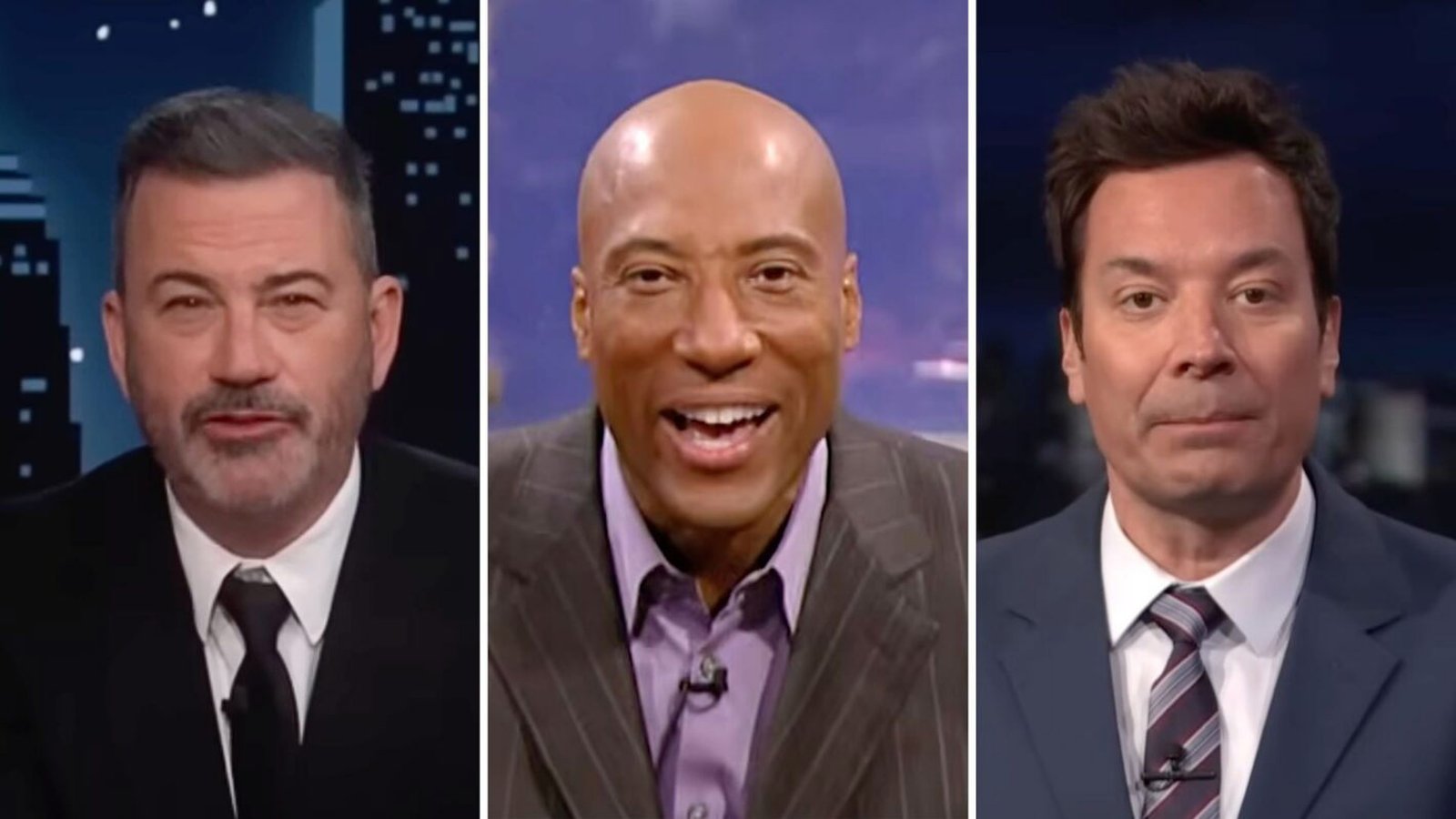
In a milestone shift for late-night broadcast television, Nielsen ratings data licensed and published by media industry outlet LateNighter revealed that a rerun of Byron Allen’s stand-up showcase Comics Unleashed outperformed both ABC’s Jimmy Kimmel Live! and NBC’s The Tonight Show Starring Jimmy Fallon in the key 18–49 adult demographic for Monday, August 24, 2026.
Preliminary live-plus-same-day figures show that Comics Unleashed, airing in CBS’s 11:35 p.m. Eastern time slot, averaged 161,000 viewers in the prized 18–49 age bracket. By comparison, an original broadcast of Jimmy Kimmel Live!—guest-hosted by musician Jelly Roll—drew 158,000 demo viewers during its opening half-hour, while a rerun of NBC’s The Tonight Show recorded 154,000. Although Allen’s syndication-style programming placed third in total overall viewers behind ABC and NBC, the demographic victory marks the first time since Allen replaced Stephen Colbert’s The Late Show franchise on May 22, 2026, that CBS has captured the top spot among younger adult viewers at 11:35 p.m.
A Surprising Shift at 11:35 PM
The week-over-week performance metrics highlight a widening divergence between traditional topical late-night formats and syndication-driven comedy libraries during summer repeat cycles. Compared to the prior week’s ratings on August 17, Comics Unleashed gained 14.5 percent in total viewers, reaching an average of 879,000 overall households, while surging 84.5 percent in the 18–49 demographic. In raw figures, Allen’s opening half-hour gained 71,000 demo viewers week over week.
Conversely, established broadcast competitors suffered notable drops. ABC’s Jimmy Kimmel Live! fell 15 percent in total audience to 1.583 million viewers and dropped 42 percent in the 18–49 demographic, shedding 93,000 demo viewers compared to the previous Monday’s edition guest-hosted by Rosie O’Donnell. NBC’s The Tonight Show Starring Jimmy Fallon declined 11 percent overall to 1.068 million total viewers and lost 15 percent in the key demographic down to 132,000 demo viewers in Nielsen’s direct half-hour breakdown.
The momentum extended past midnight across CBS’s two-hour late-night block. At 12:35 a.m., Allen’s panel game show rerun Funny You Should Ask delivered its second-highest household ratings performance since taking over the post-midnight slot in late May. During its second half-hour at 1:05 a.m., Funny You Should Ask averaged 509,000 total viewers, topping NBC’s Late Night with Seth Meyers rerun half-hour by 13 percent.
The Economics of Evergreen Comedy vs. Topical Monologues
Industry analysts point to fundamental structural differences between traditional network late-night talk shows and Byron Allen’s production pipeline. Flagship talk shows such as Jimmy Kimmel Live!, The Tonight Show, and NBC’s Late Night rely heavily on daily news monologues, celebrity promotional tours, and political commentary. While this topical focus generates immediate social media engagement during initial airings, it creates rapid viewer fatigue when episodes enter repeat cycles during summer holidays and broadcast hiatuses.
In contrast, Allen’s portfolio—produced under the Allen Media Group umbrella—relies on short-form, rapid-fire stand-up clip collections and evergreen comedy panels. Because the material does not reference specific news events or fleeting pop-culture headlines, episodes retain utility across multiple broadcast cycles without appearing dated to casual viewers. This format allows CBS to maintain low operating overhead while avoiding the steep viewership drop-offs that typically affect broadcast networks during rerun periods leading up to the fall television season.
Network tracking indicates that CBS’s full two-hour block has averaged a 13 percent increase among viewers aged 18 to 34 and a 1 percent uptick in the 18–49 demographic compared to the final seasonal averages of Colbert’s late-night tenure, even as total household viewership remains lower than historical broadcast benchmarks.
Demographics and Strategic Implications for Network Television
The 18–49 adult demographic remains the primary benchmark for linear broadcast advertising sales, determining non-preemptable ad rates and corporate sponsorship valuations. For decades, major broadcast networks justified high talent salaries, extensive writing staffs, and live musical production costs by guaranteeing dominant demo delivery to national advertisers.
Allen’s demo victory, achieved with library content that costs a fraction of standard late-night production budgets, presents network executives with a compelling financial case. As cord-cutting reduces traditional linear television audiences, high-overhead talk shows face mounting margin compression. Allen’s low-cost syndication model demonstrates that broad-appeal comedy content can maintain competitive demo density even when competing against original guest-host broadcasts on rival networks.
What to Watch Next
Broadcast networks will closely examine performance data as all major late-night programs return to original production schedules following the Labor Day holiday on September 21, 2026. The crucial test for Allen’s strategy will be whether CBS can retain its newly acquired younger audience once ABC and NBC resume live monologues, high-profile celebrity appearances, and coordinated digital clip distribution. Furthermore, media buyers will assess upcoming fall upfront commitments to determine whether Allen’s demographic surge translates into sustained advertising revenue growth for CBS’s post-local news programming.