


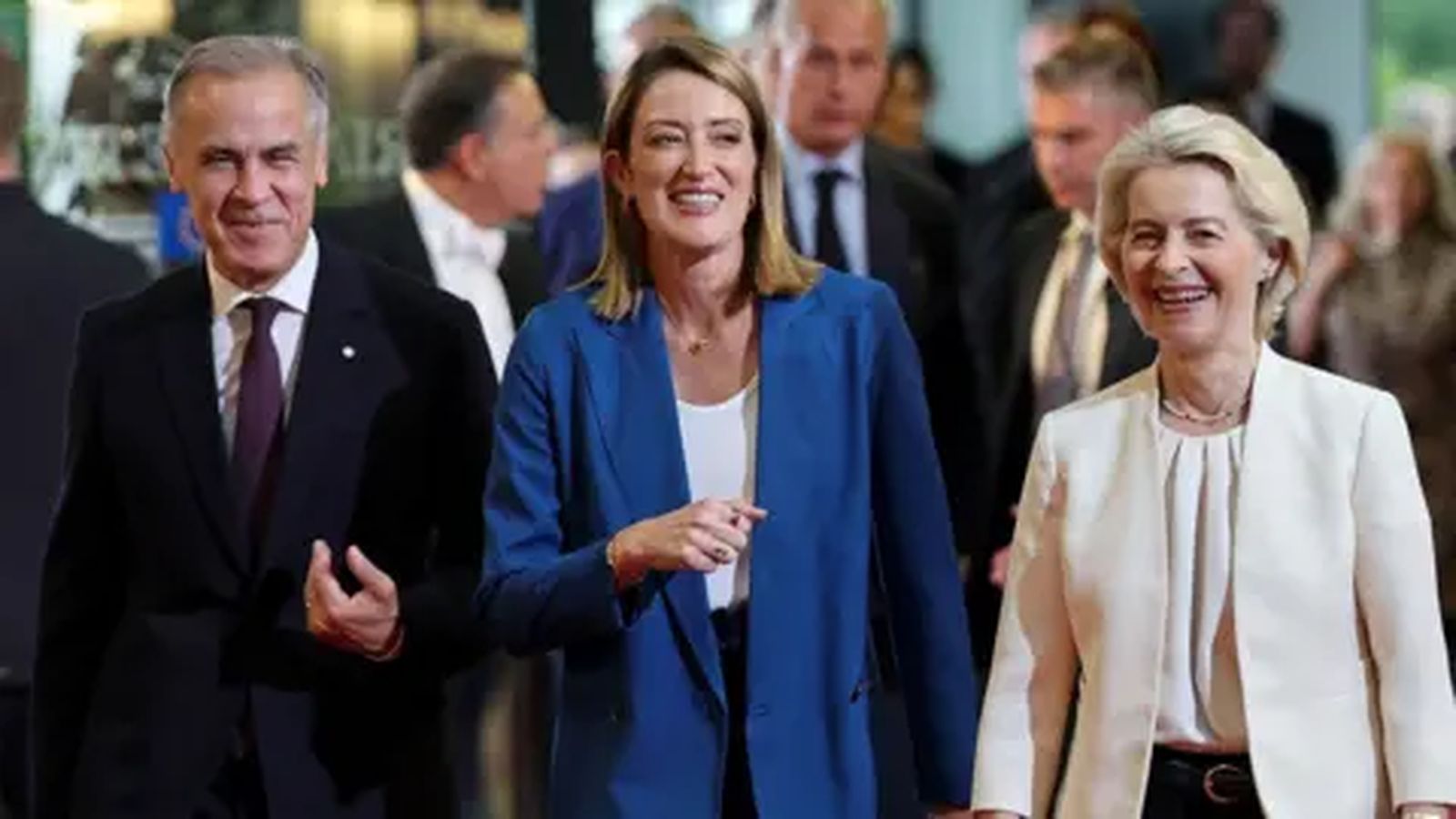
A Strategic Shift in Global Relations
STRASBOURG (Azat TV) – Canadian Prime Minister Mark Carney has formally embraced a proposal from European Commission President Ursula von der Leyen to make Canada the European Union’s first-ever “associate member.” The announcement, delivered to a receptive European Parliament on Thursday, marks a significant pivot in Canadian foreign and economic policy as Ottawa seeks to reduce its historical dependence on the United States.
The proposal, unveiled by von der Leyen on Wednesday, aims to create a new, undefined status within the bloc that would facilitate deeper integration across trade, defense, artificial intelligence, critical minerals, and energy. According to AP, Carney emphasized that the initiative is intended to build national resilience, ensuring no single country can control Canada’s markets or undermine its sovereignty. The move follows months of escalating trade tensions with the U.S., where President Donald Trump has threatened significant tariffs and publicly suggested that Canada could be treated as a “51st state.”
Defining the ‘Associate’ Framework
While the exact legal definition of “associate membership” remains to be negotiated, both parties have signaled that it would transcend existing free trade agreements. Von der Leyen described the vision as an “Alliance for the Future,” fostering a shared prosperity and economic security space. As reported by the BBC, this status would not require full EU membership, which would necessitate surrendering national sovereignty—a “red line” for Ottawa, according to Jonathan Wilkinson, Canada’s ambassador-designate to the EU.
The urgency behind this proposal is driven by geopolitical instability and the desire to circumvent economic coercion. Carney has consistently urged “middle powers” to resist negotiating in isolation against dominant global actors. His approach has found a receptive audience in Brussels, where leaders are similarly grappling with the volatility of trans-Atlantic relations and the potential for a world with diminished U.S. leadership.
The Washington Factor
The proposal has faced immediate backlash from the White House. President Trump warned that he would view such an arrangement as a “hostile act” if he determined the intent to be unfriendly, threatening severe tariffs on the EU in response. Despite the tension, the EU remains committed to exploring the partnership. Carney is set to host EU leaders in Montreal on Oct. 29-30 for a summit to further define the roadmap for this new relationship.
For Canada, which sends approximately 70% of its exports to the U.S., the economic stakes are high. While the EU has previously absorbed tariffs of up to 15% on its exports to the U.S. rather than retaliating, Canada has taken a more confrontational stance. Experts like Daniel Béland of McGill University note that the rhetoric from the Trump administration is actively pushing both Ottawa and Brussels to imagine a future where their mutual cooperation serves as a necessary buffer against external volatility.