


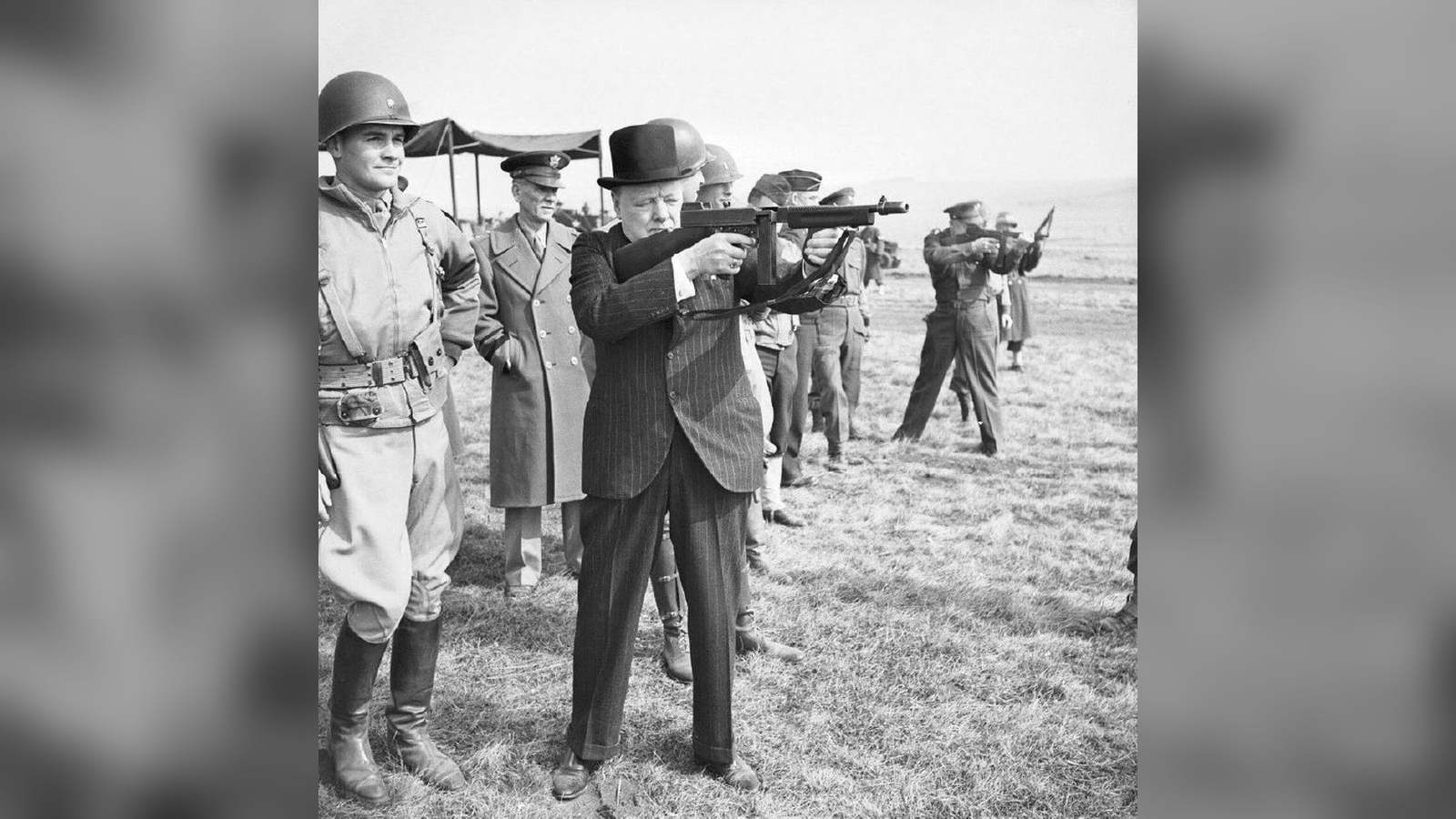
This striking photograph captures British Prime Minister Winston Churchill firmly gripping a Thompson submachine gun during a military demonstration in 1944. The image immediately draws the eye to the fascinating contrast between the statesman’s traditional civilian attire—complete with heavy overcoat and tailored hat—and the aggressive, tactical posture of an armed infantryman. By examining the visual composition, the political motivations behind wartime staging, and the historical circumstances surrounding the frame, this article explores how a single press photograph merged statecraft with martial theater at the height of World War II.
What the photograph shows
In the frame, Winston Churchill leans forward into a classic firing stance, his hands positioned decisively along the wooden stock and horizontal foregrip of a Thompson submachine gun, widely recognized across popular culture by its legendary nickname, the Tommy gun. Dressed in his characteristic heavy winter coat and functional outerwear suited for an outdoor military proving ground, his facial expression reflects intense concentration rather than casual amusement. Accompanying high-ranking military officers, aides, and observers stand nearby, their postures alert and responsive to the live-fire demonstration unfolding before them. The photographic composition places absolute visual emphasis on Churchill and the weapon, creating a stark, theatrical contrast between high-level civilian leadership and frontline infantry firepower.
Every visible element within the composition reinforces the theatricality of the moment. The open-air training range, marked by distant earthen berms and the sparse winter landscape, provides a rugged backdrop that emphasizes utility over ceremony. Churchill’s grip on the weapon appears practiced and deliberate, his shoulder squared against the recoil, suggesting that the pose was held long enough for multiple news cameras to capture the sequence. The framing deliberately isolates the Prime Minister from the surrounding crowd, turning an informal field test into an iconic tableau of personal engagement with modern mechanized warfare.
The moment behind the image
The photograph belongs to a series of official visits and inspections conducted by Churchill as Allied forces prepared for the final, grueling offensives against Nazi Germany in 1944. Throughout the global conflict, the Prime Minister frequently visited military bases, coastal defenses, and experimental testing grounds to observe new armaments, inspect fortifications, and converse directly with enlisted troops. Brandishing weapons such as the Thompson submachine gun was rarely accidental; it served as a calculated performance designed to project fearlessness, personal vigor, and an absolute, unyielding commitment to total victory.
The immediate moments surrounding the shutter click involved sharp, echoing bursts of gunfire into a designated range, followed by approving nods from accompanying generals and enthusiastic applause from assembled servicemen who witnessed the veteran statesman handling infantry hardware firsthand. Such demonstrations provided invaluable morale boosts, bridging the vast chasm between the secluded war rooms of London and the muddy trenches of the European theater. Churchill understood that public perception was a vital weapon of war, and these staged encounters provided the press with vivid proof of his physical and mental resilience.
Photographer and provenance
Distributed widely by official government information services, military press bureaus, and international news agencies, photographs of Churchill handling military equipment were carefully curated for global newspaper syndication. While specific individual attribution for every wartime press click often varies across historical archives due to anonymous syndication and security protocols, these images were captured under the strict oversight of wartime censorship and publicity bureaus.
Photographers operating under the British Ministry of Information faced tight security restrictions, travel limitations, and logistical challenges, yet they were granted privileged access to document the Prime Minister’s public appearances. These professionals operated under immense pressure to deliver imagery that met both aesthetic standards and state propaganda objectives. Their work ensured that striking visual records reached the domestic public and international allies alike, reinforcing confidence in ultimate victory and cementing Churchill’s legendary public persona.
Historical context
By 1944, the global conflict had entered its most critical, punishing, and decisive phase. The impending liberation of Nazi-occupied Europe placed immense psychological and physical pressure on Allied leaders. Churchill understood that public perception was a vital strategic asset. Images showing the aging Prime Minister actively engaging with the tools of modern infantry warfare reinforced the broader cultural narrative of an unbroken national spirit. The Thompson submachine gun itself, heavily associated with interwar American crime syndicates and prohibition-era gangsters, had been widely adopted by British commando units, airborne troops, and Home Guard formations, making it a fitting prop for a leader who championed irregular warfare, clandestine operations, and fierce resistance against fascist aggression.
Why it still matters
Decades after the cessation of hostilities, this photograph endures because it collapses the distance between political authority and armed conflict. It remains a fascinating artifact of mid-century political communication, demonstrating how deliberate visual framing could transform a statesman into an iconic symbol of militant defiance. Long after the smoke cleared from the 1944 firing range, the image continues to fascinate historians, political scientists, and photography enthusiasts as a masterclass in wartime visual culture and public relations.