


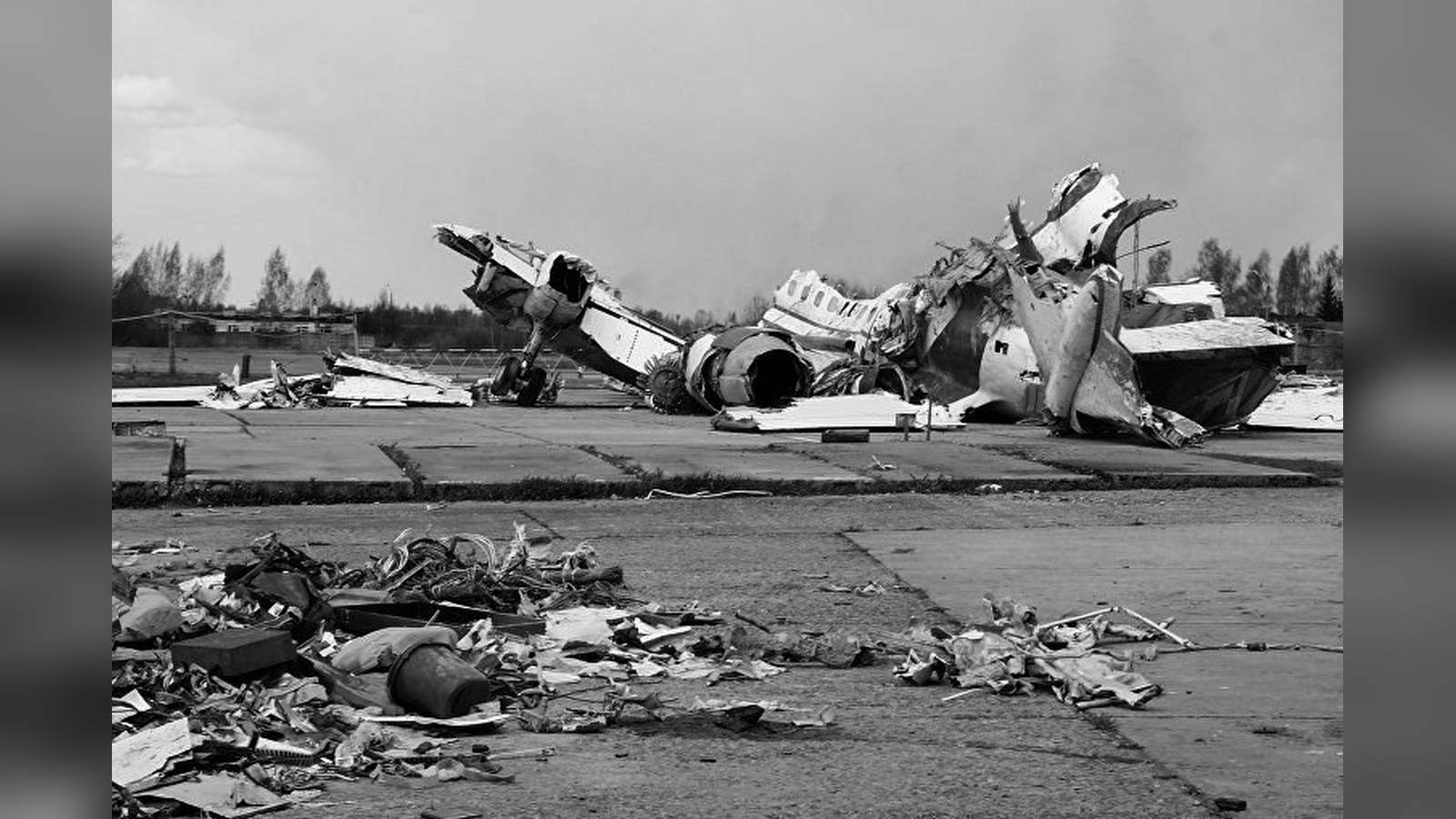
The photograph captures a desolate, scorched landscape in the Haryana district of India, where the twisted, unrecognizable remains of two commercial aircraft lie scattered across the earth like jagged, metallic debris. It is an image of profound, unnerving stillness following an unimaginable kinetic force. The frame is dominated by the gray and silver shards of fuselage, set against the muted, dusty browns of the rural Indian countryside. This haunting scene marks the site of the 1996 Charkhi Dadri mid-air collision, a disaster that remains the deadliest of its kind in aviation history. By examining this wreckage, we seek to understand how a routine flight path turned into a catastrophe that claimed 349 lives.
What the photograph shows
In the foreground, the scale of the destruction is visceral. The metal is warped and blackened, showing the intense thermal energy released during the mid-air disintegration and subsequent impact. Unlike a controlled crash landing, the wreckage here is fragmented, indicating the aircraft broke apart at high altitude. There are no recognizable wing shapes or fuselage sections; instead, the image presents a chaotic mosaic of aluminum, insulation, and personal effects, scattered across a wide radius. The lack of emergency vehicles or crowds in this specific frame emphasizes the isolation of the rural location, highlighting the helplessness of the situation at the moment of impact. The textures of the metal—torn, jagged, and fused by heat—contrast sharply with the flat, indifferent earth, emphasizing the total absence of human presence in the aftermath.
The moment behind the image
On November 12, 1996, at approximately 6:40 PM local time, the skies above the village of Charkhi Dadri, roughly 100 kilometers west of Delhi, became the site of a horrific collision. Saudia Flight 763, a Boeing 747-168B carrying 312 people, was climbing out of Delhi’s Indira Gandhi International Airport. Simultaneously, Kazakhstan Airlines Flight 1907, an Ilyushin Il-76TD with 37 people on board, was descending toward the same airport. The two planes collided at 14,000 feet. The impact was instantaneous. The Boeing, having lost its tail section, plummeted into a spiral dive, while the lighter Il-76 disintegrated shortly after the collision. There were no survivors, making this the deadliest aviation accident in the Indian subcontinent and the worst mid-air collision in global history.
Photographer and provenance
The visual record of the Charkhi Dadri crash is primarily composed of images captured by local journalists and photojournalists who arrived at the remote site in the immediate hours following the disaster. Because the crash occurred in a relatively inaccessible rural area, many early photographs were taken under difficult conditions—often at dusk or night—resulting in high-contrast, stark imagery. These photographs were widely circulated by global news agencies such as Reuters and the Associated Press, serving as the primary window for the world to witness the scale of the tragedy. The specific provenance of these images is often attributed to the pool of international press corps covering the incident, though many remain anonymous, reflecting the rapid, chaotic nature of news gathering in the mid-1990s. The image acts as a primary source for the investigation, showing the lack of a concentrated impact crater, which confirmed the mid-air structural failure.
Historical context
The investigation into the disaster, led by the Lahoti Commission, identified a tragic chain of errors. The Kazakh crew had been instructed by air traffic control to maintain an altitude of 15,000 feet, but they descended below this level. Crucially, the final report highlighted that the Kazakh pilots struggled with English, the international language of aviation, which led to a breakdown in communication with the controller. Furthermore, the Indira Gandhi International Airport in Delhi lacked secondary surveillance radar (SSR) at the time. While primary radar could detect the presence of the aircraft, it could not transmit altitude data, leaving the controller to rely on verbal reports from the pilots. This technological gap, combined with the language barrier and a lack of modern collision avoidance systems (ACAS), created a perfect storm of vulnerability.
Why it still matters
The Charkhi Dadri collision forced a global re-evaluation of aviation safety standards. It underscored the absolute necessity of standardized English language proficiency for international flight crews and the critical importance of installing Airborne Collision Avoidance Systems (ACAS) and modern radar infrastructure globally. The tragedy serves as a permanent, somber reminder of how technological gaps and communication barriers can have devastating consequences. Today, the site remains a place of reflection, and the lessons learned from the wreckage continue to inform the rigorous safety protocols that protect millions of travelers every day. The image remains a vital piece of historical documentation, illustrating the fragility of human systems when faced with the unforgiving realities of flight.