


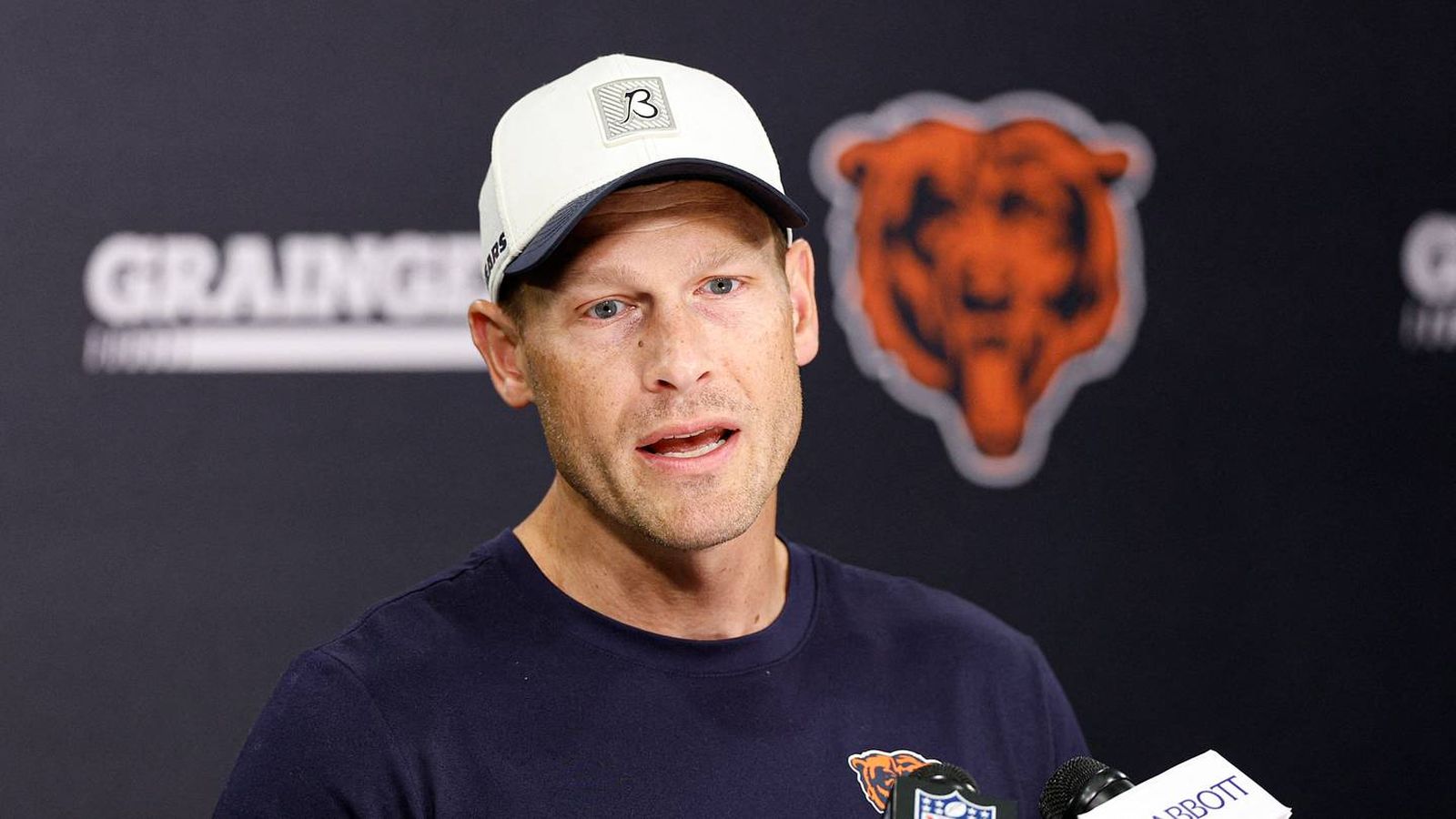
When the Chicago Bears host the Minnesota Vikings in Week 2, the primary focus centers on a high-stakes tactical chess match between two of the NFL’s most creative play-callers: Chicago head coach Ben Johnson and Minnesota defensive coordinator Brian Flores. The division clash pits an explosive Chicago attack that generated 59 points in Week 1 against a high-blitz defensive scheme designed to dismantle opposing passing structures.
Tactical Roots of an NFC North Chess Match
The coaching rivalry between Johnson and Flores is anchored in years of mutual familiarity. As detailed by Windy City Gridiron, both coordinators crossed paths early in their coaching careers when Flores was an assistant in New England and Johnson was on staff in Miami. Their head-to-head dynamic expanded during Johnson’s tenure as offensive coordinator for the Detroit Lions and carried into his head coaching role with Chicago.
Across six games against Flores-led defenses between 2023 and 2025, Johnson holds a 5-1 record. The single loss occurred in Week 1 of the 2025 season, which marked quarterback Caleb Williams’ career NFL debut in Johnson’s system. Aside from that initial transition game, Johnson’s offenses have consistently produced well above league averages against Minnesota’s defensive design.
Deconstructing the Analytics: Johnson vs. Flores
Flores’ defensive methodology relies on aggressive pre-snap disguises and extreme blitz rates to create blocking confusion. According to tracking data published by Windy City Gridiron, Minnesota blitzed Green Bay quarterback Jordan Love on 73.8% of his dropbacks in Week 1. Reporting from DaWindyCity highlighted that this rate crested over 82% during specific situational passes, illustrating Flores’ willingness to abandon traditional coverage numbers to force quick turnover-worthy decisions.
Despite this league-wide effectiveness, Johnson’s offenses have systematically mitigated Flores’ pressure systems. Comparative metrics across six head-to-head contests illustrate this divide clearly:
- Expected Points Added (EPA) per play: League average against Flores sits at -0.04, whereas Johnson’s teams maintain a positive +0.07.
- Success Rate: Opposing teams average a 41.8% success rate against Minnesota, compared to 45.9% for Johnson’s offenses.
- Points per Drive: Johnson’s units average 2.32 points per drive against Flores, substantially higher than the league baseline of 1.77.
- First Down + Touchdown Rate: Johnson achieves a 36.9% conversion rate versus the league average of 27.8%.
- Scoring Output: Johnson’s offenses average 27.5 points per game across six meetings against Flores.
The Blueprint: Quick Snaps and Condensed Sets
Johnson’s tactical advantage relies on two main structural counter-measures: tempo variation and formational compression. Flores’ defensive calls rely heavily on safety Harrison Smith managing pre-snap adjustments after observing the offense’s initial alignment. To prevent Minnesota from making late checks, Johnson utilizes quick-snap procedures that bypass pre-snap motion and force defenders to play static calls.
In Week 11 of the 2025 season, Chicago logged 19 quick snaps—where less than two seconds elapsed between the line getting set and the ball being snapped—which marked their highest single-game total of the year according to NFL Next Gen Stats. Their second-highest total of 17 quick snaps occurred in Week 1 of that same season, also against Minnesota.
Formational width plays an equally critical role. Rather than spreading the field to identify blitzing defenders—a strategy that often falls prey to Flores’ disguised alignments—Johnson condenses his formations. In Week 11 last year, Chicago recorded a league-narrowest average formational width of 17.7 yards. Narrow alignments allow tight ends and receivers to engage edge rushers directly, establishing physical double-teams that power the running game and create throwing lanes for play-action pass concepts.
Trench Warfare and Draft Capital Investments
Analysis from Yahoo Sports points out that while Green Bay attempted to protect its inexperienced offensive line in Week 1 by keeping additional blockers in max-protection, Chicago’s offensive line features greater flexibility. In Week 11 last season, Chicago utilized max-protection on just 2.8% of dropbacks, relying instead on 13-personnel (three tight ends) to create push without compromising pass routes.
Recognizing their vulnerability against physical running attacks, Minnesota spent significant draft assets prior to the 2026 season to fortify their interior defensive front. The Vikings selected defensive tackle Caleb Banks in the first round, linebacker hybrid Jake Golday in the second round, and nose tackle Domonique Orange in the third round. These additions are designed specifically to stop multi-tight end sets and force Chicago into obvious passing downs where Flores’ blitz packages are most potent.
Key Matchups and Divisional Outlook
Chicago enters Week 2 following a 59-37 victory over Carolina in which running backs D’Andre Swift and Kyle Monangai both topped 100 rushing yards and scored multiple touchdowns. Quarterback Caleb Williams posted a 72.4% completion rate with an off-target rate of just 13.8%, demonstrating growing command in his second season under Johnson.
The game will ultimately hinge on whether Minnesota’s newly upgraded defensive interior can slow Chicago’s condensed running game and compel Williams to execute under high blitz volume. For Johnson and Flores, Sunday’s meeting represents another sophisticated tactical iteration in one of the division’s defining coaching matchups.