


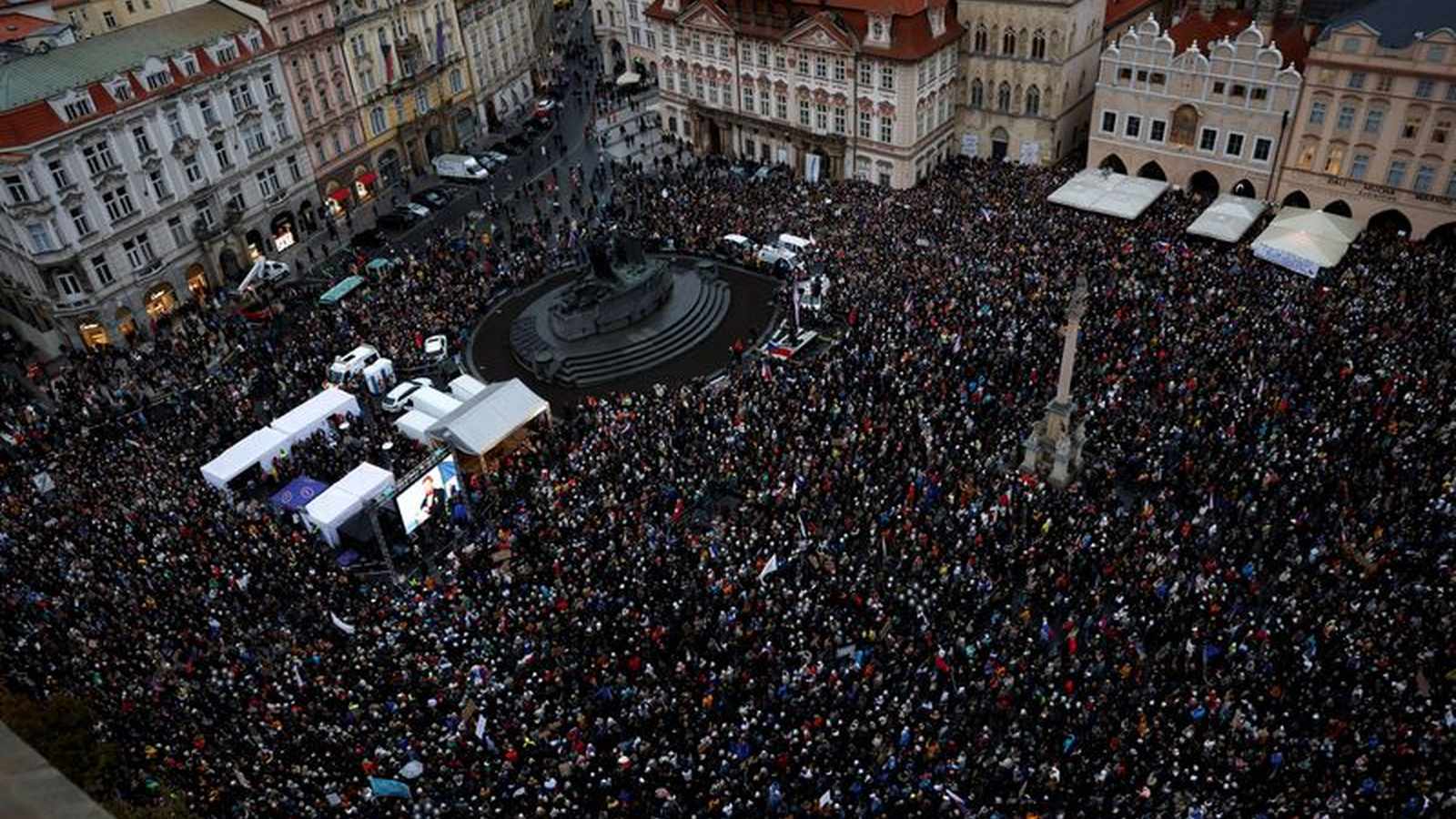
PRAGUE (Azat TV) – Thousands of demonstrators filled Prague’s historic Old Town Square and surrounding streets on Sunday, October 25, 2026, to protest the populist government’s controversial public media funding overhaul Reuters reported. The mass mobilization followed a rare overnight parliamentary vote held at 4:36 a.m. on Saturday, October 24, 2026, during which governing coalition lawmakers unexpectedly advanced the legislation through its first reading.
The fast-tracked bill, championed by billionaire Prime Minister Andrej Babiš and backed by the far-right SPD party, proposes abolishing the household license fees that currently finance Czech Television and Czech Radio. Instead, the broadcasters would rely on direct allocations from the state budget, accompanied by an estimated 15% funding cut. Critics, opposition parties, and international advocacy organizations warn that the structural shift leaves public media vulnerable to direct political interference, drawing parallels to similar media reforms enacted in Hungary and Slovakia.
Overnight Maneuvers Spark Immediate Backlash
The legislative process began unexpectedly on Friday, October 23, 2026, when coalition leaders bypassed regular scheduling to introduce the bill. Speaker Tomio Okamura of the SPD limited debate time before pushing the vote through in the early hours of Saturday morning. SPD parliamentary group leader Radim Fiala defended the tactic, stating that surprise was necessary because opposition parties had threatened to block the proceedings entirely.
Protest organizers and civil society leaders sharply condemned the timing and execution of the vote. Mikuláš Minář, a prominent organizer from the Million Moments for Democracy group, addressed the massive crowds in Prague, comparing the secretive legislative tactics to authoritarian regimes. Protesters chanted slogans such as “Resignation,” “We’ve had enough,” and “4:36,” demanding the immediate withdrawal of the draft legislation and a return to transparent public debate.
Political Stakes and Institutional Concerns
Prime Minister Babiš has defended the overhaul, insisting that state-backed financing is a matter of funding transparency and stability rather than an attack on editorial independence. However, the move has triggered widespread institutional pushback. President Petr Pavel intervened over the weekend, calling for calm while criticizing the rushed parliamentary procedure for undermining public trust. Pavel emphasized that public service media remain foundational pillars of Czech democracy and should only undergo substantial restructuring after thorough expert and public scrutiny.
International watchdogs have also mobilized against the proposal. On Friday, October 23, 2026, the European Broadcasting Union joined 15 other organizations, including Reporters Without Borders and various public broadcasters, in urging Czech lawmakers to halt the fast-tracked process and protect the financial sustainability of independent journalism.
Next Steps and Escalating Labor Unrest
With the bill currently advancing to the parliamentary committee stage, opposition leaders and civic groups are preparing for a sustained campaign of resistance. Czech Television staff and associated labor unions have announced an all-day strike scheduled for November 3, 2026. In addition, organizers have called for an even larger demonstration at Prague’s Letná park on November 15, 2026, just two days before the anniversary of the 1989 Velvet Revolution.