


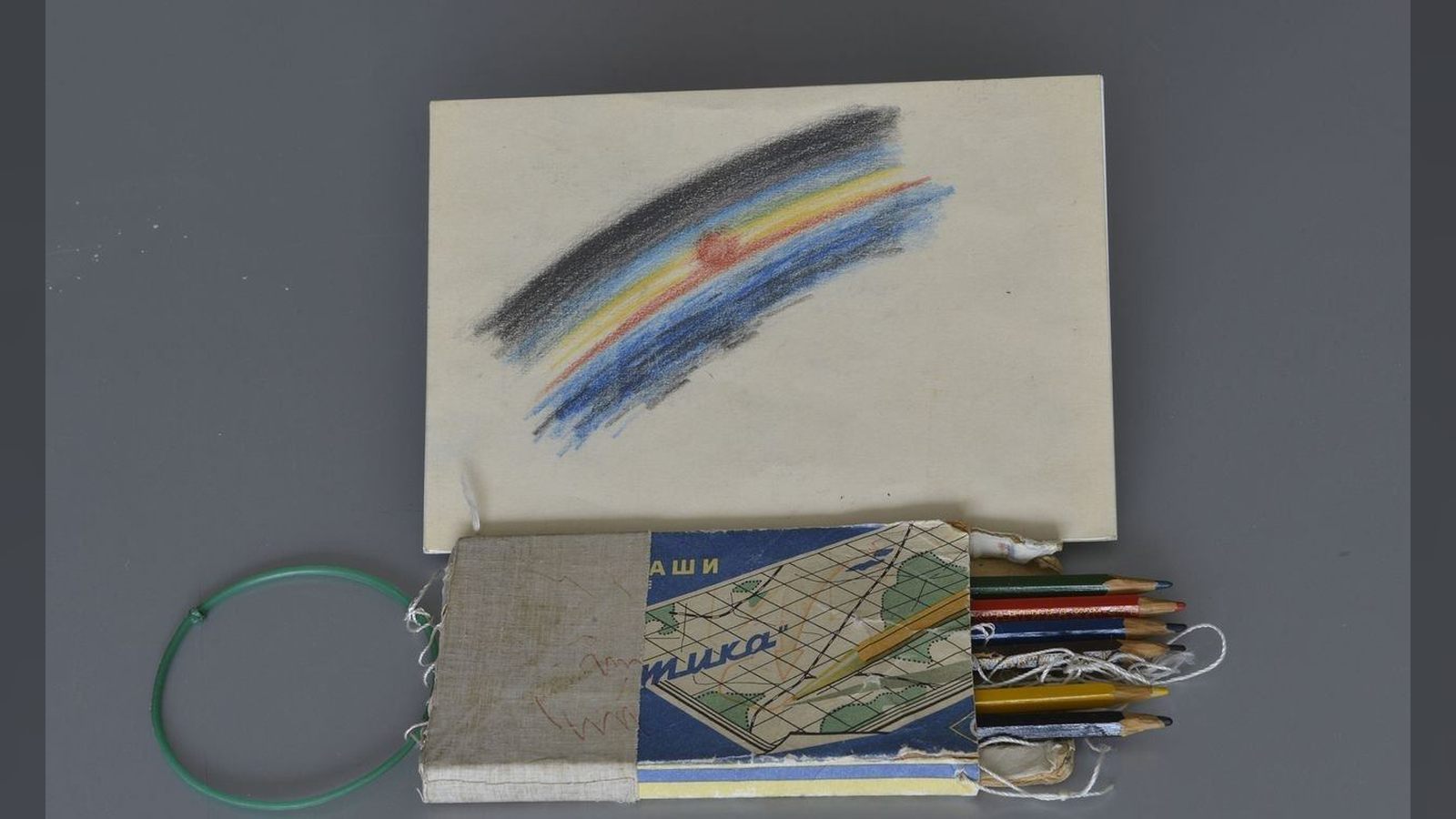
Inside the cramped and instrument-lined cabin of the Voskhod-2 spacecraft in March 1965, cosmonaut Alexei Leonov holds a small sketchbook bound with custom harness straps. Fresh off completing humanity’s very first spacewalk, Leonov used custom-tethered colored pencils to sketch the glowing curve of the Earth and the sudden burst of orbital sunrise. This photograph, taken during the mission, captures not only a milestone in human spaceflight but also the exact moment when art crossed the threshold into outer space.
What the photograph shows
The image reveals Alexei Leonov seated inside the spherical crew module of Voskhod-2, dressed in his heavy flight suit, focused intensely on a compact paper pad. Tethered to his wrist and wristband frame are specialized colored pencils, attached with elastic cords to prevent them from drifting into zero-gravity suspension. On the pad visible in the photograph, soft bands of blue, black, and radiant yellow depict the Earth’s curvature illuminated by the sun breaking over the atmosphere. The lighting inside the cabin highlights the metallic controls of the spacecraft alongside the humble graphite and wax sketch, creating a striking contrast between high Cold War technology and fine artistic impulse.
The moment behind the image
On March 18, 1965, Voskhod-2 launched from the Baikonur Cosmodrome with Commander Pavel Belyayev and pilot Alexei Leonov. During the mission’s second orbit, Leonov entered the inflatable Volga airlock and stepped into the vacuum of space, tethered by a 5.3-meter cable for twelve minutes and nine seconds. Upon returning to the cabin—a feat that required him to bleed air pressure from his dangerously swollen suit to squeeze back inside head-first—he took a rare break from technical procedures. Picking up his sketchbook, Leonov translated the overwhelming visual sensation of viewing Earth from orbit into a quick, vibrant pencil drawing, creating the first piece of art produced in extraterrestrial space.
Photographer and provenance
The photograph was taken aboard the Voskhod-2 spacecraft using automated and hand-held onboard cameras operated by Commander Pavel Belyayev and Leonov himself. The original mission photographs and flight logs were classified under Soviet state security protocols before being processed by the Gagarin Cosmonaut Training Center and the Soviet Academy of Sciences. Following the mission, images of Leonov with his orbital sketch were released through official news agency TASS and featured in Soviet periodicals such as *Ogoniok*, quickly circulating internationally as symbols of both technological achievement and human artistic expression in orbit.
Historical context
Alexei Leonov was born on May 30, 1934, in the Siberian village of Listvyanka, the eighth child of a family heavily affected by Stalinist repressions in 1937. Leonov possessed a profound talent for visual art and initially sought to enroll in the Riga Academy of Arts, but lack of financial means forced him to enroll in military flight school instead, graduating from the Chuguyev Military Aviation School in 1957. Selected in 1960 for the first Soviet cosmonaut group alongside Yuri Gagarin, Leonov never abandoned his artistic passion. The 1965 Voskhod-2 mission took place at the height of the Space Race between the Soviet Union and the United States, making every visual record brought back from orbit a vital piece of political and cultural history.
Why it still matters
The sketch produced aboard Voskhod-2, preserved today in museum collections alongside the photographs documenting its creation, remains a testament to human curiosity under extreme conditions. Shortly after Leonov completed the drawing, Voskhod-2 suffered automated navigation failures, forcing Belyayev to execute a manual re-entry that landed the crew deep in the snow-covered taiga near Solikamsk, where they survived freezing temperatures for two days before rescue teams arrived. That Leonov’s drawings and the photographic record survived intact adds to their status as rare artifacts of early space exploration, proving that even at the edge of human survival, the desire to visually capture beauty remains central to the human experience.