


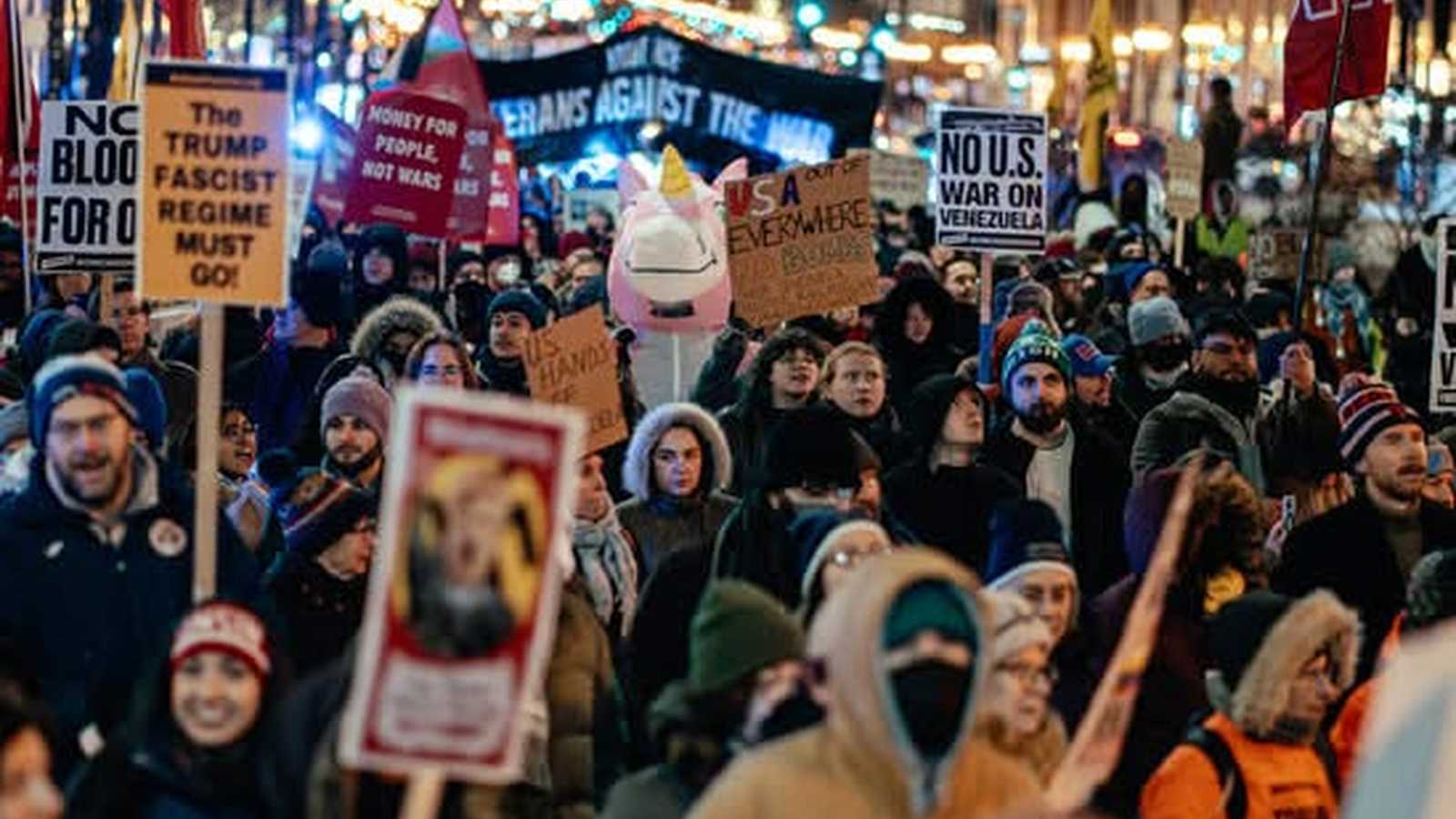
A palpable wave of discontent swept across the United States this past Saturday, January 3, 2026, as two distinct, yet equally charged, protest movements converged in Chicago and Washington D.C. While Chicagoans took to the streets demanding justice and accountability following a fatal police shooting, activists in the nation’s capital rallied against the U.S. military intervention in Venezuela and the dramatic capture of its President, Nicolás Maduro. These simultaneous demonstrations underscored a nation grappling with both internal systemic challenges and contentious foreign policy decisions, revealing deep divisions in public sentiment.
Chicago’s Cry for Justice: The Timothy Glaze Shooting Fallout
In Chicago, the air outside the 10th District Chicago Police Station grew thick with anger and frustration on Saturday as family members and supporters of Timothy Glaze confronted officers. The protest was sparked by the fatal shooting of Glaze on January 3, 2025, in the Little Village neighborhood, and intensified by the revelation that the two officers involved had returned to patrol duty after a mere 30 days on administrative leave. For Glaze’s relatives, seeing the officers back on the beat was not just a procedural matter; it was a profound insult, a glaring symbol of a system that, they argue, often fails to hold its own accountable.
The incident itself unfolded shortly after 2 a.m. on January 3, 2025, inside the Albany Terrace senior living building. Police had responded to a 911 call reporting a domestic dispute and a person armed with a knife, according to the Chicago Sun-Times. Body-worn camera footage, later released by oversight investigators, captured the harrowing moments: Glaze, knife in hand, stepped into a doorway and moved toward the officers, who then fired within seconds. An autopsy report, obtained by WTTW News, revealed that Glaze sustained multiple gunshot wounds, with a total of 16 hits. Toxicology tests also detected the presence of alcohol and cocaine in his system. Following the shooting, officers handcuffed Glaze before rendering aid, as detailed in the body-camera footage.
The decision to return the officers to active duty, initially reported by WTTW, served as a significant flashpoint for Saturday’s protest. Family members and community organizers vociferously criticized this move, arguing that it undermined public trust and demonstrated a lack of sensitivity to the gravity of the situation. Charlotta Pritchett, Glaze’s partner, expressed profound regret over calling 911, and in a stark warning to others, advised against mentioning a “knife” when reporting a crisis, as reported by CBS Chicago. Her words resonate with a broader community concern: how Chicago police respond to mental-health emergencies and the perceived limitations of current crisis-response options. Neighbors and local advocates at the protest highlighted that this case is not an isolated incident but rather underscores long-standing tensions surrounding police interactions in such delicate situations.
The Civilian Office of Police Accountability (COPA) is currently conducting a formal review of the shooting. This independent oversight body holds the power to recommend disciplinary action to the police superintendent if it finds that officers violated department policy, or it can refer the case to the Chicago Police Board, as the Chicago Sun-Times noted. However, officials have cautioned that a final determination could take several months, emphasizing that any administrative or legal outcome would remain separate from a potential criminal review. Organizers, undeterred by the slow pace of official investigations, have pledged to continue their protests until they see concrete steps toward oversight and crisis-response reforms, a commitment echoed by their statements to FOX 32 Chicago. As of Saturday, no new disciplinary actions were announced by city officials, leaving the investigation open and community tensions simmering.
Washington D.C. Rises Against Venezuela Intervention
Meanwhile, across the country in Washington D.C., a different kind of anger fueled protests following the U.S. capture and removal of Venezuelan President Nicolás Maduro. Groups gathered outside the White House and in other cities to condemn what they described as a blatant and illegal act of war by the Trump administration. The feminist anti-war organization CODEPINK released a forceful statement on Saturday, accusing the U.S. of having “bombed civilian and military sites” and “illegally kidnapped” Maduro during a swift American attack in Caracas, Venezuela’s capital. Protest signs bore stark messages like “No blood for oil” and “Stop bombing Venezuela now,” reflecting a deep opposition to military interventionism.
President Donald Trump had characterized the attack as a “large-scale” U.S. strike, which, despite explosions heard across Caracas, reportedly lasted less than 30 minutes. The primary focus of the operation, according to reports, was the seizure and extraction of Maduro and his wife, Cilia Flores. This strike culminated months of escalating tensions and conflict between the U.S. and Venezuela, marked by dozens of U.S. lethal boat strikes on alleged drug trafficking vessels and warnings of a potential land invasion. The Trump administration justified its actions by repeatedly blaming Maduro for allegedly destabilizing the U.S. by flooding the country with illegal immigrants, criminals, and drug traffickers. Furthermore, the administration claimed Maduro covertly headed a prominent Venezuelan drug cartel, framing its intervention as a protective measure for the American people against illegal drugs and a move to remove a dangerous, illegitimately-positioned leader. Trump declared that the U.S. would “run” Venezuela until a “safe, proper and judicious” transfer of power could be facilitated.
However, protesters in Washington D.C. vehemently rejected this official narrative. They viewed the intervention not as an act of assistance to either Americans or Venezuelans, but rather as an illegal maneuver designed to serve the interests of powerful Americans. Brett Heinz, a 29-year-old D.C. resident who protested outside the White House, articulated this sentiment clearly to The Center Square: “Our government has invaded a foreign country without any international legitimacy, in order to suck dry the natural resources of this country and to maintain an undemocratic structure within Venezuela, rather than to replace it, as they say.” This perspective highlighted a profound skepticism regarding the stated humanitarian or democratic aims of the U.S. intervention.
Adding another layer of complexity to the narrative, the Trump administration announced that Maduro and his wife had been indicted in New York and would face multiple criminal charges. U.S. Attorney General Pam Bondi, in a post on X, ominously stated, “They will soon face the full wrath of American justice on American soil in American courts.” Yet, in a stark contrast to the protests in Washington and Chicago, Venezuelan migrants in New York gathered to celebrate Maduro’s removal from power, as noted by The New York Times. This split reaction underscored the multifaceted and often contradictory views on the intervention, both within the U.S. and among the Venezuelan diaspora.
A Nation’s Pulse: Unpacking the Protests’ Significance
The convergence of these two distinct protest movements on a single Saturday offers a powerful snapshot of the United States in 2026. In Chicago, the calls for police accountability and reform in mental health crisis response are not new, but they gain renewed urgency with each tragic incident like that of Timothy Glaze. The community’s persistent demands for transparency from oversight bodies like COPA and a re-evaluation of how officers are handled post-incident reflect a deep-seated desire for systemic change. The emotional pleas of Glaze’s partner and the broader community concerns highlight a critical gap in public safety — one that extends beyond law enforcement tactics to the very fabric of how society supports its most vulnerable.
Concurrently, the protests in Washington D.C. against the Venezuelan intervention speak to a different, yet equally fundamental, debate about America’s role on the global stage. The strong condemnation from anti-war groups and individuals like Brett Heinz underscores a significant segment of the population that views unilateral military actions with suspicion, particularly when framed around resource control or regime change. The narrative put forth by the Trump administration, focusing on national security and drug trafficking, clashes sharply with the protesters’ accusations of illegal war and economic exploitation. This ideological divide is further complicated by the contrasting reactions of Venezuelan migrants, who celebrate Maduro’s downfall, revealing the nuanced and often painful realities faced by those directly affected by geopolitical shifts.
Together, these protests illustrate a nation grappling with the fundamental questions of justice, power, and ethics, both at home and abroad. They are not merely isolated incidents but rather symptomatic of deeper societal anxieties and unresolved issues. The demand for accountability from local law enforcement and the fierce critique of foreign military interventions both stem from a desire for systems that are perceived as fair, transparent, and aligned with democratic values. As COPA’s investigation continues in Chicago and the political fallout of Maduro’s capture unfolds, these protests serve as potent reminders that public vigilance and active dissent remain integral components of a functioning democracy.
These simultaneous protests, though geographically disparate and focused on seemingly unrelated issues, are intrinsically linked by a common thread: a profound public demand for accountability and ethical governance. Whether challenging domestic law enforcement practices or questioning international military interventions, citizens are increasingly asserting their right to scrutinize power and demand that actions taken by authorities, both at home and abroad, align with principles of justice, transparency, and human rights. The sustained nature of these demonstrations suggests a growing impatience with established narratives and a collective aspiration for more responsive and responsible leadership.