


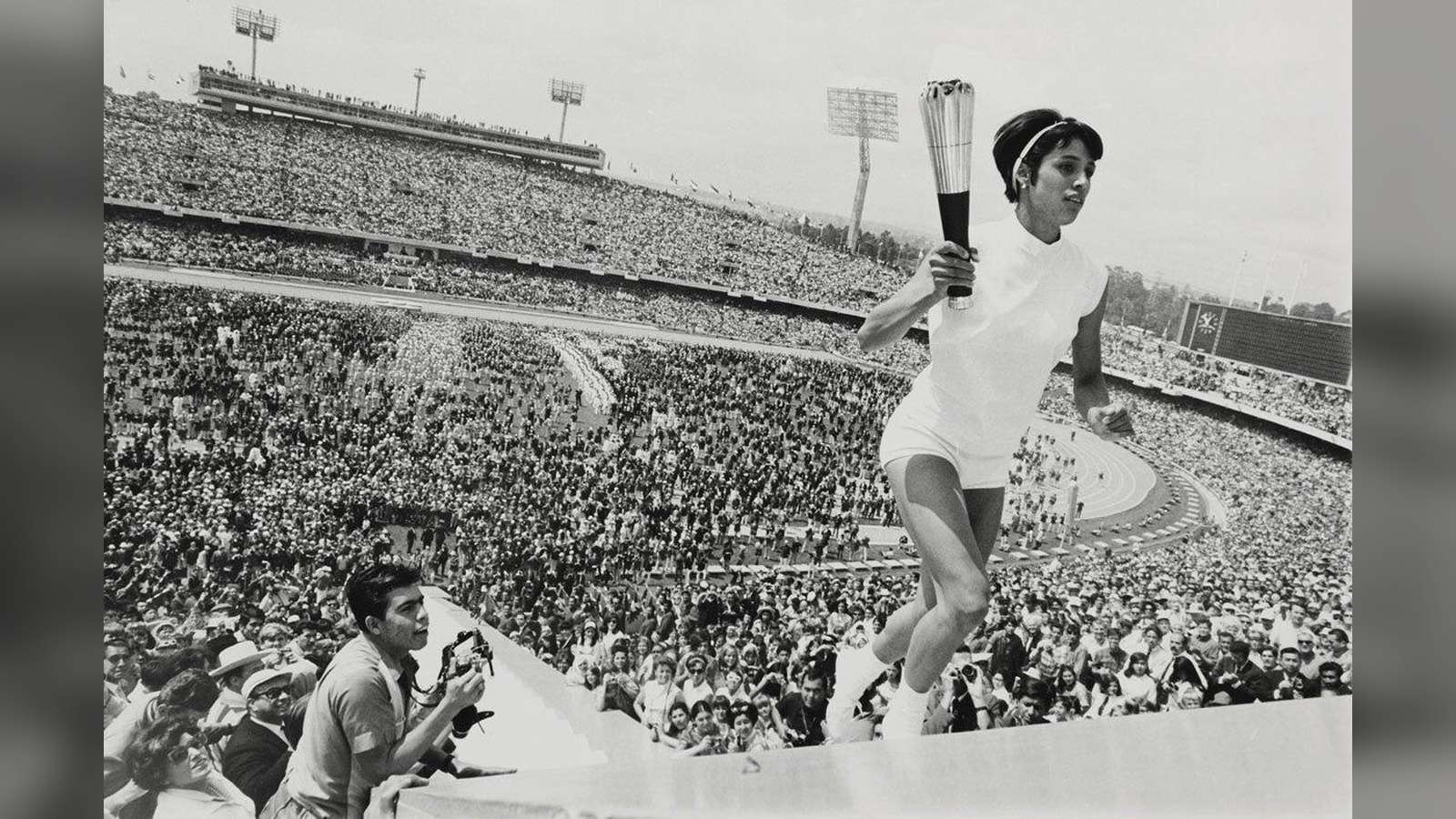
High atop the rim of the Estadio Olímpico Universitario in Mexico City, a twenty-year-old hurdler stands poised against the open sky, her right arm extending a burning metal torch toward the heavy afternoon air. Captured on October 12, 1968, this photograph records the precise instant when Norma Enriqueta Basilio Sotelo—known affectionately to her country as “Queta”—prepared to light the cauldron for the Games of the XIX Olympiad. Her calm posture and white athletic uniform starkly contrast with the immense scale of the arena below her, where over 80,000 spectators and thousands of assembled athletes watched from the stands. This image caught a turning point in sports iconography: for the first time since the modern Olympic torch relay was introduced at the 1936 Berlin Games, a woman was entrusted with the final, supreme ceremonial task of lighting the main Olympic flame.
What the photograph shows
In the framed composition, Enriqueta Basilio appears at the absolute summit of the stadium, standing upon a narrow elevated platform perched at the top edge of the concrete structure. Clad in a clean white running kit emblazoned with the official crest of the Mexican Olympic Delegation, she holds the long, stylized silver torch aloft in her right hand. Her left arm rests gracefully by her side, and her body is turned slightly toward the grandstand. The vantage point chosen by the photographer accentuates her verticality; she stands as a solitary, graceful figure against the horizon, positioned high above the oval stadium floor filled with delegations from around the world. Below her, the crowds pack the concrete tiers, while thousands of white release doves and bright helium balloons drift upward into the sky. The lighting in the photograph captures the contrast between the dark metallic torch, the glowing flame at its tip, and the pale fabric of her uniform, emphasizing her focused composure despite the extreme tension of the public spectacle.
The moment behind the image
The sequence that culminated in this photograph was both a physical test and a tightly choreographed theatrical ritual. The Olympic flame had traversed over 10,000 kilometers from Olympia, Greece, following the historical route of Christopher Columbus across the Atlantic to San Salvador, and eventually into the heart of Mexico City. When the torch entered the Estadio Olímpico Universitario, it was handed to Basilio, a national champion hurdler from Baja California. She carried the heavy torch across the brick-red track, weaving through thousands of cheering international athletes before reaching the formidable flight of 90 steep concrete steps leading to the top rim of the stadium. Breathing heavily but maintaining a steady stride, Basilio scaled the stairs without stumbling. Reaching the top platform, she turned to face the four cardinal directions, lifting the torch to salute the spectators in each quadrant of the stadium. Seconds after this photograph was taken, she brought the flame down to ignite the gas ring of the cauldron, sparking a massive wall of fire that signaled the official opening of the 1968 Summer Games under a 21-gun artillery salute.
Photographer and provenance
This image was captured by photojournalists assigned to the international press corps stationed at the Estadio Olímpico Universitario, including photographers working for major news agencies such as the Associated Press (AP), United Press International (UPI), and Agence France-Presse (AFP). Positioned on specialized camera scaffolds and catwalks along the upper perimeter of the stadium rim, these photographers were tasked with capturing the climax of the Opening Ceremony. Due to the rapid distribution demands of wire services in 1968, black-and-white film negatives were rushed to mobile darkrooms set up inside the stadium press facility, where prints were developed and transmitted globally via analog radio-telephoto transmitters within hours of the ceremony. The photograph quickly graced the front pages of international newspapers and magazines, including TIME and Sports Illustrated, solidifying Basilio’s ascent as one of the defining visual symbols of the 1968 Olympic Games.
Historical context
The 1968 Mexico City Olympics took place against the backdrop of profound global social agitation and local political tragedy. Just ten days before the Opening Ceremony, on October 2, 1968, Mexican armed forces suppressed a peaceful student demonstration in the Tlatelolco district of Mexico City, resulting in the deaths of scores, if not hundreds, of civilian protesters in what became known as the Tlatelolco Massacre. The Mexican government and the International Olympic Committee were desperate to present an image of national stability, modernity, and harmony to the global audience. Selecting a young female athlete to light the cauldron was a deliberate break with tradition designed to highlight Mexico’s progressive spirit on the world stage. While Basilio competed on the track in the 400 meters, 80-meter hurdles, and 4×100-meter relay, she did not advance past the preliminary heats; her sporting legacy was forever sealed not by her race times, but by her heroic ceremonial ascent.
Why it still matters
Before October 12, 1968, the final torchbearer role had been an exclusively male enclave across seven consecutive Olympic Games featuring cauldron lighting ceremonies. Enriqueta Basilio’s presence atop the stadium shattered a patriarchal barrier in global sports media, creating a powerful visual precedent that paved the way for future female athletes to light the flame, such as Cathy Freeman in Sydney 2000 and Naomi Osaka in Tokyo 2020. Until her death in 2019 at the age of 72, Basilio remained a revered figure in Latin American sports and a global advocate for gender equality in athletic administration. The photograph remains an enduring masterpiece of sports photojournalism—capturing a singular moment where athletic poise, historical progress, and political context converged at the summit of the world stage.