


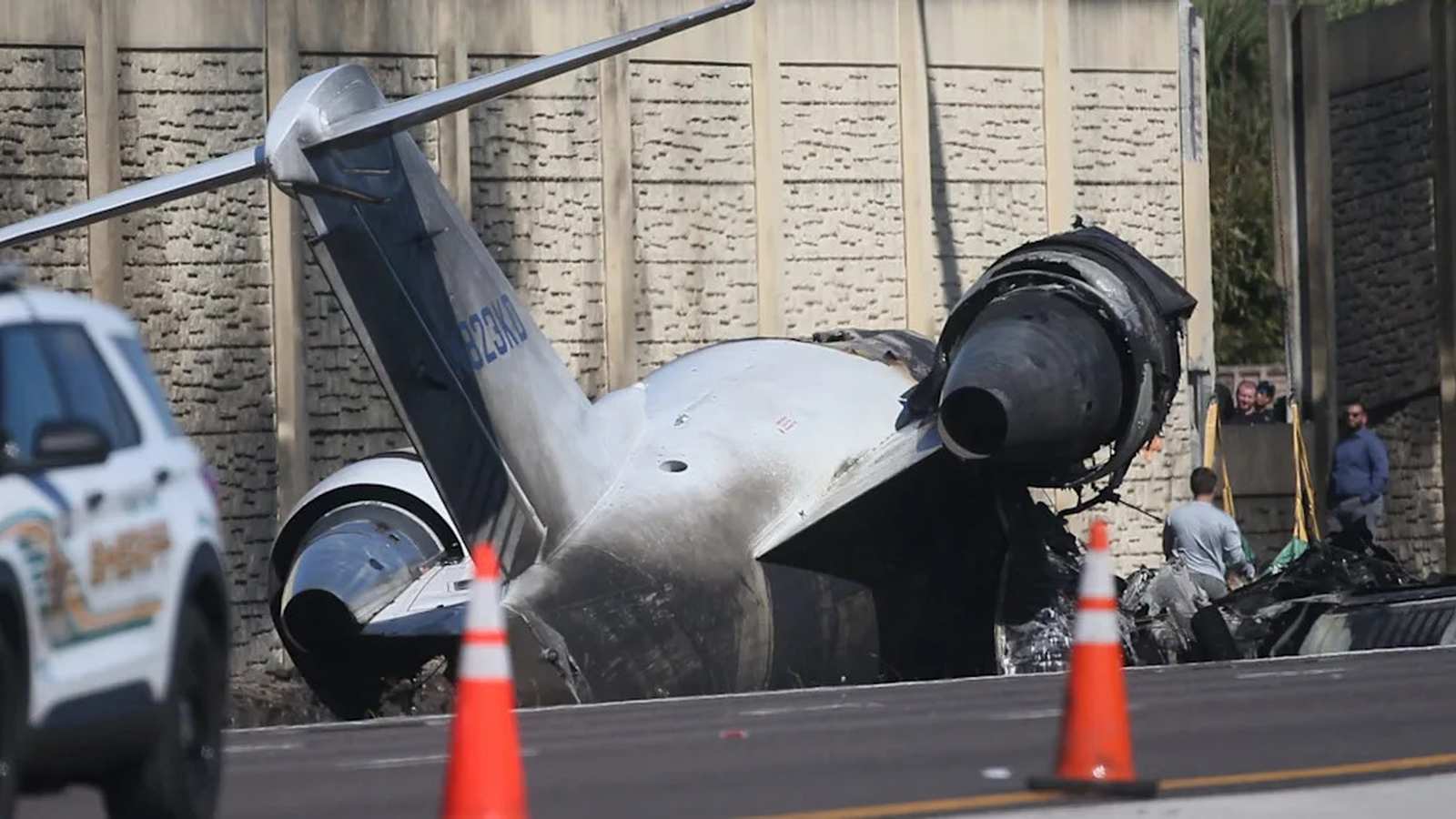
GREENACRES, Fla. (Azat TV) – Federal investigators have launched a complex inquiry into a catastrophic aviation disaster after a private business jet nosedived into a South Florida roadway on Sunday, November 1, 2026, killing all nine people on board. The Learjet 60, operating a flight from Austin, Texas, to the Bahamas, plummeted 27,000 feet in a single minute before striking the pavement in Palm Beach County CNN reported. The high-speed impact created a deep crater near Military Trail and 10th Avenue North in Greenacres, narrowly missing occupied residences and triggering a massive fireball that sent thick black smoke billowing across the community. Florida Governor Ron DeSantis described the disaster as cataclysmic, remarking that the aircraft’s descent resembled a missile strike.
While federal authorities have not yet formally released the complete manifest, grieving family members and subsequent official statements have identified eight of the nine victims. The deceased include Adam Robinson, Helen Sharp, and their two young children, Emma (4) and Charlie (2), alongside caregivers and passengers Rachael Reed, Charmi Fehr, and Anita Maria Cetina. Family statements also confirmed that 20-year-old Nathalia Gadelha Filgueiras was serving as the co-pilot of the doomed aircraft. National Transportation Safety Board officials reported that one person on the ground sustained a non-fatal leg injury from flying debris, though initial reports had indicated zero ground casualties.
Air Traffic Audio and Rapid Descent
Audio recordings captured by LiveATC.net provide a harrowing narrative of the aircraft’s final moments in the air. According to the air traffic control transmissions, co-pilot Nathalia Gadelha Filgueiras initially reported severe icing conditions as the jet cruised at high altitude with an outside temperature measuring minus 47 degrees Celsius. The flight encountered moderate turbulence that displaced the aircraft by up to 700 feet before conditions deteriorated catastrophically. Moments later, Filgueiras issued frantic Mayday calls, radioing the Miami Air Route Traffic Control Center to report an uncontrolled overspeed condition and an astonishing descent rate exceeding 20,000 feet per minute. Flight tracking data from ADS-B Exchange confirmed that the business jet ultimately plummeted 27,000 feet in just sixty seconds before telemetry signals abruptly ceased.
The National Transportation Safety Board has indicated that investigating the wreckage presents formidable logistical hurdles. NTSB Senior Air Safety Investigator Tim Monville noted that recovering the heavy components buried inside the roadway crater remains the primary operational obstacle for recovery teams. Furthermore, NTSB Member Tom Chapman disclosed that preliminary analysis suggests the aircraft may have experienced structural breakup prior to ground impact, raising the possibility that scattered debris fields extend well beyond the immediate crash site in Greenacres.
In-Flight Icing Hazards and Meteorological Focus
Investigators are closely examining meteorological factors, specifically the severe thunderstorm cells and high-altitude icing that the Learjet encountered minutes before its descent. The Federal Aviation Establishment classifies in-flight icing as one of the most severe weather hazards in aviation, capable of rapidly increasing aircraft weight while destroying lift, reducing thrust, and severely compounding aerodynamic drag. Although anti-icing systems are standard equipment on modern business jets, extreme meteorological conditions can overwhelm these protective mechanisms, making level flight impossible and degrading control surfaces.
The aviation safety community has long grappled with the insidious mechanics of high-altitude icing. When aircraft pass through convective storm cells, rapid updrafts can chill moisture to extreme temperatures, creating conditions where ice accumulates faster than thermal or pneumatic systems can clear it. The NTSB previously issued specialized safety alerts emphasizing these exact operational risks for private turbine aircraft, noting that ice accretion can silently compromise handling qualities long before flight crews receive conventional stall warnings. As federal investigators continue examining recovered flight data recorders and physical wreckage, the precise sequence of events leading to the catastrophic plunge remains under rigorous review.