


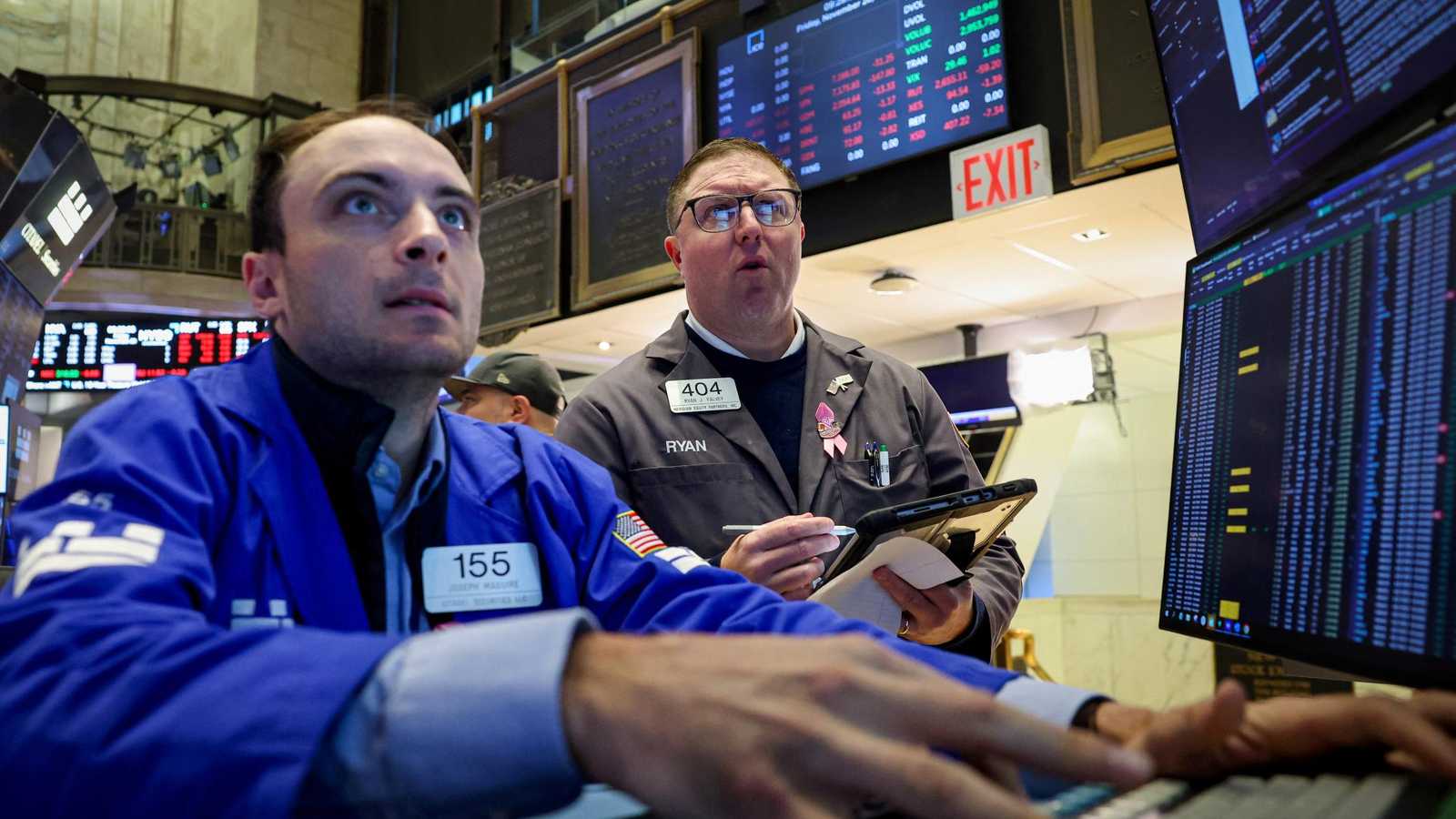
Market Indices Enter Correction Territory
On November 20, 2026, the U.S. financial markets suffered a sharp, structural decline as major indices succumbed to mounting pressures, officially entering correction territory. Both the S&P 500 and the Dow Jones Industrial Average recorded declines exceeding 10% from their recent peak valuations, signaling a profound shift in investor sentiment. The tech-heavy Nasdaq Composite faced an even more severe outcome, erasing all of its gains for the calendar year after closing down 5.3% on the day. This broad market contraction marked the conclusion of a volatile week, characterized by a rapid unwinding of the speculative AI-driven enthusiasm that had served as the primary engine of equity growth throughout the first half of 2026.
According to reporting from the New York Post, the S&P 500 fell 3.7% while the Dow Jones Industrial Average slipped 1.9%, or 949 points. Data from NBC News highlighted that the S&P 500’s seven-day losing streak reached its most significant depth since the onset of the Covid-19 pandemic. This sell-off is not merely a momentary dip but represents a fundamental repricing of the artificial intelligence sector, as investors move away from blind optimism toward a more rigorous, cautious examination of capital-intensive technology projects and their underlying financial viability.
The AI Repricing Phenomenon
Central to this market correction is the performance of Anthropic, which debuted on the Nasdaq on November 19, 2026. Despite a highly anticipated initial public offering that raised $81 billion—surpassing Elon Musk’s SpaceX as the largest IPO in history—the company’s shares plummeted 8.5% on November 20. This decline effectively neutralized the majority of its initial 17% surge, forcing market participants to confront the reality that even the most prominent players in the AI space are susceptible to intense volatility. Analysts suggest this reversal has served as a critical catalyst, compelling investors to re-evaluate the expected timeline for return on investment (ROI) regarding massive, ongoing data center spending.
Mark White, an advisor at Mark White Wealth Advisors, noted that the market is finally acknowledging the gap between the theoretical promise of artificial intelligence and the practical financial reality. “You can be right about AI changing the economy and still pay too much for an AI stock,” White told the New York Post. “When a stock is priced for years of strong growth, even a small change in expectations can produce a big drop.” This sentiment is echoed by institutional observers who believe the current environment reflects a necessary correction of growth expectations rather than a systemic economic collapse.
Regulatory and Geopolitical Headwinds
The market downturn is further compounded by a confluence of regulatory scrutiny and geopolitical instability. The chip manufacturing sector, led by industry giants like Nvidia and AMD, faced a double-digit percentage decline on November 20, with losses exceeding 13% for several key firms. Nvidia is currently navigating intense investigations into potential accounting irregularities, as reported by NBC News. Furthermore, the company has been embroiled in a high-profile scandal involving former CEO Jensen Huang, who was forced out following reports of an affair with a suspected Chinese intelligence asset. This development has triggered congressional interest, with hearings now pending for major industry leaders and government officials.
Simultaneously, the U.S. Commerce Department is moving to tighten export controls on advanced AI chips destined for China. This follows revelations from the House Foreign Affairs Committee that nearly 900,000 advanced chips from Nvidia and AMD were shipped to Chinese entities between December 2025 and May 2026, utilizing loopholes that regulators are now scrambling to close. Treasury Secretary Scott Bessent has publicly criticized Commerce Secretary Howard Lutnick, alleging that Lutnick failed to block these exports despite awareness of government memos linking industry figures to foreign intelligence services. AMD has faced additional pressure after a report from Hunterbrook Media alleged that the firm continued to provide firmware to blacklisted Chinese server maker IEIT Systems, further complicating the geopolitical landscape for semiconductor manufacturers.
The Impact of Political Uncertainty
Political shifts have played a significant role in accelerating the market’s decline. Investors have expressed growing anxiety that the results of the recent midterm elections, which saw a sweep by Democratic candidates, may lead to a federal policy pivot. There is a palpable fear that new leadership could initiate a pause on data center construction—a move that would stifle revenue growth for firms heavily reliant on the expansion of AI infrastructure. Richard Saperstein, chief investment officer at Treasury Partners, described this as a “one-two punch” for the AI sector, noting that the combination of the Nvidia crisis and the midterm election results has forced a rapid recalibration of earnings growth projections.
The market is also contending with broader macroeconomic pressures. Kevin Gordon of Charles Schwab noted that an increasingly “hawkish” Federal Reserve, combined with stubborn inflation and the tech sector downturn, is creating dual forces that threaten to cut more deeply into economic growth. While some, such as Dan Ives of Yorkville Ives & Co., characterize the movement as a “panic-driven sell-off” rather than a systemic failure, the market remains fragile. As companies prepare to report their next round of earnings and government agencies finalize more stringent export regulations, investors remain hyper-focused on the long-term sustainability of capital expenditures and the ongoing impact of geopolitical tensions on global supply chains.
Looking Ahead
The current correction highlights the inherent risks in a sector where valuation is heavily dependent on future growth expectations that may no longer align with current regulatory and political realities. With the Nasdaq having erased its 2026 gains and the broader indices in correction territory, the next few months will be decisive. Investors are seeking more reliable returns, as evidenced by increased purchases of U.S. Treasury bonds, signaling a flight to safety amid signs of weakening growth. The transition from speculative AI investment to a more disciplined, value-oriented approach appears to be the defining characteristic of this market cycle, as the industry navigates a period of profound structural change.
Reporting source: nypost.com.