


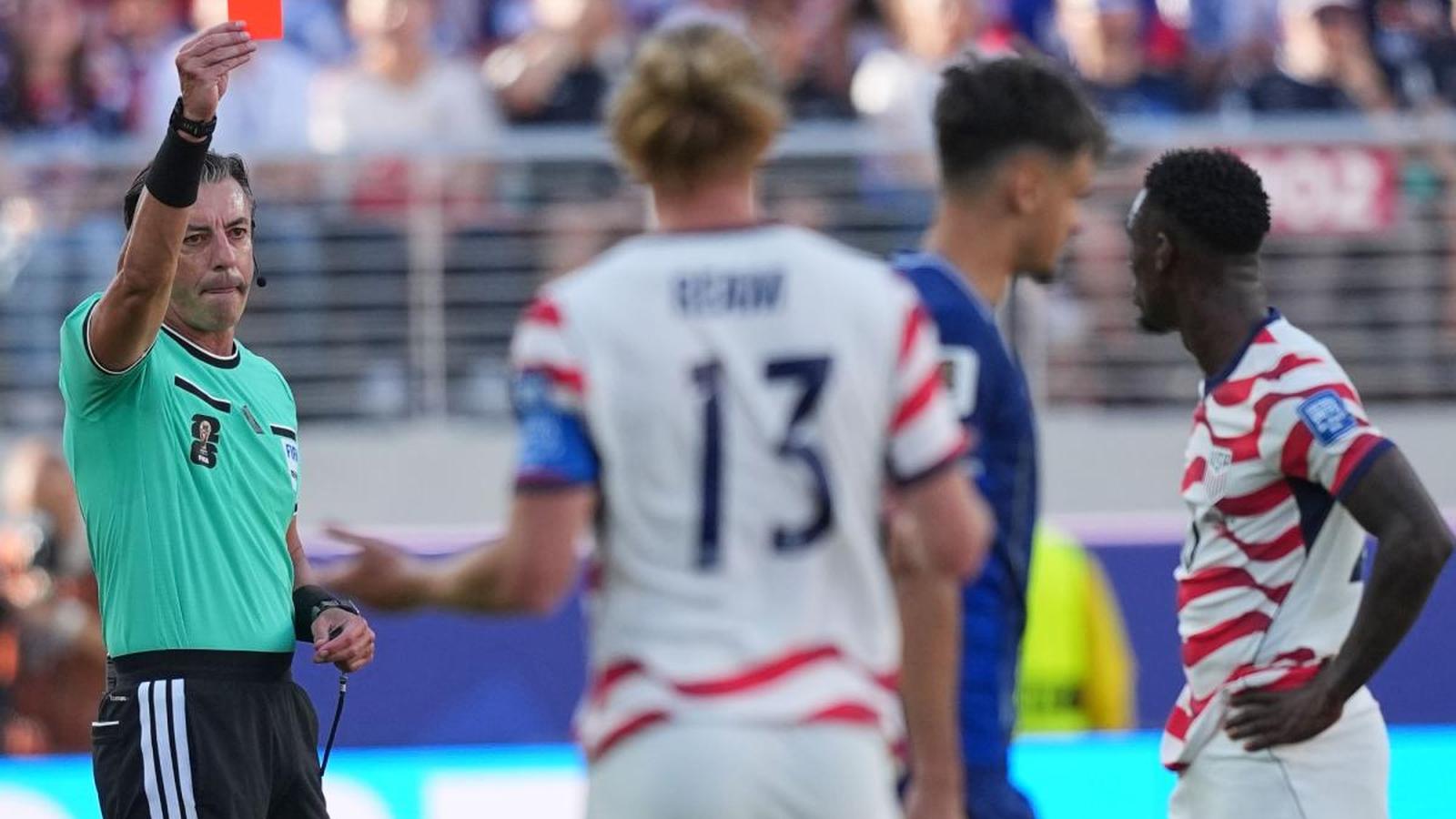
ESPN reported that FIFA President Gianni Infantino will chair the first session of the 37-member FIFA council in Zurich, where a motion to close the loophole that permitted Balogun’s reprieve will top the agenda. The meeting follows months of mounting scrutiny over governance standards and executive overreach within world football’s governing body.
The Balogun Controversy and Political Interference Claims
Folarin Balogun was sent off during the United States’ group-stage match against Bosnia and Herzegovina following a challenge on an opponent’s ankle. Under long-standing FIFA regulations, the offense carried an unreviewable mandatory one-match suspension that would have forced the forward to miss the team’s round-of-16 clash against Belgium.
However, the disciplinary committee subsequently reversed the ban, allowing Balogun to play in the team’s 4-1 loss to Belgium, as reported by the New York Post. The decision triggered immediate public outcry and accusations of political interference after U.S. President Donald Trump publicly admitted he had personally asked Infantino to review the suspension.
The extraordinary reversal drew international condemnation and formal inquiries. Football Association chair and FIFA vice president Debbie Hewitt subsequently wrote to Infantino demanding transparency and the release of all documents related to the decision, while Infantino maintained that the disciplinary committee operated independently.
Integrity Watchdog Scrutiny and Betting Markets
The controversy deepened when the Group of Copenhagen, the sporting integrity arm of the Council of Europe, flagged the Balogun red-card reversal in its post-tournament audit. According to the New York Post, the watchdog issued one of seven yellow notices for the 104-match tournament over the incident, noting unusual activity on prediction markets such as Polymarket where users traded on whether Balogun would be permitted to play.
While integrity experts emphasized that a yellow notice does not inherently indicate match manipulation, the opaque nature of prediction markets and the unique overturning of the only red card among 15 tournament expulsions raised severe conflict-of-interest concerns. The Council of Europe requested a formal written explanation from FIFA regarding the sequence of events.
Wider Governance Crisis at FIFA Headquarters
The rule-change motion arrives at a critical juncture for Gianni Infantino, who faces the most severe leadership challenge of his nearly 11-year presidency ahead of the November 18 candidate entry deadline for the upcoming election in Rabat, Morocco. In addition to disciplinary procedures, the Zurich council meeting is set to debate Infantino’s recently dropped proposal to sell a permanent stake in tournament rights to private investors led by Joshua Kushner, a plan that sparked internal rebellion and led departed chief operating officer Kevin Lamour to label it “the project of one person.”
National federations remain divided. While many associations have benefited financially from FIFA’s substantial reserves, the convergence of political lobbying, integrity audits, and executive centralization has placed intense pressure on the organization’s leadership structure as the Swiss-based body approaches its next electoral cycle.
Reporting source: espn.com.