


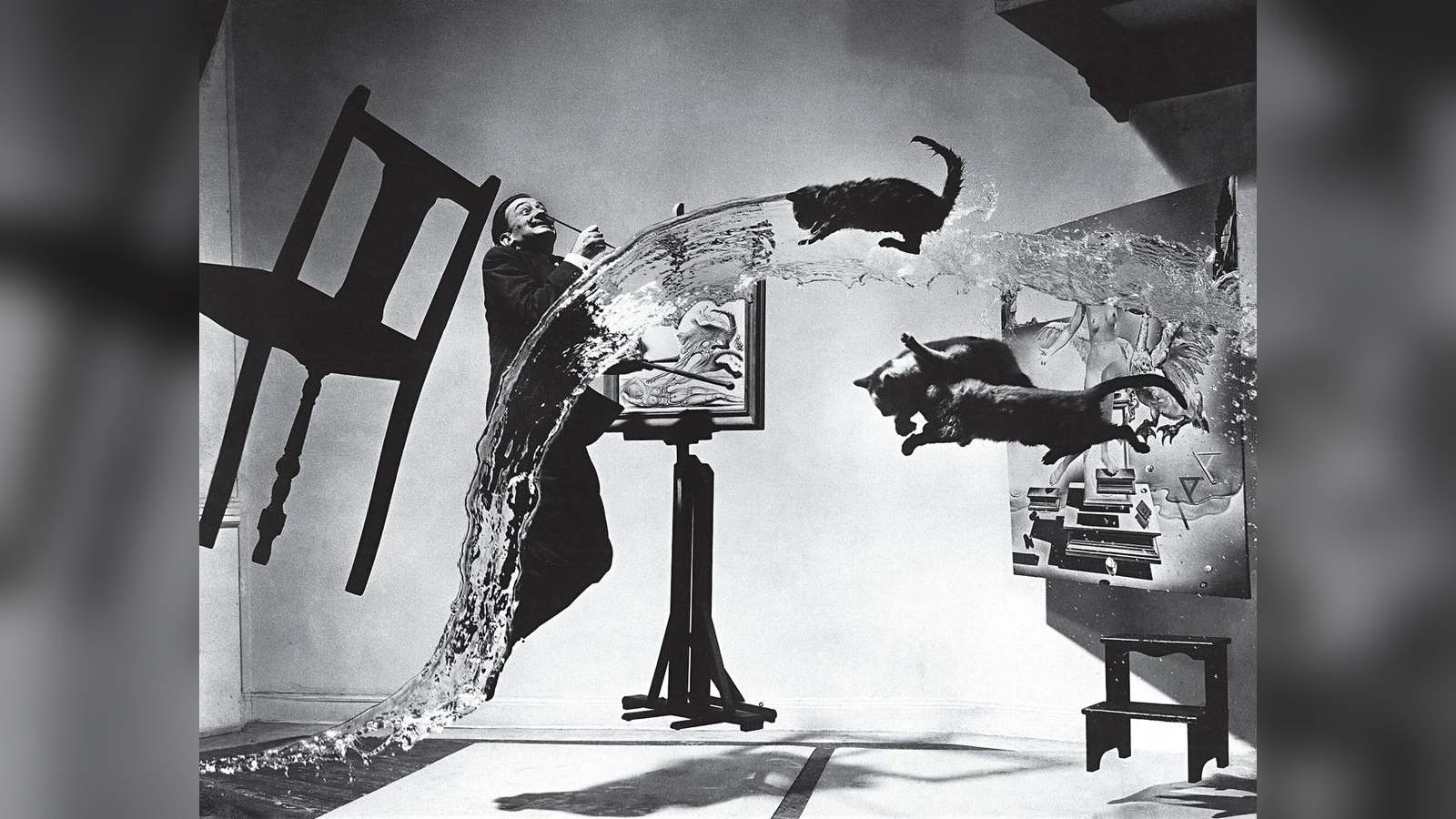
A thick, glistening ribbon of water curves through the air like sculpted glass, three domestic cats hurtle sideways with splayed limbs, and Salvador Dalí hovers several inches above the studio floor, brushes and palette clutched firmly in his hands. In Philippe Halsman’s 1948 masterwork Dali Atomicus, the laws of terrestrial gravity appear entirely suspended. This instant captures a collision of high-wire technical precision and sheer surrealist delirium, freezing an entire room in a state of levitation decades before digital image manipulation existed. How did an exiled Latvian portrait photographer and the world’s most flamboyant painter spend an exhausting afternoon choreographing twenty-eight takes of water, felines, and furniture, and why does this single analog negative remain an enduring landmark of photographic history?
What the photograph shows
Every element within Dali Atomicus is caught in mid-motion, creating a visual rhythm that draws the eye across the frame. On the far left, a carved wooden easel, a chair, and a footstool seem to hover weightlessly above the wooden floorboards, their invisible suspension wires later removed in darkroom finishing. Cutting across the middle ground is an enormous plume of water hurled from a bucket off-camera; caught in high-speed flash illumination, every droplet refracts light with crystalline clarity. Flung along roughly the same trajectory are three cats, their postures capturing genuine panic and airborne confusion.
To the right of the water, Salvador Dalí himself is frozen at the apex of a vertical leap. Dressed in a formal dark three-piece suit with crisp white cuffs, his posture remains remarkably composed despite the exertion. His trademark waxed mustache points skyward, and his eyes bulge outward in a theatrical stare directly aimed at the lens. In his right hand he balances a wet paintbrush, while his left grips an artist’s palette. Just behind him rests his canvas Leda Atomica, suspended on an easel with no visible contact with the ground. The background is a sparse studio wall, reminding the viewer that this impossible tableau unfolded inside a tangible, physical room.
The moment behind the image
The creation of Dali Atomicus took place during an exhausting six-hour session in the summer of 1948 at Halsman’s studio at 33 West 67th Street in New York City. The shoot was an intensely collaborative, physically punishing performance. Working without computers or photographic trick composites, Halsman and Dalí had to coordinate several chaotic physical events into a fraction of a second. The studio crew consisted of Halsman’s wife, Yvonne, his young daughter, Irene, and several weary studio assistants.
The sequence was governed by a strict vocal countdown. On the count of one, Yvonne and an assistant held the chair and easel steady. On two, assistants prepared buckets of water and gathered the cats. On three, an assistant hurled the bucket of water from the right while two others tossed the cats across the field of view. On four, Dalí leaped straight up into the air. At the count of five, Halsman clicked the shutter of his custom-built twin-lens reflex camera, synchronized with high-power electronic strobes. After each take, Halsman rushed into the darkroom to develop the sheet film while the assistants mopped the floor, caught and dried the thoroughly bewildered cats, and reset the flying furniture. It was only on the twenty-eighth attempt that the water formed an unbroken wave without obscuring Dalí’s face, all three cats were visibly airborne, and the artist achieved the required height and theatrical expression.
Photographer and provenance
Philippe Halsman, born in Riga, Latvia, in 1906, had built a reputation in Paris before escaping the Nazi invasion of France in 1940 with the personal intervention of Albert Einstein. Upon arriving in the United States, Halsman quickly became one of LIFE magazine’s premier cover photographers. He possessed both rigorous technical discipline and an appetite for psychological experimentation. Working with Dalí offered Halsman an ideal partner to test his emerging concept of “jumpology”—the belief that when a subject leaps into the air, the sudden burst of physical effort strips away self-conscious social masks, revealing the genuine inner character.
The resulting photograph was published in the November 1948 issue of LIFE magazine, where it caused an immediate sensation. The raw negative, preserved today in the Library of Congress, reveals the working mechanics behind the magic: thin monofilament wires holding the furniture aloft, the arm of an assistant steadying the easel from behind the right edge, and an unfinished version of Leda Atomica on the easel frame. In the finished, published print, Halsman meticulously retouched out the wires and assistant’s hands and inset a clean reproduction of Dalí’s completed painting, cementing the illusion of pure, effortless levitation.
Historical context
The concept for Dali Atomicus was born out of the intellectual and psychological rupture caused by the dawn of the nuclear era. Following the atomic bombings of Hiroshima and Nagasaki in August 1945, Dalí became deeply fascinated by modern subatomic physics, inaugurating what he termed his “Nuclear Mysticism” phase. He was captivated by the revelation that physical matter is largely empty space, composed of atoms whose electrons perpetually orbit their nuclei without ever making physical contact.
Dalí translated this scientific epiphany into his 1949 masterpiece Leda Atomica, in which his wife and muse Gala, depicted as the mythological Leda, floats entirely unsupported above a calm sea alongside a hovering swan, an egg, and broken architectural fragments. When Dalí approached Halsman to create a photographic counterpart to the painting, Dalí originally proposed dynamiting a live duck. Halsman firmly rejected the idea, citing cruelty and practical sanity, and countered with throwing water and domestic cats to simulate the discontinuous, suspended orbits of electrons around a nucleus. The photograph was deliberately christened Dali Atomicus to position Dalí himself as the radiant nucleus of this kinetic microcosm.
Why it still matters
In a contemporary media landscape saturated with digital rendering, Photoshop, and generative artificial intelligence, Dali Atomicus commands renewed reverence for the craft of practical photography. Every bead of water hanging in mid-air and every strand of Dalí’s hair represents authentic kinetic energy expended inside an actual room. There was no safety net, no digital compositing, and no post-production shortcut; the image is the direct yield of mechanical ingenuity, stamina, and patience.
The photograph fundamentally broadened the boundaries of commercial and editorial portraiture, demonstrating that a photographic portrait could be an autonomous work of surrealist performance art rather than a static likeness. By transforming Dalí’s philosophical obsession with atomic discontinuity into a breathtaking physical reality, Philippe Halsman created an indelible icon of twentieth-century visual culture—a testament to the moment when scientific anxiety and artistic absurdity met in mid-air.