


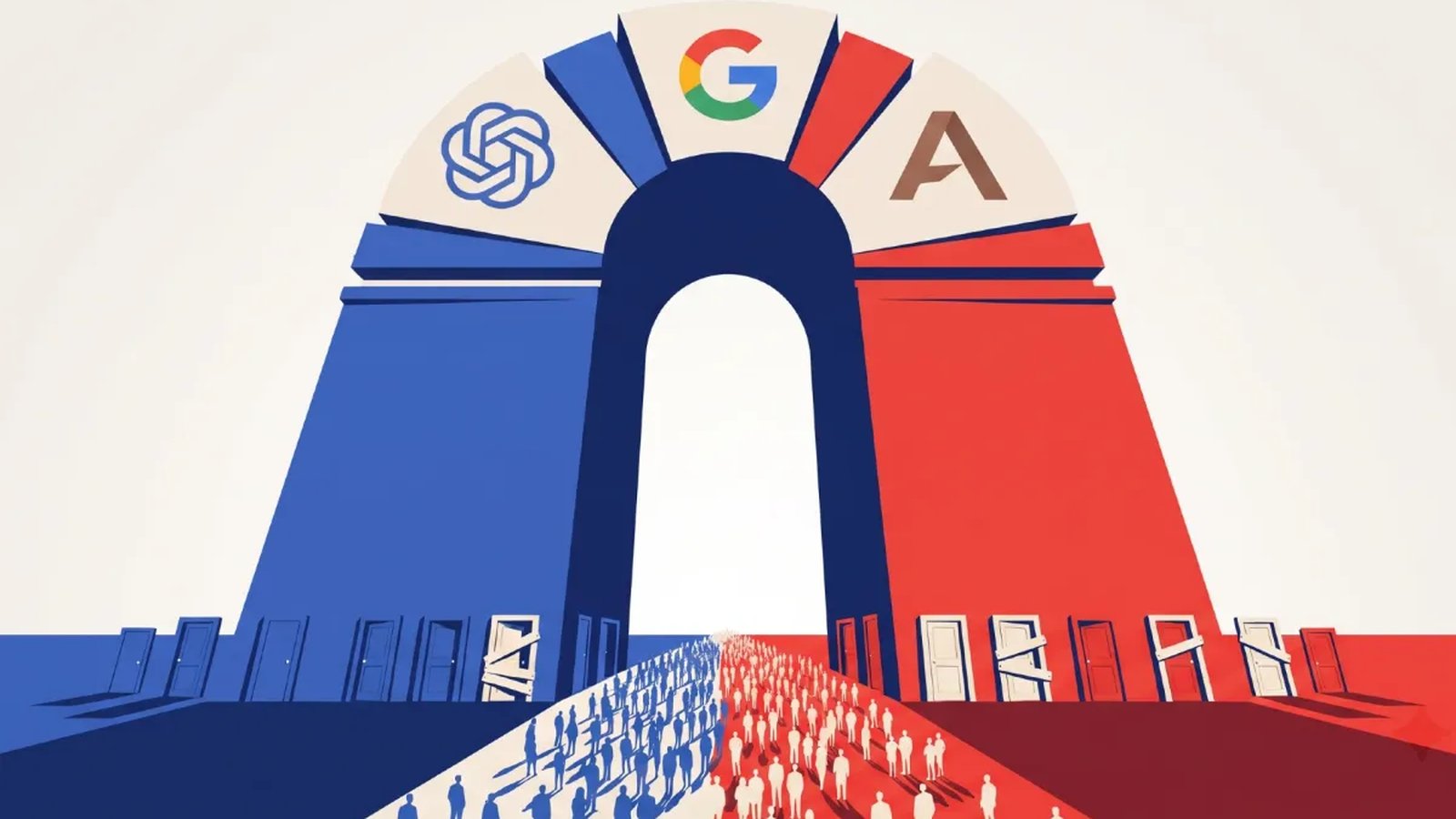
France’s competition authority has warned that the fast-growing market for AI agents risks becoming concentrated around a small group of dominant technology companies before users, merchants and regulators fully understand how these tools will reshape online choice.
In opinion 26-A-05, published on July 17, 2026, the Autorité de la concurrence said OpenAI, Google and Anthropic together represent more than 84% of global AI agent use. The regulator did not accuse the companies of breaking the law. Its warning is more structural: as AI assistants move from answering questions to acting on behalf of users, the companies that control the leading agents may also influence which sources, sellers and services become visible.
The report focuses on the shift from chatbots to autonomous or semi-autonomous agents. These systems can search, compare, summarize, recommend and, in some cases, help complete transactions. That makes them different from ordinary search tools. If the user asks an agent to find the best product, plan a purchase or select a service, the agent becomes the gatekeeper between the customer and the open web.
For competition authorities, that gatekeeper role is the core concern. A market can appear open on the surface while the practical path to the customer is controlled by a few interfaces. If an AI agent favors certain sources, partners or marketplaces, smaller companies may lose visibility even when their products are competitive.
The French authority says building AI models has become technically easier, but scaling an AI agent business still depends on data access, platform integration, distribution, cloud infrastructure and orchestration costs. Those advantages tend to favor large companies with existing ecosystems. A model can be powerful, but the surrounding platform can be even more important for market control.
The regulator’s own testing adds a practical layer to the warning. In May 2026, it submitted 550 queries to ChatGPT and Gemini to examine how the agents selected and cited sources. The results showed different patterns. ChatGPT more often referred to Reddit in some cases, while Gemini leaned more heavily on sources such as Idealo and Cdiscount. The issue is not only which source is better. It is whether users can understand why one source is surfaced and another is not.
The report also looks at agentic commerce, where an AI agent helps users choose or buy products. This area is still developing, but it could alter the traffic model for e-commerce. If users stop visiting comparison sites, search pages or merchant websites directly, visibility will depend increasingly on how agents rank, filter and recommend options.
That is why the authority links the issue to the EU’s wider digital rulebook. The AI Act, the Digital Markets Act and the Data Act are presented as tools that can help preserve user choice, data access and fair competition. The question is how quickly those rules can be applied to a market that is changing faster than traditional regulatory cycles.
For publishers, retailers and smaller digital services, the risk is not abstract. A business may lose traffic without being directly blocked. It may simply become less visible inside the agent’s answer. That can affect advertising, subscriptions, sales and brand recognition. In that sense, AI agents may become a new layer of distribution power across the web.
The report’s wider message is that AI competition is no longer only about who has the best model. It is also about who controls defaults, integrations, data flows, payment paths and user trust. If regulators wait until habits are already locked in, reversing concentration may become much harder.