


Google’s New AI Tools for Language Learning
Google has introduced three innovative AI-powered tools aimed at enhancing the way people learn new languages. These tools—Tiny Lesson, Slang Hang, and Word Cam—are part of Google’s ‘Little Language Experiments’ initiative and are powered by the Gemini large language model (LLM). Designed to make language learning more dynamic and personalized, these tools focus on real-life scenarios, casual conversations, and object identification to aid learners in acquiring practical language skills.
What Are the New Tools?
The three tools each serve distinct purposes, catering to various aspects of language learning:
Tiny Lesson: Context-Specific Learning
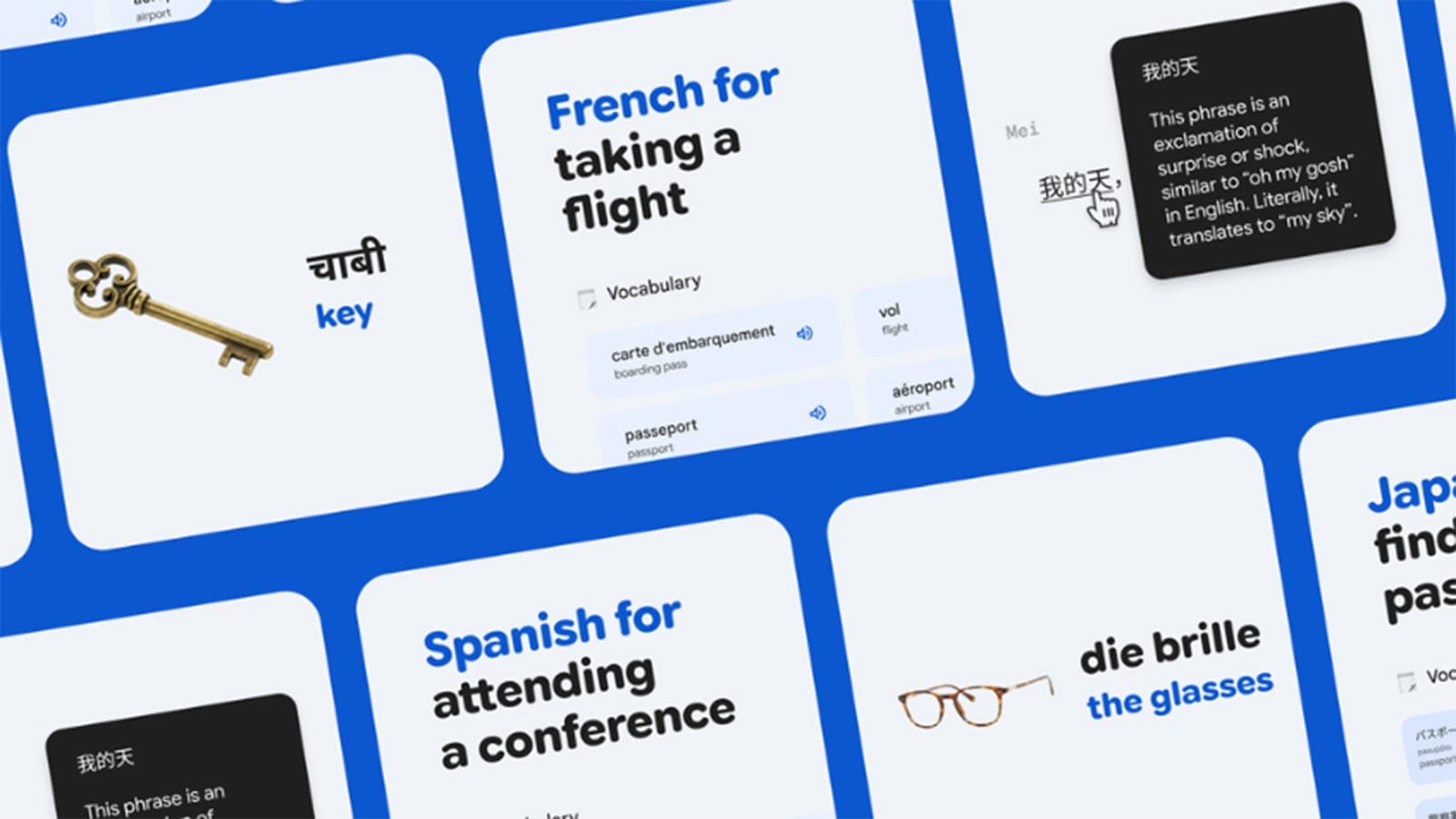
Tiny Lesson helps users learn vocabulary and grammar tailored to specific situations. For example, if a user describes a scenario like ‘finding a lost passport,’ the tool provides relevant phrases and grammar tips to navigate the situation. This feature addresses one of the most common challenges in language learning—being unprepared for real-life situations where specific phrases are needed.
Slang Hang: Mastering Casual Conversations
Slang Hang focuses on teaching learners how to converse informally, moving away from rigid textbook language. It generates realistic dialogues between native speakers, allowing users to learn colloquial expressions and slang. For instance, users can explore conversations between coworkers or friends, with the ability to hover over unfamiliar terms for explanations. However, Google advises users to cross-check some slang terms, as the AI may occasionally misidentify or invent words.
Word Cam: Learning Through Visuals
Word Cam uses the Gemini LLM to identify objects in photographs taken by the user. It then provides translations and additional vocabulary to describe the objects in the target language. This tool is particularly useful for learners who want to expand their vocabulary by interacting with their immediate environment. However, Google recommends verifying translations, as the AI may sometimes mislabel objects.
Supported Languages and Accessibility
These tools currently support 15 languages, including Arabic, Chinese, English, French, German, Greek, Hebrew, Hindi, Italian, Japanese, Korean, Portuguese, Russian, Spanish, and Turkish. They are accessible via the Google Labs webpage, where users can experiment without needing to download any applications. The tools are designed for short, bite-sized lessons, making them convenient for on-the-go learning.
Google’s Vision for AI in Language Learning
Google’s ‘Little Language Experiments’ aim to explore how AI can make language learning more engaging and effective. According to Maggie Shiels, a Google representative, these experiments are not intended to be permanent features but rather a way to inspire developers to create innovative applications using the Gemini LLM. The tools are part of Google’s broader effort to integrate AI into educational technologies, competing with platforms like Duolingo and OpenAI’s ChatGPT, which also offer AI-driven language learning features.
Challenges and Limitations
While these tools offer exciting possibilities, they are not without limitations. For instance, the AI may occasionally provide inaccurate translations or misuse slang. Users are encouraged to double-check information with reliable sources. Additionally, the tools are experimental and will eventually be discontinued, as confirmed by Google. Despite these challenges, the initiative represents a significant step forward in leveraging AI for personalized education.
Google’s new AI-powered language learning tools—Tiny Lesson, Slang Hang, and Word Cam—demonstrate the potential of AI to revolutionize education. By focusing on real-life applications, casual conversations, and visual learning, these tools offer a fresh approach to mastering new languages. Although experimental, they provide valuable insights into how AI can make language learning more accessible and effective for users worldwide.
Source: CNET, Google Blog